
[Paper Review] Bounding the Invertibility of Privacy-preserving Instance Encoding using Fisher Information
This paper introduces a theoretically grounded privacy metric—diagonal Fisher Information Leakage (dFIL)—to bound the invertibility of privacy-preserving instance encodings. By leveraging the van Trees inequality, dFIL provides a lower bound on reconstruction error for any input attack, enabling principled design of encoders with provable privacy guarantees while maintaining utility in downstream ML tasks.
Privacy-preserving instance encoding aims to encode raw data as feature vectors without revealing their privacy-sensitive information. When designed properly, these encodings can be used for downstream ML applications such as training and inference with limited privacy risk. However, the vast majority of existing instance encoding schemes are based on heuristics and their privacy-preserving properties are only validated empirically against a limited set of attacks. In this paper, we propose a theoretically-principled measure for the privacy of instance encoding based on Fisher information. We show that our privacy measure is intuitive, easily applicable, and can be used to bound the invertibility of encodings both theoretically and empirically.
Motivation & Objective
- To address the lack of theoretical privacy guarantees in heuristic-based instance encoding schemes used in ML.
- To develop a rigorous, information-theoretic measure to quantify how easily an encoding can be inverted by an attacker.
- To enable the design of privacy-preserving ML systems where privacy is provably bounded using dFIL.
- To demonstrate that dFIL can be used to guide practical training and inference systems with both high privacy and acceptable utility.
Proposed method
- Adapt the dFIL framework from Guo et al. (2022) to instance encoding, using diagonal Fisher information to quantify privacy leakage.
- Apply the van Trees inequality to derive a general lower bound on mean squared error (MSE) of any input reconstruction attack, not just unbiased ones.
- Extend the bound to account for prior knowledge in attacks by connecting it to score matching in distribution estimation.
- Modify common encoders (e.g., ResNet, NCF, DistilBERT) with minimal changes to enable dFIL computation.
- Use dFIL as a training objective or constraint to control privacy-utility trade-offs in split learning and encoded-data training.
- Evaluate the dFIL lower bound empirically across multiple datasets and models under various attack settings.

Experimental results
Research questions
- RQ1Can dFIL provide a theoretically sound lower bound on the reconstruction error of any input inversion attack on an instance encoding?
- RQ2How does dFIL compare to empirical attack performance in realistic settings across different model architectures and data types?
- RQ3Can dFIL be used as a practical privacy metric to guide the design of privacy-preserving ML systems with high utility?
- RQ4To what extent does dFIL correlate with semantic reconstruction quality, and how conservative is the bound?
Key findings
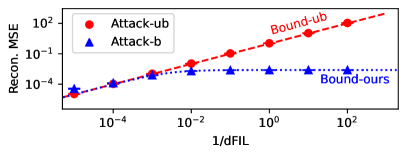
- dFIL successfully bounds the MSE of any input reconstruction attack, including strong attacks leveraging prior knowledge, via a novel application of the van Trees inequality.
- In split inference, models trained with encodings having dFIL values of 10–100 achieved test accuracies of up to 91.35% on CIFAR-10, demonstrating high utility with strong privacy.
- For MovieLens-20M, dFIL-based encodings preserved AUC above 0.82 even with dFIL = 100, showing robustness in recommendation tasks.
- On GLUE-SST2, models trained on encoded data with dFIL = 10–100 achieved test accuracy of 82.80–83.03%, indicating viability for NLP tasks.
- dFIL-based training on encoded data achieved 80.16–81.99% accuracy on CIFAR-10, showing that model utility is feasible even with privacy constraints.
- The bound is conservative—some inputs may have lower MSE than the dFIL lower bound, highlighting a limitation of Bayesian bounds.
Read this paper
Open the full text in the Nubint reader and ask about any passage as you read.
Read this paper on NubintThis review was generated by AI from the original paper. Please check the paper before citing it.