
[Paper Review] Brain Tumor Diagnosis Using Quantum Convolutional Neural Networks
The paper develops a Quantum Convolutional Neural Network (QCNN) hybrid model to classify brain tumor MRI images, achieving 99.67% accuracy on a 3-class dataset and validating quantum-enhanced medical imaging.
Accurate classification of brain tumors from MRI scans is critical for effective treatment planning. This study presents a Hybrid Quantum Convolutional Neural Network (HQCNN) that integrates quantum feature-encoding circuits with depth-wise separable convolutional layers to analyze images from a publicly available brain tumor dataset. Evaluated on this dataset, the HQCNN achieved 99.16% training accuracy and 91.47% validation accuracy, demonstrating robust performance across varied imaging conditions. The quantum layers capture complex, non-linear relationships, while separable convolutions ensure computational efficiency. By reducing both parameter count and circuit depth, the architecture is compatible with near-term quantum hardware and resource-constrained clinical environments. These results establish a foundation for integrating quantum-enhanced models into medical-imaging workflows with minimal changes to existing software platforms. Future work will extend evaluation to multi-center cohorts, assess real-time inference on quantum simulators and hardware, and explore integration with surgical-planning systems.
Motivation & Objective
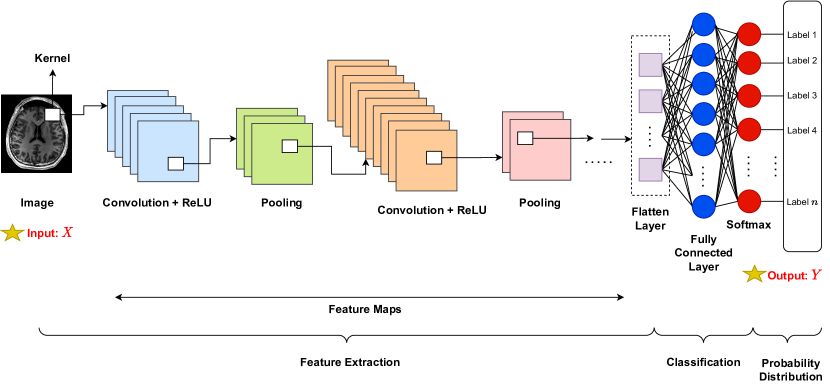
- Motivate quantum machine learning (QML) for medical image diagnostics and address limitations of classical CNNs.
- Propose and implement a QCNN-hybrid architecture for brain tumor classification.
- Demonstrate high accuracy and generalization on a sizeable brain tumor MRI dataset.
- Show feasibility of quantum image processing within a practical ML pipeline.
- Highlight potential clinical implications and future research directions in QCNNs for medical imaging.
Proposed method
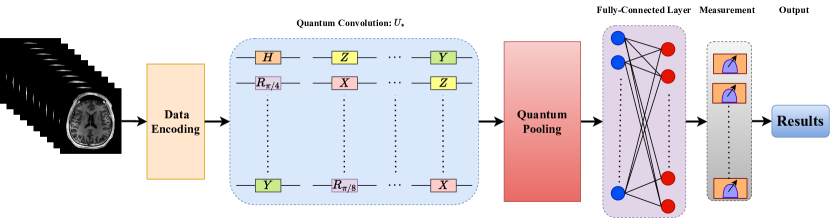
- Describe QCNN architecture and data encoding of classical images into quantum states.
- Apply quantum convolution and quantum pooling using U*, RX gates, CRZ/CRX gates, CZ entanglement, and measurements.
- Use a 2x2 quantum patching scheme and a SWAP-test-based pooling mechanism.
- Integrate a classical CNN within the QCNN framework in a hybrid model.
- Train the resulting network on quantum-processed images with a CNN classifier (Conv2D, MaxPooling, dense layers) for final class scores.
- Evaluate performance over 20 training/validation epochs with accuracy and loss plots.
Experimental results
Research questions
- RQ1Can a QCNN-hybrid model achieve high accuracy on brain tumor classification compared to classical approaches?
- RQ2How does quantum image processing affect feature representation and generalization in medical imaging?
- RQ3What is the impact of dataset size and class distribution on QCNN performance for brain tumors?
- RQ4Is a hybrid QCNN-CNN architecture practical within current (NISQ) computational constraints?
- RQ5Which tumor types are most challenging to distinguish with QCNN features?
Key findings
- The QCNN achieved a peak validation accuracy of 99.67%.
- The model demonstrated robust training with decreasing loss across 20 epochs.
- Pituitary tumor cases were perfectly classified in the reported confusion matrix.
- Misclassifications mainly occurred between meningioma and glioma classes, indicating areas for refinement.
- The approach uses a hybrid quantum-classical framework and a quantum simulator to realize QCNN performance improvements over classical baselines.
- The dataset comprised 3,064 T1-weighted MRI slices from 233 patients across three tumor types (meningioma, glioma, pituitary).
Better researchstarts right now
From reading papers to final review, dramatically reduce your research time.
No credit card · Free plan available
This review was created by AI and reviewed by human editors.