
[Paper Review] Breast Cancer Segmentation using Attention-based Convolutional Network and Explainable AI
The paper proposes an attention-based UNet architecture for breast cancer segmentation on ultrasound images, enhanced by CLAHE preprocessing and explainable AI (Grad-CAM) to analyze model focus, with competitive accuracy and IoU.
Breast cancer (BC) remains a significant health threat, with no long-term cure currently available. Early detection is crucial, yet mammography interpretation is hindered by high false positives and negatives. With BC incidence projected to surpass lung cancer, improving early detection methods is vital. Thermography, using high-resolution infrared cameras, offers promise, especially when combined with artificial intelligence (AI). This work presents an attention-based convolutional neural network for segmentation, providing increased speed and precision in BC detection and classification. The system enhances images and performs cancer segmentation with explainable AI. We propose a transformer-attention-based convolutional architecture (UNet) for fault identification and employ Gradient-weighted Class Activation Mapping (Grad-CAM) to analyze areas of bias and weakness in the UNet architecture with IRT images. The superiority of our proposed framework is confirmed when compared with existing deep learning frameworks.
Motivation & Objective
- Motivate automated breast cancer detection and segmentation to reduce misinterpretation in mammography and ultrasound imaging.
- Develop a segmentation framework that combines attention-based CNNs with image enhancement to improve ROI extraction.
- Incorporate explainable AI to visualize and understand model decisions in ultrasound-based BC segmentation.
Proposed method
- Use histogram equalization via CLAHE to enhance ultrasound images and extract regions of interest.
- Adopt a UNet-based encoder–decoder architecture with an attention mechanism (Attention Gate) to improve segmentation quality.
- Incorporate Vision Transformer (ViT) elements within the segmentation framework to enhance performance.
- Evaluate segmentation using standard metrics including IoU, Loss, Accuracy, Precision, Recall, and F1-Score, with Grad-CAM for XAI analysis.
- Compare the proposed AttentionUNet with state-of-the-art deep learning frameworks on BC datasets.
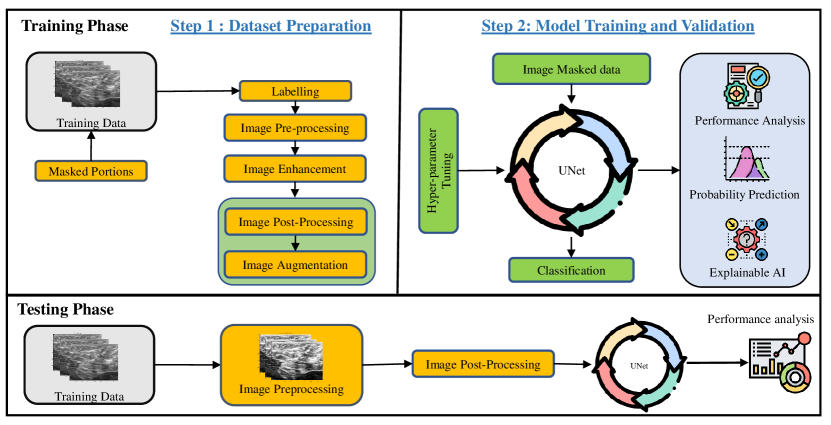
Experimental results
Research questions
- RQ1Can an attention-enhanced UNet improve breast cancer segmentation in ultrasound images compared to standard architectures?
- RQ2Does CLAHE-based preprocessing improve ROI extraction and segmentation performance in noisy ultrasound data?
- RQ3Can Grad-CAM provide meaningful explanations of model focus areas to support clinical trust in AI-based segmentation?
Key findings
- Maximum training accuracy reported as 95% and maximum validation accuracy as 99%.
- The model demonstrates strong segmentation performance after 12 epochs with high IoU and robust learning curves.
- Grad-CAM analysis is used to inspect model regions, supporting the explainability of the segmentation decisions.
- The proposed architecture is claimed to be faster and more precise than some existing deep learning frameworks on the BC ultrasound dataset.
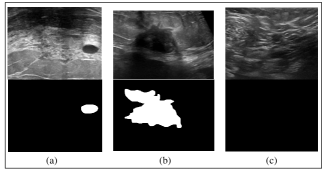
- Qualitative results show the model can detect dark regions effectively but may struggle with irregular shapes, suggesting training adjustments (e.g., longer training, chunked epochs).
Better researchstarts right now
From reading papers to final review, dramatically reduce your research time.
No credit card · Free plan available
This review was created by AI and reviewed by human editors.