
[Paper Review] Bridging Language and Items for Retrieval and Recommendation
BLaIR introduces a series of pretrained sentence-embedding models that link user-language context with item metadata to improve retrieval and recommendation, trained on a large Amazon Reviews 2023 dataset and evaluated on sequential recommendation and complex product search tasks.
This paper introduces BLaIR, a series of pretrained sentence embedding models specialized for recommendation scenarios. BLaIR is trained to learn correlations between item metadata and potential natural language context, which is useful for retrieving and recommending items. To pretrain BLaIR, we collect Amazon Reviews 2023, a new dataset comprising over 570 million reviews and 48 million items from 33 categories, significantly expanding beyond the scope of previous versions. We evaluate the generalization ability of BLaIR across multiple domains and tasks, including a new task named complex product search, referring to retrieving relevant items given long, complex natural language contexts. Leveraging large language models like ChatGPT, we correspondingly construct a semi-synthetic evaluation set, Amazon-C4. Empirical results on the new task, as well as conventional retrieval and recommendation tasks, demonstrate that BLaIR exhibit strong text and item representation capacity. Our datasets, code, and checkpoints are available at: https://github.com/hyp1231/AmazonReviews2023.
Motivation & Objective
- Motivate language-heavy retrieval and recommendation in scenarios with millions of items.
- Propose a lightweight, specialized model family to bridge natural language with item metadata.
- Create and utilize a large, up-to-date Amazon Reviews 2023 dataset for pretraining.
- Introduce and evaluate a new complex product search task.
- Assess generalization across multiple domains and tasks, including semi-synthetic evaluation with Amazon-C4.
Proposed method
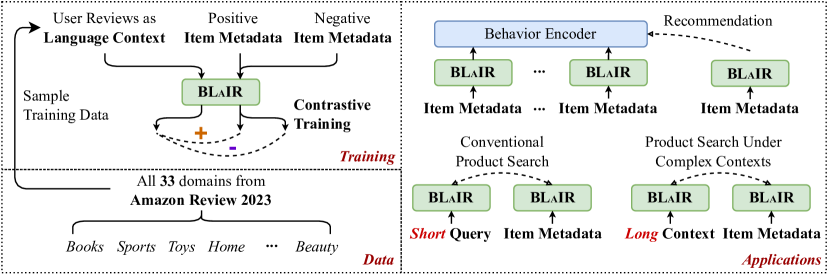
- Pretrain a series of sentence-embedding models (BLaIR) using a contrastive objective that pairs language context c with item metadata m.
- Backbone architectures include RoBERTa-based encoders; embeddings s are the [CLS]-token representations.
- Train with a supervised contrastive loss L_CL = -sum_i log exp(c_i · m_i / τ) / sum_j exp(c_i · m_j / τ).
- Auxiliary objective L_PT (e.g., MLM for RoBERTa/BERT, denoising for T5) is used to stabilize training: L = L_CL + λ L_PT.
- Prepare data from Amazon Reviews 2023 by pairing review contexts with item metadata and splitting data by fixed timestamps to avoid contamination.
- Evaluate on sequential recommendation, conventional product search, and a new complex product search task; create Amazon-C4 via ChatGPT for semi-synthetic evaluation.
Experimental results
Research questions
- RQ1Can language-aware item representations improve retrieval and recommendation across multiple domains?
- RQ2Do multi-domain pretraining and contrastive objectives generalize to new tasks like complex product search?
- RQ3How does BLaIR compare to traditional ID-based and other text-based item representations in zero-shot settings?
- RQ4What is the impact of data curriculum and multi-domain training on model performance?
Key findings
- BLaIR improves over existing methods across multiple domains and tasks in zero-shot settings.
- Text-based representations with BLaIR generally outperform ID-based methods across evaluated datasets.
- Scaling up model parameters (123M to 354M) and using mixture-of-experts adaptors (SASRec to UniSRec) yields performance gains.
- Multi-domain pretraining generally enhances generalization compared to in-domain training.
- BLaIR demonstrates strong performance on the newly introduced complex product search task with Amazon-C4 data.
Read this paper
Open the full text in the Nubint reader and ask about any passage as you read.
Read this paper on NubintThis review was generated by AI from the original paper. Please check the paper before citing it.