
[Paper Review] Bridging the Sim2Real gap with CARE: Supervised Detection Adaptation with Conditional Alignment and Reweighting
This paper proposes CARE, a novel supervised domain adaptation framework for 2D object detection that bridges the sim2real gap by leveraging labeled real data to jointly align appearance and content distributions. By using conditional alignment of instance features and reweighting samples based on spatial, size, and class distributions, CARE achieves state-of-the-art performance, boosting mAP@50 by up to 25% on Synscapes→Cityscapes.
Sim2Real domain adaptation (DA) research focuses on the constrained setting of adapting from a labeled synthetic source domain to an unlabeled or sparsely labeled real target domain. However, for high-stakes applications (e.g. autonomous driving), it is common to have a modest amount of human-labeled real data in addition to plentiful auto-labeled source data (e.g. from a driving simulator). We study this setting of supervised sim2real DA applied to 2D object detection. We propose Domain Translation via Conditional Alignment and Reweighting (CARE) a novel algorithm that systematically exploits target labels to explicitly close the sim2real appearance and content gaps. We present an analytical justification of our algorithm and demonstrate strong gains over competing methods on standard benchmarks.
Motivation & Objective
- Address the research-practice gap in sim2real domain adaptation, where real-world labeled data is often available but underutilized in existing DA methods.
- Formulate a supervised Sim2Real adaptation setting for 2D object detection, where both synthetic (labeled) and real (labeled) data are available.
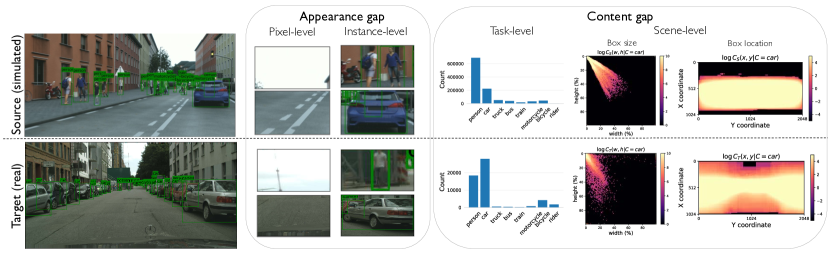
- Systematically close the sim2real domain gap by explicitly modeling and aligning both appearance (visual) and content (label distribution) disparities.
- Develop a method that outperforms naive data mixing, sequential fine-tuning, and unsupervised/semi-supervised baselines in this label-privileged setting.
Proposed method
- Propose a joint risk minimization framework that integrates source and target domain losses with conditional alignment of intermediate instance representations.
- Apply conditional alignment using ground-truth target labels to reduce visual and instance-level distribution shifts between simulation and real data.
- Introduce a reweighting mechanism that adjusts sample importance based on estimated conditional distributions: $P(x,y|C)$, $P(w,h|C)$, and $P(C)$.
- Decompose bounding box reweighting into spatial ($P(x,y|C)$) and size ($P(w,h|C)$) components to better match target statistics.
- Enforce cycle consistency in feature space to improve cross-domain instance matching and ensure aligned representations.
- Use a modular design that can be integrated with standard detection models and existing domain adaptation baselines.

Experimental results
Research questions
- RQ1How can labeled real data be systematically leveraged to close the sim2real gap in 2D object detection beyond simple data mixing or fine-tuning?
- RQ2To what extent do conditional alignment and reweighting of content distributions improve generalization compared to unsupervised or few-shot domain adaptation methods?
- RQ3What is the relative contribution of appearance alignment versus content distribution reweighting in reducing domain shift?
- RQ4Can a unified framework that jointly models appearance and content gaps outperform heuristic combinations of source and target data?
- RQ5How does the proposed method perform across different domain shifts, especially in long-tail scenarios with rare object categories?
Key findings
- CARE achieves an mAP@50 of 68.1 on the Sim10K→Cityscapes benchmark, outperforming the next best method (Seq. FT) by 1.7 points and the mixing baseline by 3.3 points.
- On the Synscapes→Cityscapes shift, CARE improves mAP@50 by up to 25% compared to baselines, demonstrating strong gains in challenging, long-tail scenarios.
- Class-conditional reweighting based on $P(C)$ significantly improves performance, especially in multi-class source settings, with a 1.5–2.5 point mAP gain over baselines.
- Reweighting based on $P(w,h|C)$ and $P(x,y|C)$ leads to consistent mAP improvements across all object categories, with up to +10 mAP gain for large objects like buses.
- Fine-grained error analysis using TIDE shows CARE reduces classification, localization, and duplicate detection errors while maintaining robustness to joint errors.
- Qualitative analysis confirms that cycle consistency improves cross-domain instance matching, with similar-looking cars embedded closer in feature space.
Read this paper
Open the full text in the Nubint reader and ask about any passage as you read.
Read this paper on NubintThis review was generated by AI from the original paper. Please check the paper before citing it.