
[Paper Review] Broad-Range Directional Detection of Light Dark Matter in Cryogenic Ice
This paper proposes cryogenic hexagonal ice (H₂O) as a novel target for direct detection of light dark matter via single-phonon excitations. By leveraging ice's broad phonon spectrum—from low-energy optical modes down to 6 meV—the method achieves sensitivity to dark matter masses as low as ~29 keV, outperforming other materials in the sub-GeV range, especially at near-term experimental thresholds above 100 meV.
We propose hexagonal ice (H$_2$O) as a new target for light dark matter (DM) direct detection. Ice, a polar material, is suitable for single phonon detection through DM scattering for which we consider light dark photon and light scalar mediator models. We report a rate sensitivity down to a DM mass of $\sim$keV, constituting a broader mass range than other promising candidates. We find better sensitivity for near-term experimental thresholds from the presence of high-frequency phonons. These advantages, and ice's availability, make it highly promising for single-phonon detection.
Motivation & Objective
- To identify a new, cost-effective, and experimentally accessible target material for direct detection of sub-GeV dark matter.
- To address the challenge of detecting light dark matter (keV–GeV range) using low-energy quasiparticle excitations in condensed matter systems.
- To evaluate ice's performance in comparison to existing polar semiconductors and quantum materials for single-phonon detection.
- To demonstrate that ice's broad phonon spectrum enables sensitivity across a wider mass range than current leading candidates.
- To explore the feasibility of directional detection via daily modulation of the dark matter wind using ice's anisotropic phonon response.
Proposed method
- The study models spin-independent dark matter scattering via light dark photon and light scalar mediators using a quantum field theory framework with momentum transfer integration.
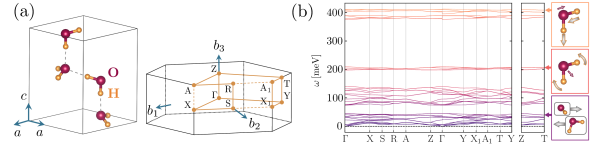
- The scattering rate is calculated using the dynamic structure factor $ S(\mathbf{q}, \omega) $, which depends on the phonon dispersion and density of states in ice XIh.
- The detector response is evaluated using a threshold-dependent rate integral, with sensitivity projected for detector thresholds from 1 meV to 400 meV.
- Directional sensitivity is assessed by computing the daily modulation of the scattering rate due to Earth's rotation, assuming crystal alignment with the dark matter wind.
- Material properties such as speed of sound ($ c_s = 4376 \, \text{m/s} $) and phonon linewidths are derived from lattice dynamics and anharmonic effects in ice.
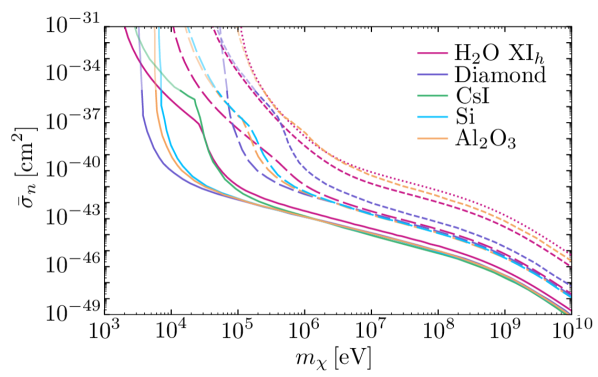
- Comparative reach is evaluated against other materials (e.g., GaAs, SiC, diamond) by normalizing cross-section sensitivity and projecting 1 kg·year exposure limits.
Experimental results
Research questions
- RQ1Can cryogenic hexagonal ice (H₂O) achieve competitive sensitivity for light dark matter detection via single-phonon excitations across a broad mass range?
- RQ2How does the phonon spectrum of ice XIh compare to that of conventional polar semiconductors in terms of low-energy and high-energy response for dark matter detection?
- RQ3What is the minimum dark matter mass accessible via kinematic thresholds in ice, given realistic detector energy thresholds?
- RQ4To what extent can ice support directional detection through daily modulation of the dark matter wind?
- RQ5How do phonon anharmonicity and linewidths in ice affect the detectability of single-phonon signals compared to inorganic semiconductors?
Key findings
- Ice XIh enables detection sensitivity down to a dark matter mass of ~29 keV for a 1 meV detector threshold, extending the reach into the sub-keV regime.
- The presence of ultra-low-frequency optical phonons (as low as 6 meV) in ice provides exceptional sensitivity to light dark photon-mediated dark matter in the 10–100 keV range.
- For near-term experiments with thresholds above 100 meV, ice outperforms other materials due to its broad phonon spectrum extending up to 400 meV, enabling single-phonon detection where others rely on suppressed multiphonon signals.
- The daily modulation of the scattering rate in ice is significant for both light dark photon and scalar mediator models, especially in the 10–100 keV mass range, enabling directional discrimination.
- Ice’s phonon linewidths (4–5 cm⁻¹ at 0 K) are broader than in GaAs, indicating faster anharmonic decay, but this does not significantly reduce detectability due to the high density of accessible phonon modes.
- Despite its lower density compared to diamond or GaAs, ice’s ability to form large, high-quality single crystals compensates for reduced cross-section per unit mass, making it a viable and scalable target.
Read this paper
Open the full text in the Nubint reader and ask about any passage as you read.
Read this paper on NubintThis review was generated by AI from the original paper. Please check the paper before citing it.