
[Paper Review] Bugs in our Pockets: The Risks of Client-Side Scanning
This paper critiques client-side scanning (CSS), a proposed technology that scans user devices for illegal content before encryption, arguing it undermines privacy and security by enabling mass surveillance. Despite claims of targeting only illegal material like CSAM, CSS creates systemic risks, enabling abuse by adversaries and eroding trust in digital systems.
Our increasing reliance on digital technology for personal, economic, and government affairs has made it essential to secure the communications and devices of private citizens, businesses, and governments. This has led to pervasive use of cryptography across society. Despite its evident advantages, law enforcement and national security agencies have argued that the spread of cryptography has hindered access to evidence and intelligence. Some in industry and government now advocate a new technology to access targeted data: client-side scanning (CSS). Instead of weakening encryption or providing law enforcement with backdoor keys to decrypt communications, CSS would enable on-device analysis of data in the clear. If targeted information were detected, its existence and, potentially, its source, would be revealed to the agencies; otherwise, little or no information would leave the client device. Its proponents claim that CSS is a solution to the encryption versus public safety debate: it offers privacy -- in the sense of unimpeded end-to-end encryption -- and the ability to successfully investigate serious crime. In this report, we argue that CSS neither guarantees efficacious crime prevention nor prevents surveillance. Indeed, the effect is the opposite. CSS by its nature creates serious security and privacy risks for all society while the assistance it can provide for law enforcement is at best problematic. There are multiple ways in which client-side scanning can fail, can be evaded, and can be abused.
Motivation & Objective
- To analyze the security and privacy risks of client-side scanning (CSS) as a proposed solution to law enforcement's access to encrypted communications.
- To challenge the claim that CSS provides a balanced compromise between privacy and public safety.
- To demonstrate that CSS inherently enables mass surveillance and is vulnerable to abuse by state and non-state actors.
- To argue that CSS undermines the security of all users, not just suspects, by introducing persistent backdoors on personal devices.
- To advocate for rigorous public scrutiny and rejection of CSS as a policy tool due to its irreversible and invasive nature.
Proposed method
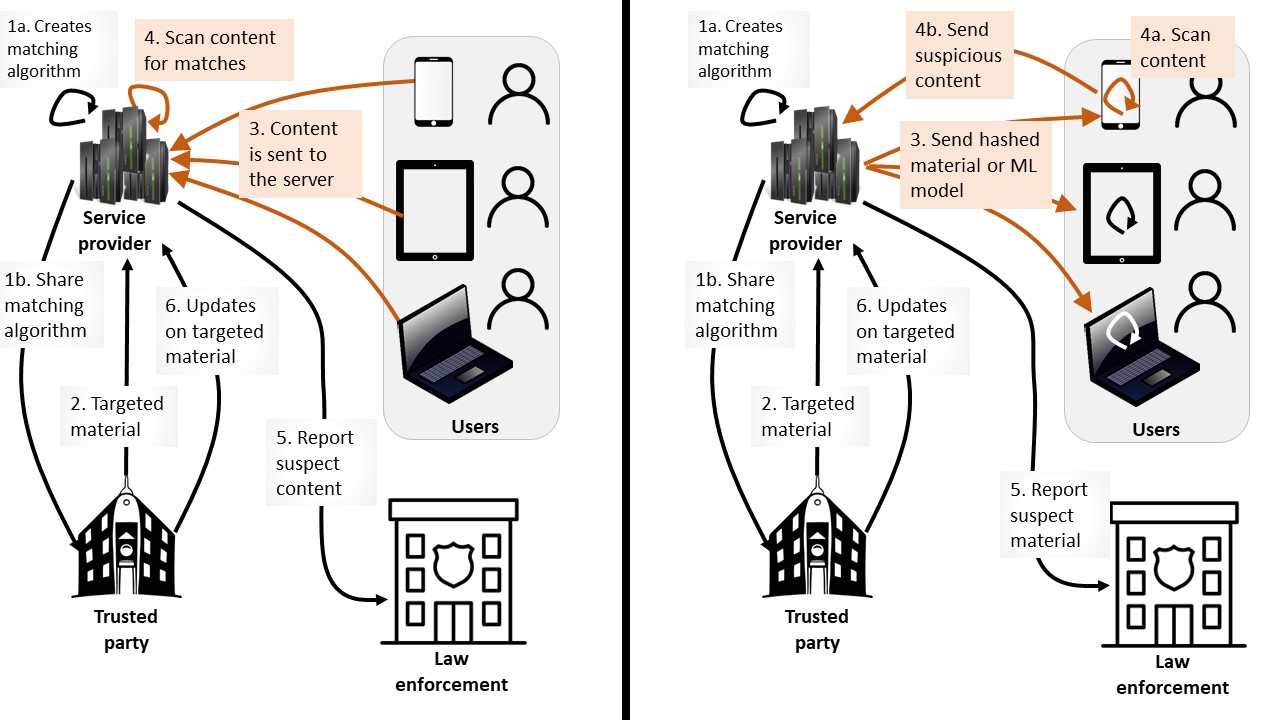
- Analyzing the technical architecture of CSS, including on-device scanning, cryptographic verification, and policy enforcement mechanisms.
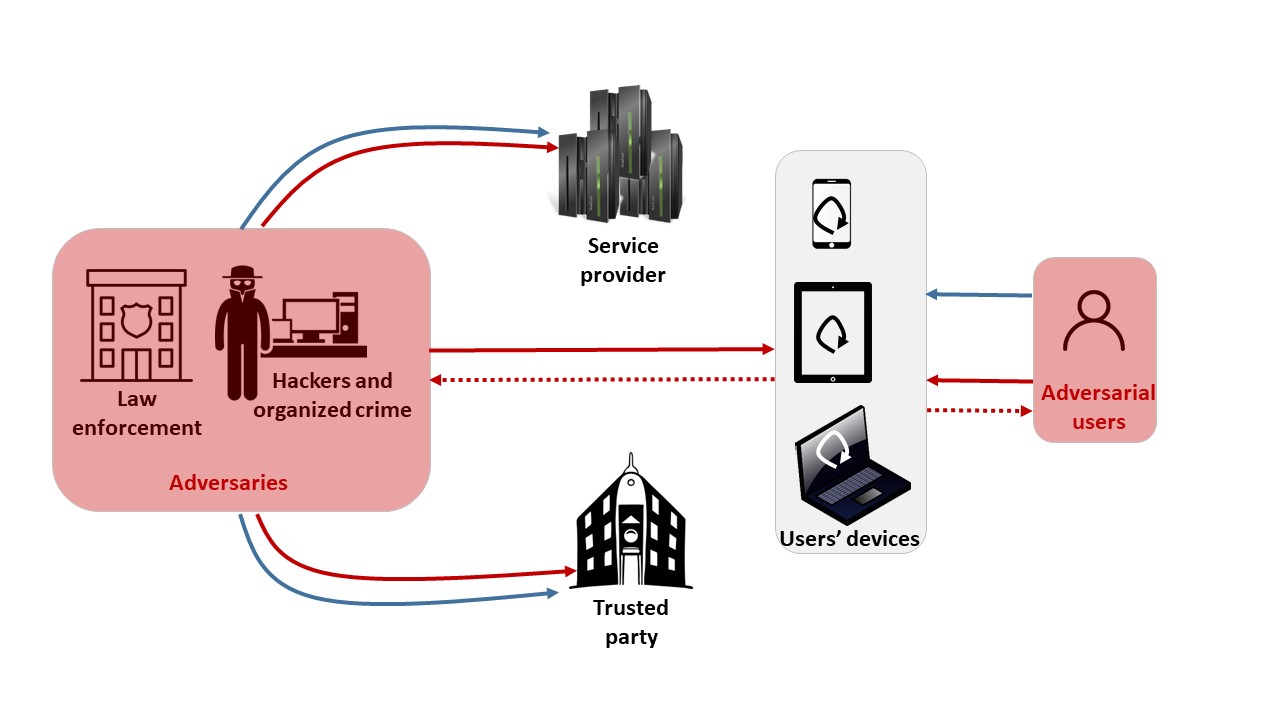
- Evaluating the threat model of CSS, focusing on how adversaries—such as nation-states, criminals, and intimate partners—can exploit vulnerabilities in client devices.
- Examining real-world examples, including Apple’s 2021 proposal and GCHQ’s AI-driven surveillance vision, to illustrate the expansion of scanning scope.
- Assessing the feasibility of secure implementation, highlighting the lack of proven, verifiable, and trustworthy designs despite extensive research.
- Comparing CSS to prior surveillance models like key escrow and wiretapping, emphasizing its lower legal and technical barriers to abuse.
- Using policy and economic analysis to show that CSS reduces the cost of surveillance, making bulk data collection scalable and systemic.
Experimental results
Research questions
- RQ1Can client-side scanning be implemented securely and transparently without enabling mass surveillance?
- RQ2What are the technical and systemic vulnerabilities introduced by deploying scanning logic on user devices?
- RQ3How does CSS compare to traditional surveillance methods in terms of privacy impact and legal oversight?
- RQ4What are the long-term implications of deploying a system that scans all user data on personal devices?
- RQ5Can the scope of CSS be meaningfully limited to only illegal content, or is there an inevitable path to expansion?
Key findings
- Client-side scanning fundamentally shifts surveillance from targeted, warrant-based access to bulk, automated scanning of all user devices, undermining privacy at scale.
- Even if designed to scan only for child sexual abuse material (CSAM), CSS creates a precedent for expanding surveillance to other content categories.
- The technology increases the attack surface on personal devices, making them vulnerable to exploitation by hostile actors, including governments and intimate partners.
- The opacity of mobile operating systems makes it impossible to verify that scanning policies are limited to uncontested illegal content.
- CSS is not a privacy-preserving solution; it enables remote, large-scale access to private data, effectively making it a form of industrial-scale surveillance.
- The economic and legal costs of traditional wiretapping are replaced by a system that makes surveillance cheap and ubiquitous, removing critical checks on abuse.
Read this paper
Open the full text in the Nubint reader and ask about any passage as you read.
Read this paper on NubintThis review was generated by AI from the original paper. Please check the paper before citing it.