
[Paper Review] Building Accurate Translation-Tailored LLMs with Language Aware Instruction Tuning
This paper proposes a two-stage fine-tuning method to enhance language-aware instruction following in translation-tailored LLMs, using instruction-conflicting samples with unlikelihood loss to reduce off-target translation. It achieves a 53.3% average reduction in off-target ratios and +5.7 SacreBLEU gains on zero-shot translation benchmarks.
Translation-tailored Large language models (LLMs) exhibit remarkable translation capabilities, even competing with supervised-trained commercial translation systems. However, off-target translation remains an unsolved problem, especially for low-resource languages, hindering us from developing accurate LLMs-based translation models. To mitigate the off-target translation problem and enhance the performance of LLMs on translation, recent works have either designed advanced prompting strategies to highlight the functionality of translation instructions or exploited the in-context learning ability of LLMs by feeding few-shot demonstrations. However, these methods essentially do not improve LLM's ability to follow translation instructions, especially the language direction information. In this work, we design a two-stage fine-tuning algorithm to improve the instruction-following ability (especially the translation direction) of LLMs. Specifically, we first tune LLMs with the maximum likelihood estimation loss on the translation dataset to elicit the basic translation capabilities. In the second stage, we construct instruction-conflicting samples by randomly replacing the translation directions with a wrong one within the instruction, and then introduce an extra unlikelihood loss to learn those samples. Experiments on IWSLT and WMT benchmarks upon the LLaMA model spanning 16 zero-shot directions show that, compared to the competitive baseline -- translation-finetuned LLama, our method could effectively reduce the off-target translation ratio (averagely -53.3\%), thus improving translation quality with average +5.7 SacreBLEU and +16.4 BLEURT. Analysis shows that our method could preserve the model's general task performance on AlpacaEval. Code and models will be released at \url{https://github.com/alphadl/LanguageAware_Tuning}.
Motivation & Objective
- Address the persistent off-target translation problem in zero-shot translation settings, especially for low-resource languages.
- Identify that standard LLM pretraining fails to properly follow translation direction instructions due to weak instruction encoding.
- Improve the instruction-following capability of LLMs—specifically for language direction—without degrading general or supervised translation performance.
- Develop a method that enhances the model's sensitivity to instruction content, particularly conflicting translation directions.
- Maintain strong performance on both zero-shot and supervised translation directions while reducing hallucination-like off-target outputs.
Proposed method
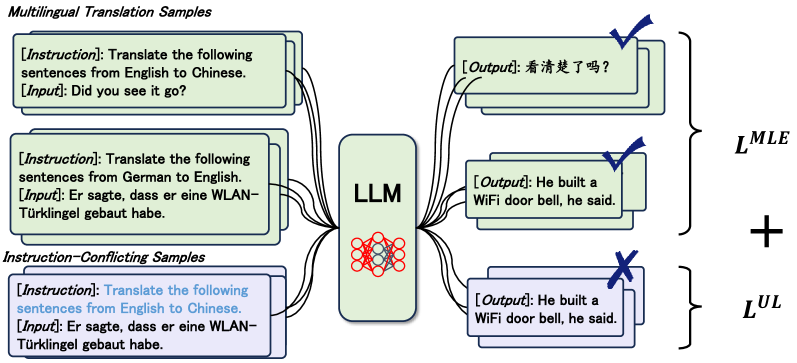
- First-stage fine-tuning uses maximum likelihood estimation (MLE) on multilingual translation data to unlock basic translation capabilities in LLaMA.
- Second-stage training introduces instruction-conflicting samples by randomly replacing the correct translation direction in the instruction with a wrong one.
- An unlikelihood loss is applied to these conflicting samples to suppress model generation of sequences that contradict the instruction.
- The model is jointly trained with MLE loss on correct samples and unlikelihood loss on conflicting samples, using a balancing hyperparameter α.
- The method emphasizes instruction tokens during generation, making the model more sensitive to language direction cues.
- The approach is applied to LLaMA and evaluated on IWSLT and WMT benchmarks across 16 zero-shot translation directions.
Experimental results
Research questions
- RQ1To what extent does standard instruction tuning fail to guide LLMs in correctly following translation direction instructions in zero-shot settings?
- RQ2Can introducing unlikelihood training on instruction-conflicting samples improve the model’s ability to avoid off-target translations?
- RQ3Does the proposed method maintain or degrade performance on supervised translation directions or general instruction-following tasks?
- RQ4How effective is the method in reducing off-target translation ratios across diverse low-resource and zero-shot language pairs?
- RQ5Can the unlikelihood loss mechanism be effectively adapted to enhance instruction following in multilingual translation tasks?
Key findings
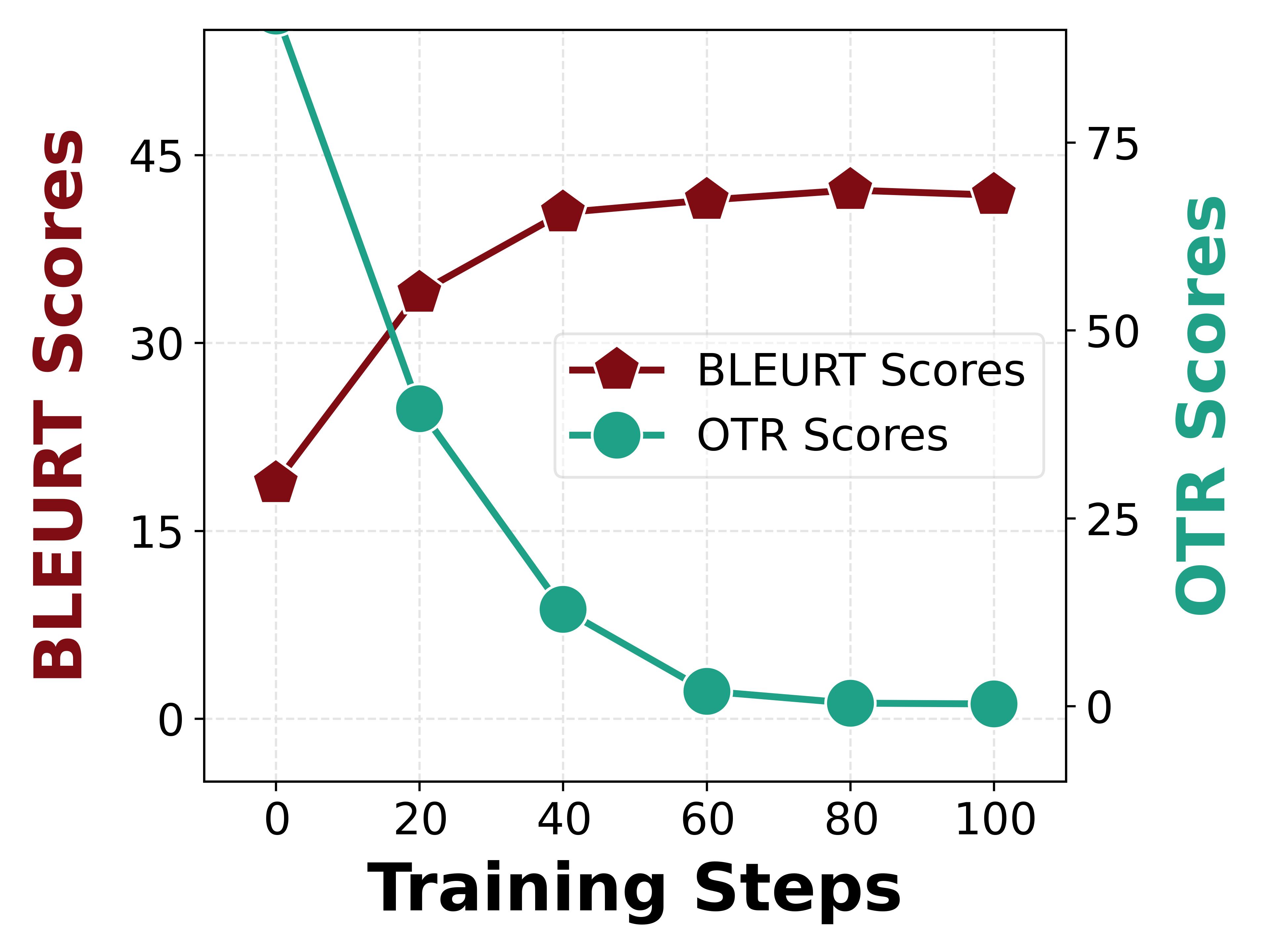
- The method reduces the average off-target translation ratio by 53.3% across 16 zero-shot directions, with a -92.2% reduction on IWSLT and -29.9% on WMT.
- Translation quality improves by +5.7 SacreBLEU and +16.4 BLEURT on average across benchmarks, with +23.0/ +12.4 BLEURT and +5.2/ +6.1 SacreBLEU gains on IWSLT/WMT respectively.
- The model maintains strong performance on supervised translation directions, indicating no degradation in in-domain capabilities.
- The method preserves general instruction-following ability, as shown by stable AlpacaEval scores, indicating no negative impact on broader tasks.
- The approach is robust across diverse language pairs, including low-resource languages, with consistent improvements even in challenging cases like De→Fr.
- The unlikelihood loss effectively suppresses generation of sequences that conflict with the instruction, especially when the instruction specifies a wrong direction.
Read this paper
Open the full text in the Nubint reader and ask about any passage as you read.
Read this paper on NubintThis review was generated by AI from the original paper. Please check the paper before citing it.