
[Paper Review] BurstGPT: A Real-world Workload Dataset to Optimize LLM Serving Systems
Introduces BurstGPT, the first real-world LLM-serving workload trace, and a benchmark suite to evaluate and optimize LLM serving systems under bursty workloads.
Serving systems for Large Language Models (LLMs) are often optimized to improve quality of service (QoS) and throughput. However, due to the lack of open-source LLM serving workloads, these systems are frequently evaluated under unrealistic workload assumptions. Consequently, performance may degrade when systems are deployed in real-world scenarios. This work presents BurstGPT, an LLM serving workload with 10.31 million traces from regional Azure OpenAI GPT services over 213 days. BurstGPT captures LLM serving characteristics from user, model and system perspectives: (1) User request concurrency: burstiness variations of requests in Azure OpenAI GPT services, revealing diversified concurrency patterns in different services and model types. (2) User conversation patterns: counts and intervals within conversations for service optimizations. (3) Model response lengths: auto-regressive serving processes of GPT models, showing statistical relations between requests and their responses. (4) System response failures: failures of conversation and API services, showing intensive resource needs and limited availability of LLM services in Azure. The details of the characteristics can serve multiple purposes in LLM serving optimizations, such as system evaluation and trace provisioning. In our demo evaluation with BurstGPT, frequent variations in BurstGPT reveal declines in efficiency, stability, or reliability in realistic LLM serving. We identify that the generalization of KV cache management, scheduling and disaggregation optimizations can be improved under realistic workload evaluations. BurstGPT is publicly available now at https://github.com/HPMLL/BurstGPT and is widely used to develop prototypes of LLM serving frameworks in the industry.
Motivation & Objective
- Highlight the characteristics of real-world LLM serving workloads to guide system design and provisioning.
- Quantify burstiness, concurrency patterns, and failure rates in real-world GPT services (ChatGPT and GPT-4).
- Develop a scalable benchmark suite mirroring BurstGPT’s workload patterns for evaluating serving systems.
- Provide insights to enable elastic resource management and improved QoS in LLM serving.
Proposed method
- Collect and analyze real-time workload traces from ChatGPT and GPT-4 API and conversational services over two months in a campus setting.
- Characterize temporal (periodic/aperiodic) and spatial (request/response length) patterns of LLM workloads.
- Model burstiness using Gamma distributions and demonstrate its impact on GPU memory and service reliability.
- Develop a mirrored BurstGPT benchmark that scales to different system sizes and reflects observed workload patterns.
- Prototype a workload generator with a prompt pool, concurrency generator, and HTTP-based inference driver to evaluate LLM serving systems.
- Evaluate vLLM on Llama-2-chat models under BurstGPT-like workloads to study latency, throughput, and failure behavior.
Experimental results
Research questions
- RQ1What are the temporal and spatial characteristics of real-world LLM-serving workloads?
- RQ2How does burstiness affect reliability and GPU memory usage in LLM serving systems?
- RQ3Can a benchmark suite based on BurstGPT faithfully evaluate serving systems across scales?
- RQ4How does a leading LLM serving framework (vLLM) perform under BurstGPT-like bursty workloads?
Key findings
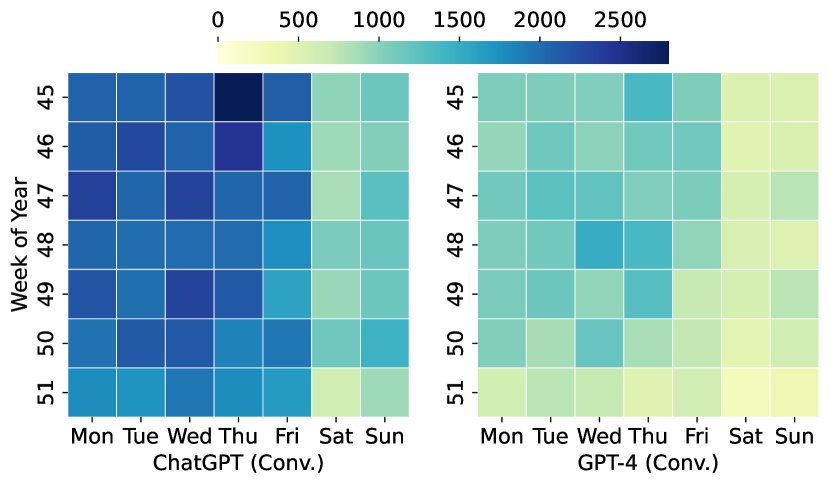
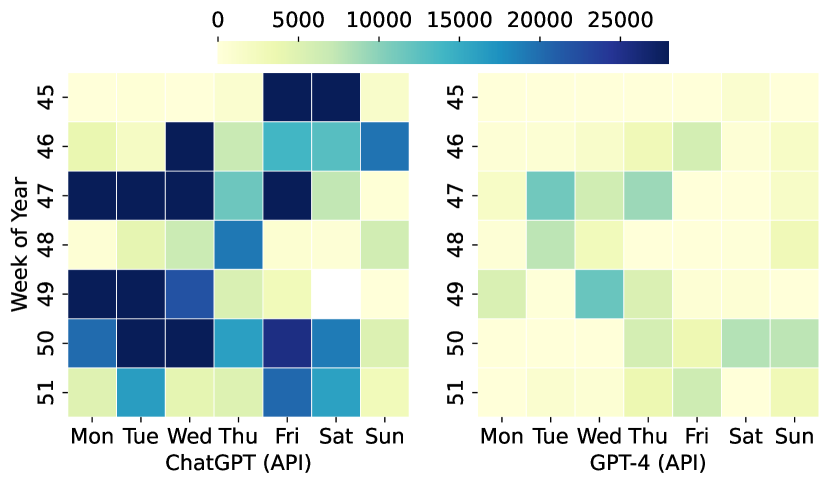
- Burstiness in LLM workloads shows both periodic and aperiodic patterns, varying by service type (conversation vs API) and model (ChatGPT vs GPT-4).
- Conversation services exhibit more regular daily patterns, while API services show irregular, bursty traffic with higher variability.
- Request lengths follow Zipf-like distributions, while response lengths show model-dependent, often bimodal or longer-tail distributions.
- GPU memory pressure from bursty workloads correlates with higher failure rates, indicating memory bottlenecks as a key reliability risk.
- The BurstGPT benchmark can mirror real-world burstiness and reveal performance degradation in existing systems under short-term bursts.
- vLLM’s evaluation under BurstGPT-like workloads demonstrates sensitivity to burstiness and memory management, affecting latency and success rates.
Read this paper
Open the full text in the Nubint reader and ask about any passage as you read.
Read this paper on NubintThis review was generated by AI from the original paper. Please check the paper before citing it.