
[Paper Review] Byte Latent Transformer: Patches Scale Better Than Tokens
The Byte Latent Transformer (BLT) introduces a tokenizer-free, byte-level large language model architecture that dynamically groups bytes into variable-sized patches based on next-byte prediction entropy, enabling adaptive compute allocation. It matches Llama 3 performance at scale with up to 50% fewer inference FLOPs and demonstrates superior robustness and long-tail generalization, while enabling simultaneous scaling of model and patch size under fixed inference budget.
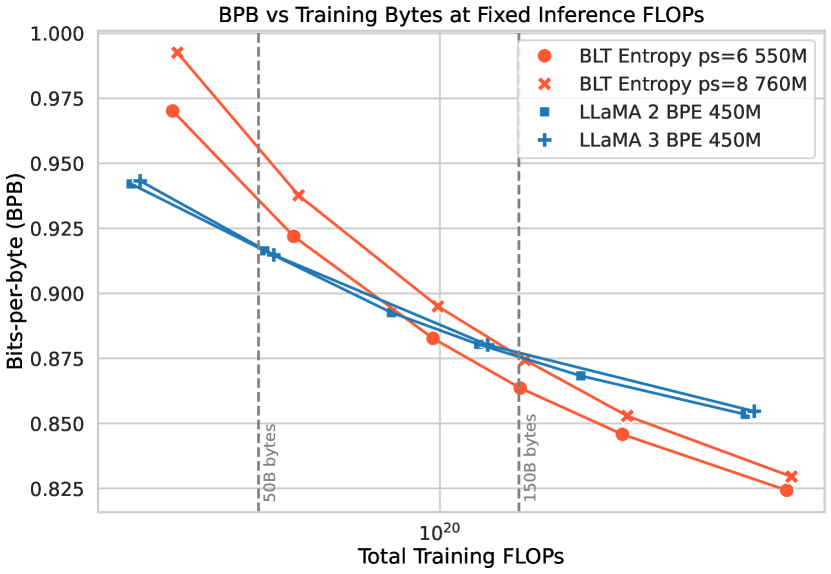
We introduce the Byte Latent Transformer (BLT), a new byte-level LLM architecture that, for the first time, matches tokenization-based LLM performance at scale with significant improvements in inference efficiency and robustness. BLT encodes bytes into dynamically sized patches, which serve as the primary units of computation. Patches are segmented based on the entropy of the next byte, allocating more compute and model capacity where increased data complexity demands it. We present the first FLOP controlled scaling study of byte-level models up to 8B parameters and 4T training bytes. Our results demonstrate the feasibility of scaling models trained on raw bytes without a fixed vocabulary. Both training and inference efficiency improve due to dynamically selecting long patches when data is predictable, along with qualitative improvements on reasoning and long tail generalization. Overall, for fixed inference costs, BLT shows significantly better scaling than tokenization-based models, by simultaneously growing both patch and model size.
Motivation & Objective
- To eliminate dependency on fixed-vocabulary tokenization in large language models by training end-to-end on raw bytes.
- To improve inference efficiency and robustness by dynamically allocating compute based on data complexity.
- To enable a new scaling axis that simultaneously increases model size and patch size under a fixed inference FLOP budget.
- To demonstrate that byte-level models can match token-based model performance at scale without a fixed vocabulary.
- To enhance long-tail generalization and subword-level understanding through direct access to byte-level information.
Proposed method
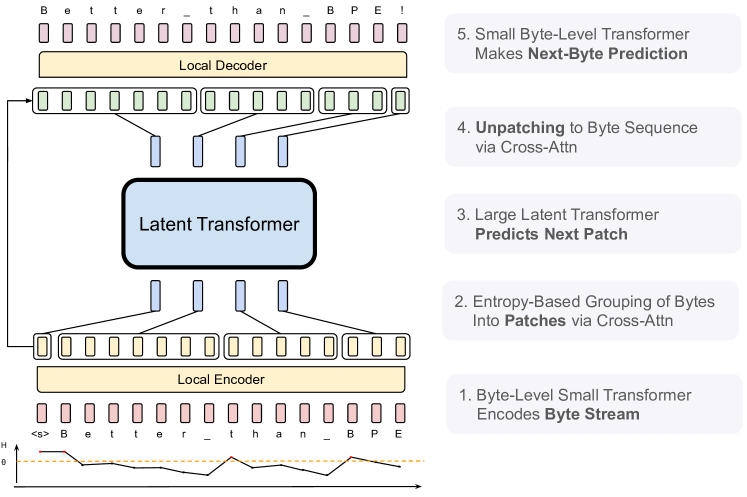
- The model uses a lightweight local encoder to map input bytes into patch representations based on entropy-driven segmentation of the next-byte prediction.
- A large global latent transformer processes the patch representations, with cross-attention mechanisms integrating byte-level and patch-level information.
- A lightweight local decoder reconstructs the next patch of bytes, enabling autoregressive generation.
- Patch size is dynamically determined by the entropy of the next byte, allocating more compute to high-complexity regions.
- The architecture avoids fixed vocabularies by learning patch representations end-to-end without predefined tokens.
- The method enables FLOP-controlled scaling studies up to 8B parameters and 4T training bytes, with inference budget held constant.
Experimental results
Research questions
- RQ1Can a large language model trained end-to-end on raw bytes match the performance of tokenization-based models like Llama 3 at scale?
- RQ2Does dynamic patching based on next-byte entropy lead to improved inference efficiency and compute allocation?
- RQ3Can a tokenizer-free architecture simultaneously scale model size and patch size under a fixed inference FLOP budget?
- RQ4Does direct byte-level modeling improve robustness to input noise and long-tail data generalization?
- RQ5Can byte-level models achieve better character-level understanding and orthographic knowledge than tokenized models?
Key findings
- BLT matches the performance of Llama 3 at scale while reducing inference FLOPs by up to 50% in FLOP-controlled experiments.
- The model achieves superior robustness to input noise and improved performance on low-resource machine translation and orthographic knowledge tasks.
- Dynamic patching based on entropy leads to more efficient compute allocation, with longer patches used in predictable regions and shorter ones in complex regions.
- BLT enables a new scaling trajectory where both model size and patch size can grow simultaneously under a fixed inference budget, outperforming token-based models in scaling trends.
- The architecture demonstrates qualitative improvements in reasoning and long-tail generalization due to direct access to byte-level information.
- Initial experiments show that fine-tuning a pre-trained Llama 3 with a byte-ified head can retain performance while benefiting from byte-level inductive biases.
Read this paper
Open the full text in the Nubint reader and ask about any passage as you read.
Read this paper on NubintThis review was generated by AI from the original paper. Please check the paper before citing it.