
[Paper Review] C-RAG: Certified Generation Risks for Retrieval-Augmented Language Models
C-RAG introduces the first certified risk framework for Retrieval-Augmented Generation (RAG) models, using conformal inference to provably bound generation risks. It establishes that RAG reduces conformal generation risk compared to vanilla LLMs under non-trivial retrieval and model quality, with tight, sound guarantees even under distribution shifts across four NLP datasets.
Despite the impressive capabilities of large language models (LLMs) across diverse applications, they still suffer from trustworthiness issues, such as hallucinations and misalignments. Retrieval-augmented language models (RAG) have been proposed to enhance the credibility of generations by grounding external knowledge, but the theoretical understandings of their generation risks remains unexplored. In this paper, we answer: 1) whether RAG can indeed lead to low generation risks, 2) how to provide provable guarantees on the generation risks of RAG and vanilla LLMs, and 3) what sufficient conditions enable RAG models to reduce generation risks. We propose C-RAG, the first framework to certify generation risks for RAG models. Specifically, we provide conformal risk analysis for RAG models and certify an upper confidence bound of generation risks, which we refer to as conformal generation risk. We also provide theoretical guarantees on conformal generation risks for general bounded risk functions under test distribution shifts. We prove that RAG achieves a lower conformal generation risk than that of a single LLM when the quality of the retrieval model and transformer is non-trivial. Our intensive empirical results demonstrate the soundness and tightness of our conformal generation risk guarantees across four widely-used NLP datasets on four state-of-the-art retrieval models.
Motivation & Objective
- To address the lack of theoretical understanding of generation risks in retrieval-augmented language models (RAG).
- To provide provable guarantees on generation risks for both RAG and vanilla LLMs under distribution shifts.
- To identify sufficient conditions under which RAG reduces generation risks compared to standalone LLMs.
- To enable certification of RAG configurations that ensure generation risks remain below a desired threshold.
Proposed method
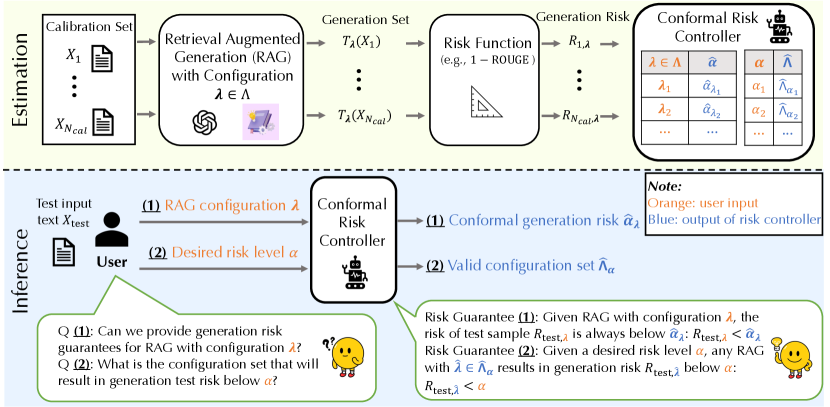
- Proposes a constrained generation protocol that controls RAG outputs via retrieval example count, generation set size, and similarity threshold for diversity.
- Applies conformal risk analysis to derive a high-probability upper bound on generation risk, termed 'conformal generation risk'.
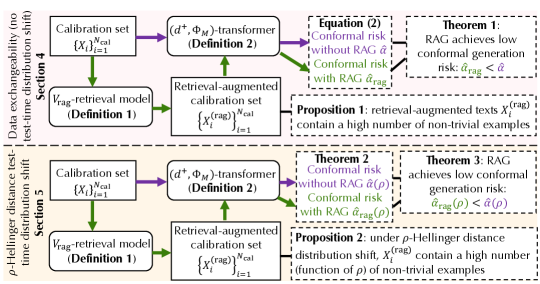
- Establishes theoretical guarantees for conformal generation risk under test-time distribution shifts using bounded risk functions.
- Uses in-distribution calibration samples to compute valid confidence bounds on risk during inference.
- Employs Bonferroni correction for family-wise error rate control when identifying valid configurations for risk certification.
- Validates bounds across multiple retrieval models (BM25, BAAI/bge, OpenAI ada, Biencoder-SFT) on DART, E2E, CommonGen, and WebNLG datasets.
Experimental results
Research questions
- RQ1Can RAG truly lead to lower generation risks compared to vanilla LLMs?
- RQ2How can we provide provable guarantees on the generation risks of RAG and vanilla LLMs?
- RQ3What are the sufficient conditions under which RAG reduces generation risk?
- RQ4Can we certify that generation risk remains below a desired threshold using RAG configurations?
- RQ5How do distribution shifts affect conformal risk bounds, and can they be robustly controlled?
Key findings
- C-RAG provides a sound and tight upper bound on empirical generation risks across all four datasets, with a minimal gap of up to 1e-3.
- RAG consistently achieves lower conformal generation risk than a single LLM, confirming theoretical predictions.
- The conformal generation risk increases linearly with Hellinger distance under distribution shifts, remaining non-trivial up to ρ = 0.2.
- Biencoder-SFT and OpenAI text-embedding-ada-002 achieve the lowest conformal risk bounds due to superior retrieval quality.
- A larger number of retrieved examples (N_rag) reduces conformal risk more sensitively than increasing the generation set size (λ_g).
- Valid configurations identified via C-RAG consistently yield empirical risks below the desired risk level α, confirming certification soundness.
Read this paper
Open the full text in the Nubint reader and ask about any passage as you read.
Read this paper on NubintThis review was generated by AI from the original paper. Please check the paper before citing it.