
[Paper Review] Cal-QL: Calibrated Offline RL Pre-Training for Efficient Online Fine-Tuning
Cal-QL extends conservative offline RL by calibrating Q-values against a reference policy to enable fast, sample-efficient online fine-tuning. It builds on CQL with a simple calibration constraint that improves online performance across diverse tasks.
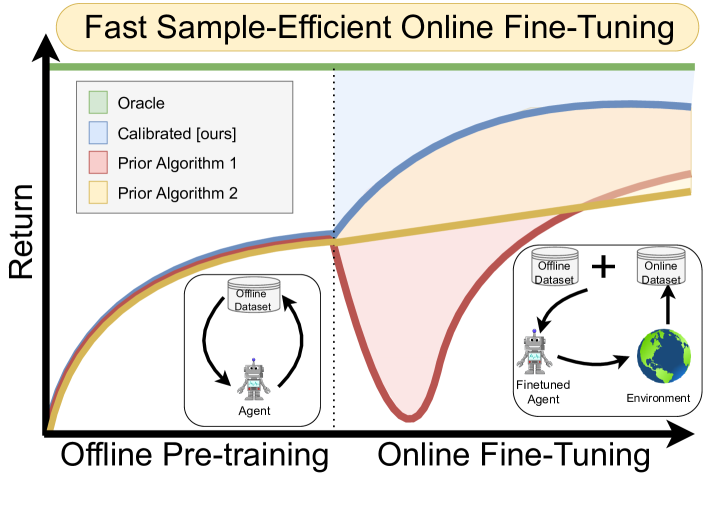
A compelling use case of offline reinforcement learning (RL) is to obtain a policy initialization from existing datasets followed by fast online fine-tuning with limited interaction. However, existing offline RL methods tend to behave poorly during fine-tuning. In this paper, we devise an approach for learning an effective initialization from offline data that also enables fast online fine-tuning capabilities. Our approach, calibrated Q-learning (Cal-QL), accomplishes this by learning a conservative value function initialization that underestimates the value of the learned policy from offline data, while also being calibrated, in the sense that the learned Q-values are at a reasonable scale. We refer to this property as calibration, and define it formally as providing a lower bound on the true value function of the learned policy and an upper bound on the value of some other (suboptimal) reference policy, which may simply be the behavior policy. We show that offline RL algorithms that learn such calibrated value functions lead to effective online fine-tuning, enabling us to take the benefits of offline initializations in online fine-tuning. In practice, Cal-QL can be implemented on top of the conservative Q learning (CQL) for offline RL within a one-line code change. Empirically, Cal-QL outperforms state-of-the-art methods on 9/11 fine-tuning benchmark tasks that we study in this paper. Code and video are available at https://nakamotoo.github.io/Cal-QL
Motivation & Objective
- Motivate offline RL pre-training followed by online fine-tuning to reduce online sample complexity.
- Identify why conservative offline RL can hinder online fine-tuning and propose calibration to address it.
- Develop Cal-QL as a practical, one-line modification to CQL enabling calibrated value estimates.
- Demonstrate that calibration leads to stronger fine-tuning performance across multiple benchmarks.
Proposed method
- Base method on conservative Q-learning (CQL) for offline RL pre-training.
- Introduce calibration by constraining the learned Q-function to be at least as large as the value of a reference policy (e.g., the behavior policy).
- Modify the CQL regularizer to replace pushes below V^μ with max(Q, V^μ) when the learned Q is not calibrated.
- Use behavior policy-based estimates for V^μ as the calibration reference.
- Train on a mixture of offline data and online data during fine-tuning, with Cal-QL's calibration enforced during learning.
Experimental results
Research questions
- RQ1Can calibration of conservative offline Q-functions against a reference policy improve online fine-tuning efficiency and final performance?
- RQ2What is the impact of calibration on the online regret during fine-tuning compared to standard offline-to-online methods?
- RQ3How does Cal-QL perform across diverse tasks and observation modalities (including vision-based inputs) during online fine-tuning?
- RQ4Is Cal-QL a drop-in modification to existing offline RL pipelines with practical hyperparameters?
- RQ5What theoretical guarantees does calibration provide for cumulative regret during online fine-tuning?
Key findings
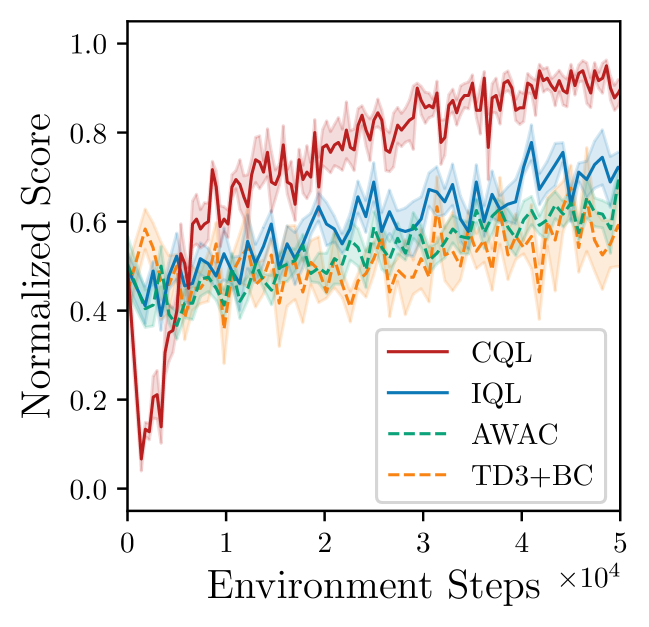
- Cal-QL improves online fine-tuning performance relative to state-of-the-art offline-to-online methods across a suite of tasks, including manipulation and navigation domains.
- Calibration prevents the initial unlearning observed with some conservative offline RL methods by ensuring Q-values are scaled similarly to true returns.
- Cal-QL matches or exceeds the best baselines on 9 of 11 fine-tuning tasks in the reported benchmarks.
- A simple one-line modification to the CQL objective suffices to enforce calibration in expectation over dataset states.
- Theoretical analysis shows Cal-QL yields a refined regret bound during online fine-tuning by balancing conservatism and calibration.
Read this paper
Open the full text in the Nubint reader and ask about any passage as you read.
Read this paper on NubintThis review was generated by AI from the original paper. Please check the paper before citing it.