
[Paper Review] Calibrated Language Models Must Hallucinate
The paper proves that calibrated language models must hallucinate arbitrary facts at a lower bound related to the fraction of unseen facts, even with ideal training data, and discusses implications for post-training mitigation and factual vs. systematic hallucinations.
Recent language models generate false but plausible-sounding text with surprising frequency. Such "hallucinations" are an obstacle to the usability of language-based AI systems and can harm people who rely upon their outputs. This work shows that there is an inherent statistical lower-bound on the rate that pretrained language models hallucinate certain types of facts, having nothing to do with the transformer LM architecture or data quality. For "arbitrary" facts whose veracity cannot be determined from the training data, we show that hallucinations must occur at a certain rate for language models that satisfy a statistical calibration condition appropriate for generative language models. Specifically, if the maximum probability of any fact is bounded, we show that the probability of generating a hallucination is close to the fraction of facts that occur exactly once in the training data (a "Good-Turing" estimate), even assuming ideal training data without errors. One conclusion is that models pretrained to be sufficiently good predictors (i.e., calibrated) may require post-training to mitigate hallucinations on the type of arbitrary facts that tend to appear once in the training set. However, our analysis also suggests that there is no statistical reason that pretraining will lead to hallucination on facts that tend to appear more than once in the training data (like references to publications such as articles and books, whose hallucinations have been particularly notable and problematic) or on systematic facts (like arithmetic calculations). Therefore, different architectures and learning algorithms may mitigate these latter types of hallucinations.
Motivation & Objective
- Motivate why hallucinations occur from a statistical viewpoint under semantic calibration for generative models.
- Define a generative calibration framework suitable for open-domain facts and arbitrary factoids.
- Derive lower bounds on hallucination rates in relation to unseen facts and calibration quality.
- Discuss implications for different fact types (arbitrary vs. systematic) and post-training mitigation.
Proposed method
- Model a language as a distribution over documents generated from training data drawn i.i.d. from a language distribution.
- Define factoids as arbitrary pieces of information with a one-fact-per-document simplification.
- Use Good-Turing (mono-fact) estimator to bound missing mass of unobserved facts.
- Introduce a generative calibration notion with adaptive binning to measure miscalibration.
- Prove a probabilistic lower bound on hallucination rate in terms of the mono-fact estimate and calibration terms.
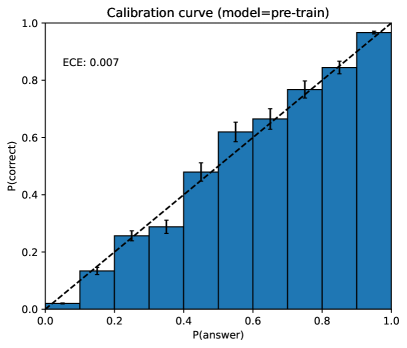
Experimental results
Research questions
- RQ1What is the minimum rate at which a calibrated language model must hallucinate arbitrary facts?
- RQ2How does the missing mass of unobserved facts relate to hallucination rates under semantic calibration?
- RQ3How does calibration quality affect the derived lower bounds on hallucinations?
- RQ4Do the bounds extend to multiple fact types and regularity conditions on the world distribution?
- RQ5What are the implications for mitigating hallucinations via post-training versus architectural changes?
Key findings
- Calibrated predictors must hallucinate for arbitrary facts at a rate tied to the fraction of unobserved facts in training data.
- A mono-fact (Good-Turing) estimate serves as a lower bound for the missing mass of unseen facts and, hence, for hallucination rate under regularity assumptions.
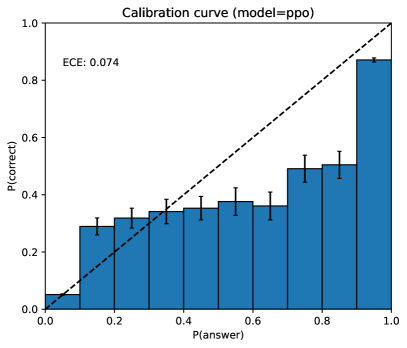
- There is a calibration cost: improving post-training calibration can increase hallucination rates for arbitrary facts.
- For systematic facts and references, there is no statistical necessity for hallucinations, suggesting potential mitigation via architectural or learning changes.
- The results hold even in an idealized, static setting with no training data errors and highlight a fundamental tension between predictive accuracy, calibration, and factual generation.
Read this paper
Open the full text in the Nubint reader and ask about any passage as you read.
Read this paper on NubintThis review was generated by AI from the original paper. Please check the paper before citing it.