
[Paper Review] Calibrated One-class Classification for Unsupervised Time Series Anomaly Detection
This paper proposes COUTA, a calibrated one-class classification method for unsupervised time series anomaly detection that improves normality modeling by addressing anomaly contamination and lack of anomaly knowledge. It uses uncertainty modeling-based calibration to suppress noisy predictions and native anomaly-based calibration to inject realistic abnormal patterns, achieving 6%–31% higher F₁ scores than state-of-the-art methods on six real-world datasets.
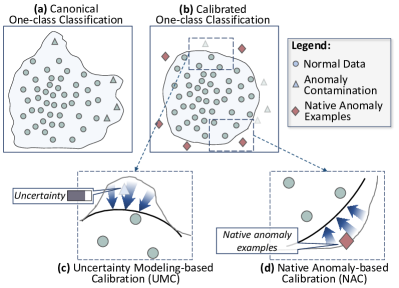
Time series anomaly detection is instrumental in maintaining system availability in various domains. Current work in this research line mainly focuses on learning data normality deeply and comprehensively by devising advanced neural network structures and new reconstruction/prediction learning objectives. However, their one-class learning process can be misled by latent anomalies in training data (i.e., anomaly contamination) under the unsupervised paradigm. Their learning process also lacks knowledge about the anomalies. Consequently, they often learn a biased, inaccurate normality boundary. To tackle these problems, this paper proposes calibrated one-class classification for anomaly detection, realizing contamination-tolerant, anomaly-informed learning of data normality via uncertainty modeling-based calibration and native anomaly-based calibration. Specifically, our approach adaptively penalizes uncertain predictions to restrain irregular samples in anomaly contamination during optimization, while simultaneously encouraging confident predictions on regular samples to ensure effective normality learning. This largely alleviates the negative impact of anomaly contamination. Our approach also creates native anomaly examples via perturbation to simulate time series abnormal behaviors. Through discriminating these dummy anomalies, our one-class learning is further calibrated to form a more precise normality boundary. Extensive experiments on ten real-world datasets show that our model achieves substantial improvement over sixteen state-of-the-art contenders.
Motivation & Objective
- Address the critical challenge of anomaly contamination in unlabeled training data for one-class time series anomaly detection.
- Overcome the limitation of existing methods that lack knowledge about genuine abnormal behaviors during normality learning.
- Develop a contamination-tolerant, anomaly-informed one-class classification framework that improves normality modeling accuracy.
- Enable robust and scalable anomaly detection in real-world time series applications with high-dimensional and long sequences.
- Provide a simple yet effective calibration mechanism that enhances model confidence and generalization without complex architectures or objectives.
Proposed method
- Introduce uncertainty modeling-based calibration (UMC) that models prediction uncertainty via a prior distribution on one-class distance values.
- Design a novel learning objective that mildly penalizes high-uncertainty predictions while encouraging confident predictions on hard normal samples.
- Propose native anomaly-based calibration (NAC) to generate realistic anomaly examples by applying domain-specific perturbations to original time series data.
- Use perturbation operations (e.g., point, contextual, collective anomalies) to simulate genuine abnormal behaviors without requiring labeled anomalies.
- Combine UMC and NAC into a unified training objective that enhances model robustness and normality boundary learning.
- Employ a sliding window-based feature extraction strategy with a learnable feature space dimension H to capture temporal dependencies.
Experimental results
Research questions
- RQ1Can uncertainty-aware calibration improve the robustness of one-class models to anomaly contamination in training data?
- RQ2Can injecting knowledge of realistic abnormal patterns through data perturbation improve normality modeling in unsupervised settings?
- RQ3How does the proposed calibration framework compare to state-of-the-art methods in terms of F₁ score, AUC-PR, and generalization across diverse anomaly types?
- RQ4What is the impact of hyperparameters such as perturbation type, loss weighting, and window length on detection performance?
- RQ5Does the method scale effectively to long and high-dimensional time series data commonly found in real-world systems?
Key findings
- COUTA achieves 6%–31% higher F₁ scores than 12 state-of-the-art competitors across six real-world time series datasets.
- The method demonstrates superior robustness to anomaly contamination, maintaining high performance even when training data contain unknown anomalies.
- Native anomaly-based calibration (NAC) with a full perturbation operation pool (Ω) yields the best performance, especially on the ASD dataset.
- COUTA shows stable performance across different hyperparameter settings, with minimal sensitivity to α, β, and l, indicating strong generalization.
- The model exhibits excellent scalability, with significantly lower training time per epoch than competing deep learning-based methods, particularly on long and high-dimensional sequences.
- COUTA outperforms methods like TranAD, USAD, and MSCRED in long-sequence and high-dimensional settings, which failed due to memory constraints.
Read this paper
Open the full text in the Nubint reader and ask about any passage as you read.
Read this paper on NubintThis review was generated by AI from the original paper. Please check the paper before citing it.