
[Paper Review] Call for Papers -- The BabyLM Challenge: Sample-efficient pretraining on a developmentally plausible corpus
This is a call for papers for the BabyLM Challenge, offering three tracks on small-scale pretraining with developmentally plausible data and a shared evaluation pipeline.
We present the call for papers for the BabyLM Challenge: Sample-efficient pretraining on a developmentally plausible corpus. This shared task is intended for participants with an interest in small scale language modeling, human language acquisition, low-resource NLP, and cognitive modeling. In partnership with CoNLL and CMCL, we provide a platform for approaches to pretraining with a limited-size corpus sourced from data inspired by the input to children. The task has three tracks, two of which restrict the training data to pre-released datasets of 10M and 100M words and are dedicated to explorations of approaches such as architectural variations, self-supervised objectives, or curriculum learning. The final track only restricts the amount of text used, allowing innovation in the choice of the data, its domain, and even its modality (i.e., data from sources other than text is welcome). We will release a shared evaluation pipeline which scores models on a variety of benchmarks and tasks, including targeted syntactic evaluations and natural language understanding.
Motivation & Objective
- Incentivize research on pretraining with limited data sizes that resemble human linguistic input.
- Democratize pretraining research by enabling university-budget participation.
- Explore techniques that improve data efficiency and cognitive plausibility in language models.
- Provide a platform for cognitive science and linguistics insights in NLP.
- Offer a transparent evaluation pipeline with benchmarks across multiple tasks.
Proposed method
- Three tracks (Strict, Strict-small, Loose) with fixed datasets or flexible data limits.
- Developmentally plausible pretraining corpus under 100M words with a focus on transcribed speech.
- Shared evaluation pipeline compatible with HuggingFace transformers for scoring and downstream tasks.
- Baseline models derived from established LMs (OPT, RoBERTa, T5) trained on fixed datasets.
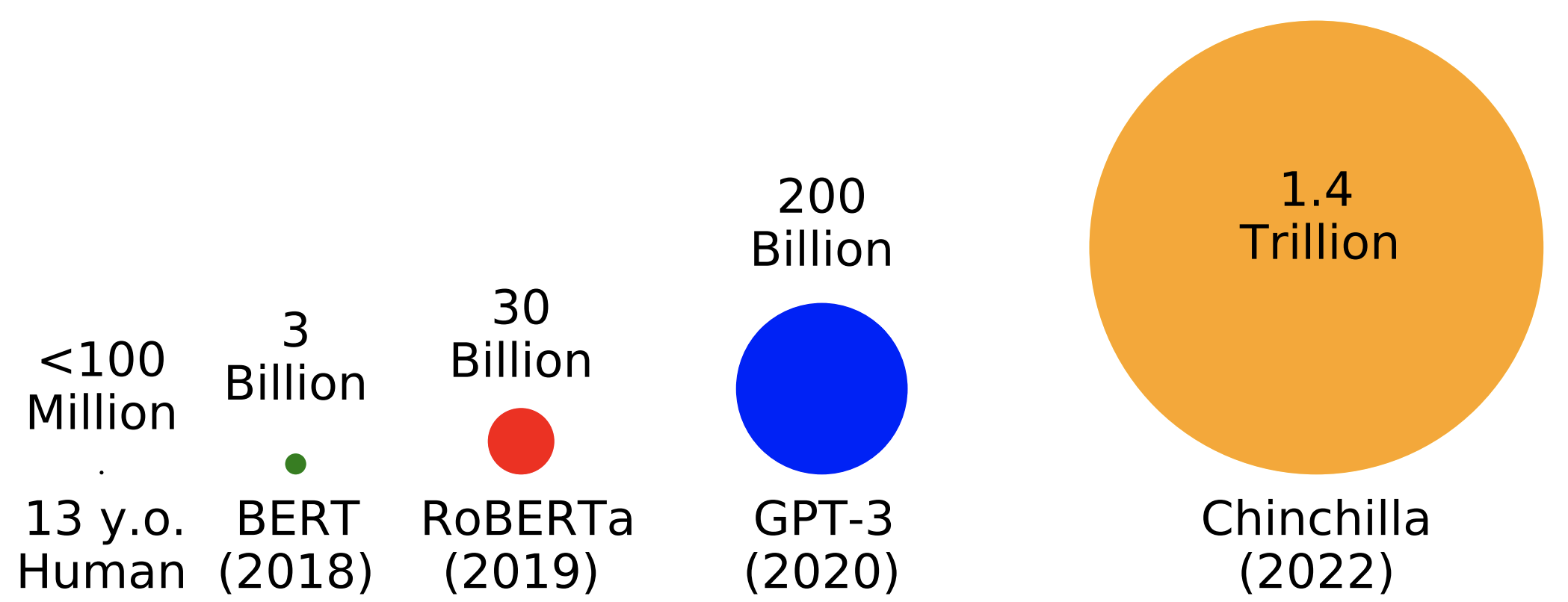
Experimental results
Research questions
- RQ1How does language model pretraining perform when data is limited to human-like scales (10M vs 100M words)?
- RQ2What architectural, objective, or curriculum strategies improve data efficiency under developmentally plausible data constraints?
- RQ3How do models fare on targeted syntactic evaluations and natural language understanding with restricted data?
- RQ4What are the resource and efficiency trade-offs when training under strict versus loose data restrictions?
Key findings
- A three-track setup (Strict, Strict-small, Loose) with clearly defined data constraints and a shared evaluation pipeline.
- A fixed set of datasets totaling about 100M words across diverse domains (child-directed speech, dialogue, children’s books, Wikipedia, subtitles).
- A 10M-word Strict track and a 100M-word Loose track enable exploration of data-efficient pretraining approaches.
- Baseline models (from OPT, RoBERTa, T5 family) will be provided to give a naïve starting point for comparisons.
- Evaluation emphasizes efficiency, cognitive plausibility, and downstream NLP tasks, with a Colab-based pipeline for broad accessibility.
Read this paper
Open the full text in the Nubint reader and ask about any passage as you read.
Read this paper on NubintThis review was generated by AI from the original paper. Please check the paper before citing it.