
[Paper Review] CamoFA: A Learnable Fourier-based Augmentation for Camouflage Segmentation
This paper proposes CamoFourier, a learnable Fourier-based data augmentation method for camouflaged object detection (COD) and instance segmentation (CIS) that enhances model performance by generating reference images via a conditional GAN and using cross-attention to align features, followed by adaptive hybrid swapping of low-frequency components from the reference and high-frequency components from the input image. The method significantly boosts state-of-the-art models on COD and CIS benchmarks without architectural changes.
Camouflaged object detection (COD) and camouflaged instance segmentation (CIS) aim to recognize and segment objects that are blended into their surroundings, respectively. While several deep neural network models have been proposed to tackle those tasks, augmentation methods for COD and CIS have not been thoroughly explored. Augmentation strategies can help improve models' performance by increasing the size and diversity of the training data and exposing the model to a wider range of variations in the data. Besides, we aim to automatically learn transformations that help to reveal the underlying structure of camouflaged objects and allow the model to learn to better identify and segment camouflaged objects. To achieve this, we propose a learnable augmentation method in the frequency domain for COD and CIS via the Fourier transform approach, dubbed CamoFA. Our method leverages a conditional generative adversarial network and cross-attention mechanism to generate a reference image and an adaptive hybrid swapping with parameters to mix the low-frequency component of the reference image and the high-frequency component of the input image. This approach aims to make camouflaged objects more visible for detection and segmentation models. Without bells and whistles, our proposed augmentation method boosts the performance of camouflaged object detectors and instance segmenters by large margins.
Motivation & Objective
- To address the lack of effective data augmentation strategies specifically tailored for camouflaged object detection and instance segmentation.
- To improve model generalization and robustness by learning transformations that reveal hidden structures in camouflaged objects.
- To develop a frequency-domain augmentation method that preserves spatial structure while enhancing visibility of camouflaged objects.
- To create a flexible, trainable augmentation framework compatible with various detection and segmentation architectures.
Proposed method
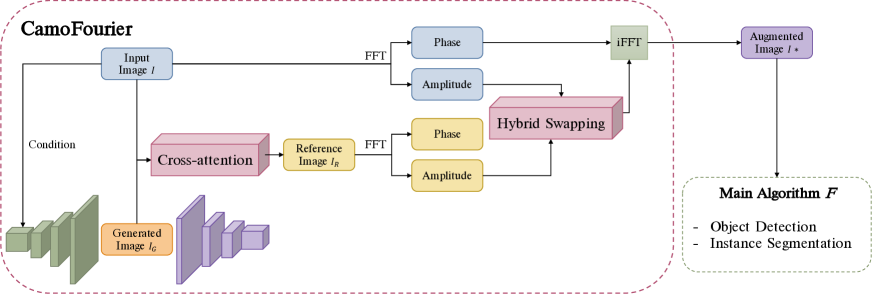
- A conditional generative adversarial network (cGAN) generates a reference image from the input image to serve as a source of structural and texture cues.
- A cross-attention mechanism learns spatial correspondence and alignment between the input image and the generated reference image to improve feature consistency.
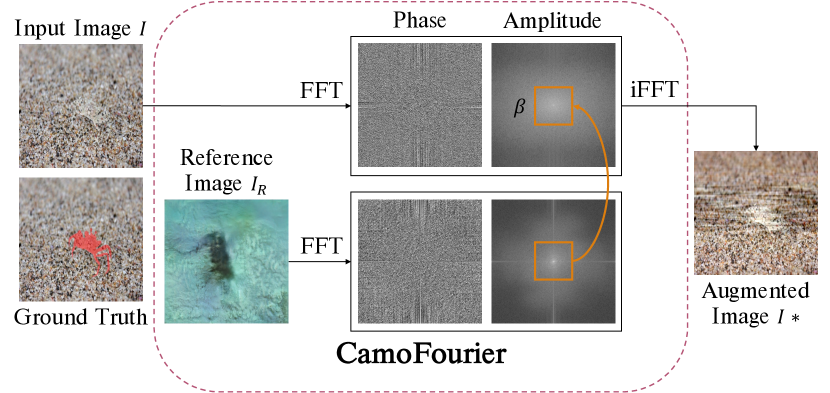
- The method transforms both input and reference images into the frequency domain using the Fourier transform, separating amplitude and phase components.
- An adaptive hybrid swapping mechanism combines the low-frequency amplitude of the reference image with the high-frequency amplitude of the input image, controlled by a learnable parameter β.
- The hybrid swapping allows controlled transfer of texture and color information from the reference to the input, enhancing camouflaged object visibility.
- The augmented image is reconstructed via inverse Fourier transform, preserving resolution and spatial structure while highlighting object boundaries.
Experimental results
Research questions
- RQ1Can a learnable, frequency-domain augmentation method improve performance in camouflaged object detection and instance segmentation tasks?
- RQ2How does the integration of a conditional GAN and cross-attention mechanism enhance the quality and relevance of augmented images for camouflaged objects?
- RQ3What is the impact of adaptive hybrid swapping of Fourier components on model generalization and detection accuracy?
- RQ4How does CamoFourier compare to existing augmentation methods that are not designed for high-background similarity in camouflaged objects?
- RQ5To what extent does the proposed method generalize across different state-of-the-art models for COD and CIS?
Key findings
- CamoFourier significantly improves the performance of SINetV2 and OSFormer on both COD and CIS benchmarks, outperforming previous state-of-the-art methods.
- The cross-attention mechanism improves performance across all metrics on COD10K and NC4K datasets, with consistent gains in F-measure, mean F-score, and S-measure.
- Adaptive hybrid swapping leads to measurable performance gains over basic amplitude swapping, demonstrating its importance in controlling information transfer.
- The method outperforms CamDiff, the prior state-of-the-art, on both COD and CIS tasks, confirming its superiority in enhancing model sensitivity to camouflaged objects.
- Qualitative results show that CamoFourier produces augmented images that make camouflaged object structures more visible, enabling better segmentation and detection.
- Ablation studies confirm that both the cross-attention module and adaptive hybrid swapping are essential components for optimal performance.
Read this paper
Open the full text in the Nubint reader and ask about any passage as you read.
Read this paper on NubintThis review was generated by AI from the original paper. Please check the paper before citing it.