
[Paper Review] Can Generative Large Language Models Perform ASR Error Correction?
The paper investigates zero-shot and few-shot ASR error correction using ChatGPT on two ASR architectures (Conformer-Transducer and Whisper AED), comparing unconstrained, selective, and closest-mapping approaches with 0- and 1-shot prompts.
ASR error correction is an interesting option for post processing speech recognition system outputs. These error correction models are usually trained in a supervised fashion using the decoding results of a target ASR system. This approach can be computationally intensive and the model is tuned to a specific ASR system. Recently generative large language models (LLMs) have been applied to a wide range of natural language processing tasks, as they can operate in a zero-shot or few shot fashion. In this paper we investigate using ChatGPT, a generative LLM, for ASR error correction. Based on the ASR N-best output, we propose both unconstrained and constrained, where a member of the N-best list is selected, approaches. Additionally, zero and 1-shot settings are evaluated. Experiments show that this generative LLM approach can yield performance gains for two different state-of-the-art ASR architectures, transducer and attention-encoder-decoder based, and multiple test sets.
Motivation & Objective
- Motivate and assess error correction as post-processing for ASR outputs without retraining.
- Evaluate zero-shot and few-shot generative LLM approaches on multiple ASR architectures and datasets.
- Compare unconstrained and constrained (N-best) prompting strategies using ChatGPT for error correction.
Proposed method
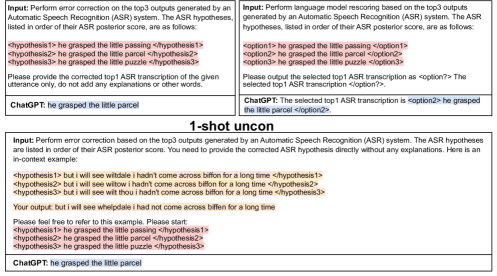
- Input the ASR N-best list (top 5 by default) to ChatGPT without training an error-corrector.
- Test zero-shot unconstrained, zero-shot selective, and 1-shot unconstrained prompts.
- Apply constrained decoding variants: selective approach and closest mapping to restrict outputs to N-best candidates.
- Evaluate across two ASR systems (Conformer-Transducer and Whisper small.en) on LibriSpeech test sets, TED-LIUM3, and Artie Bias.
- Compare ChatGPT results with a fine-tuned N-best T5 error correction model.

Experimental results
Research questions
- RQ1Can a generative LLM (ChatGPT) improve ASR error correction in zero-shot and one-shot settings without additional training?
- RQ2Do N-best constrained decoding variants (selective, closest) yield gains over unconstrained generation when using ChatGPT?
- RQ3How does ChatGPT-based correction compare to a fine-tuned T5 N-best error correction model across different ASR architectures and domains?
Key findings
- ChatGPT delivers performance gains over ASR baselines for both Conformer-Transducer and Whisper AED systems.
- Zero-shot 1-shot unconstrained prompts with ChatGPT improve WER, with 1-shot closest often close to T5 performance on some setups.
- Constrained approaches (closest, selective) can outperform zero-shot unconstrained, with closest often yielding strong results.
- ChatGPT-based correction shows better gains on LibriSpeech-related in-domain data and some out-of-domain sets, but degrades in certain Whisper-driven cases due to N-best diversity issues.
- Compared to T5-based error correction, ChatGPT can be competitive or superior in several scenarios, and does not require prior model training.
Read this paper
Open the full text in the Nubint reader and ask about any passage as you read.
Read this paper on NubintThis review was generated by AI from the original paper. Please check the paper before citing it.