
[Paper Review] Can Large Language Models Be an Alternative to Human Evaluations?
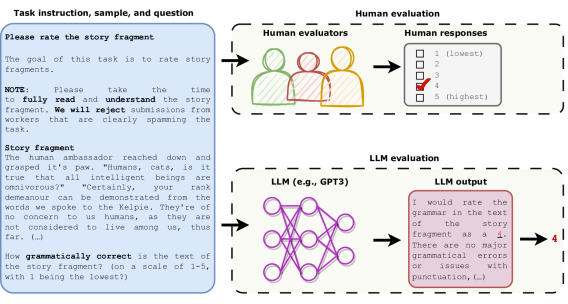
The paper investigates using large language models (LLMs) as an alternative to human evaluation by providing the same instructions, samples, and questions used in human assessments and evaluating outputs in open-ended story generation and adversarial attacks.
Human evaluation is indispensable and inevitable for assessing the quality of texts generated by machine learning models or written by humans. However, human evaluation is very difficult to reproduce and its quality is notoriously unstable, hindering fair comparisons among different natural language processing (NLP) models and algorithms. Recently, large language models (LLMs) have demonstrated exceptional performance on unseen tasks when only the task instructions are provided. In this paper, we explore if such an ability of the LLMs can be used as an alternative to human evaluation. We present the LLMs with the exact same instructions, samples to be evaluated, and questions used to conduct human evaluation, and then ask the LLMs to generate responses to those questions; we dub this LLM evaluation. We use human evaluation and LLM evaluation to evaluate the texts in two NLP tasks: open-ended story generation and adversarial attacks. We show that the result of LLM evaluation is consistent with the results obtained by expert human evaluation: the texts rated higher by human experts are also rated higher by the LLMs. We also find that the results of LLM evaluation are stable over different formatting of the task instructions and the sampling algorithm used to generate the answer. We are the first to show the potential of using LLMs to assess the quality of texts and discuss the limitations and ethical considerations of LLM evaluation.
Motivation & Objective
- Motivate the challenges of human evaluation in NLP due to unreliability and low reproducibility.
- Propose LLM evaluation as an alternative by feeding LLMs the same instructions, samples, and questions used in human evaluation.
- Empirically compare LLM evaluation with expert human evaluation across open-ended story generation and adversarial text attacks.
- Analyze stability of LLM evaluation under instruction variations and sampling hyperparameters.
- Discuss limitations, ethics, and practical considerations of adopting LLM-based evaluation.
Proposed method
- Provide LLMs with identical task instructions, samples, and questions used in human evaluation and extract a Likert-style rating from the LLM outputs.
- Use multiple LLMs (T0, text-curie-001, text-davinci-003, ChatGPT) with nucleus sampling to generate ratings.
- Compare LLM ratings with ratings from three expert English teachers on 200 human-written and 200 GPT-2-generated stories.
- Repeat experiments with variations in instructions and sampling temperatures to assess robustness.
Experimental results
Research questions
- RQ1Can LLMs rate textual quality in a manner consistent with expert human evaluators?
- RQ2How stable are LLM evaluations to changes in task instructions, questions, and sampling settings?
- RQ3Do LLM evaluations align with human judgments on adversarial text quality (fluency and meaning preservation)?
Key findings
- LLM evaluation with strong models (especially text-davinci-003) yields ratings that align with expert human evaluation, with human-written texts preferred over GPT-2-generated ones across multiple attributes.
- LLM evaluation results show only modest variance with different task instructions and sampling temperatures, preserving the relative ranking between human-written and model-generated texts.
- ChatGPT can explain its reasoning and tends to rate human-written texts higher, while sometimes diverging in absolute scores on some attributes.
- LLMs can effectively rank adversarial samples versus benign samples in fluency and meaning preservation in line with expert judgments, though some model-specific biases exist (e.g., safety policies affecting ratings).
- The approach offers improved reproducibility and lower cost compared to human evaluation, while acknowledging limitations such as potential knowledge biases and safety constraints of LLMs.
Read this paper
Open the full text in the Nubint reader and ask about any passage as you read.
Read this paper on NubintThis review was generated by AI from the original paper. Please check the paper before citing it.