
[Paper Review] Can Large Language Models Detect Rumors on Social Media?
This paper proposes LeRuD, a zero-shot rumor detection framework that leverages Large Language Models (LLMs) to analyze both news content and user comments on social media by structuring propagation information into a Chain-of-Propagation and using targeted prompts to guide LLMs in focusing on key clues like writing style, commonsense inconsistencies, and comment conflicts. LeRuD achieves 3.2% to 7.7% higher performance than state-of-the-art models on Twitter and Weibo datasets without requiring any training data.
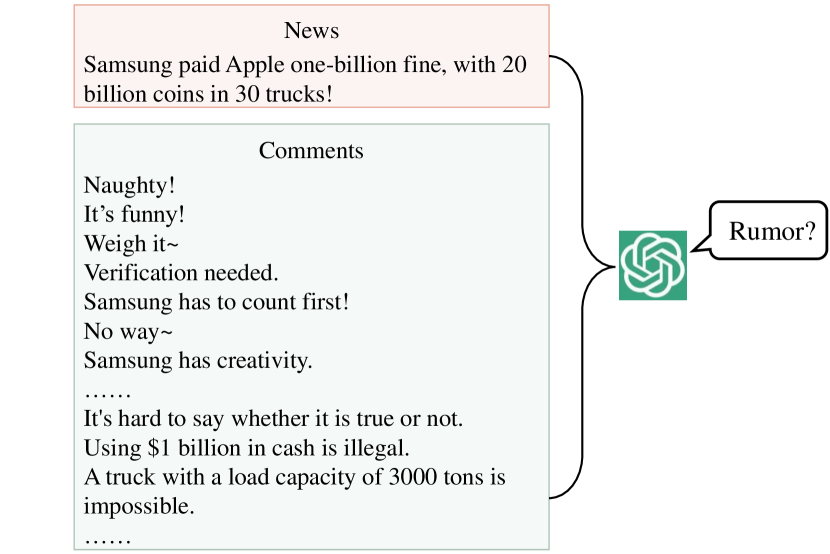
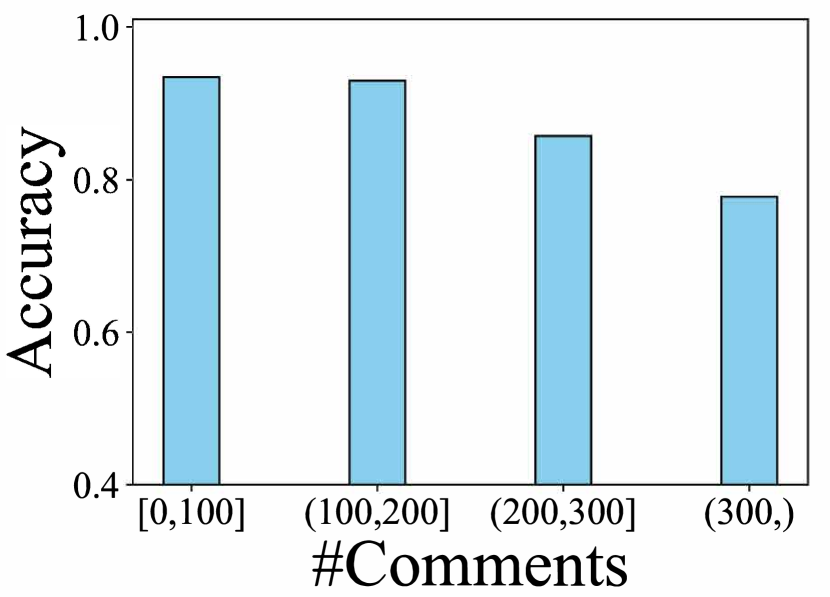
In this work, we investigate to use Large Language Models (LLMs) for rumor detection on social media. However, it is challenging for LLMs to reason over the entire propagation information on social media, which contains news contents and numerous comments, due to LLMs may not concentrate on key clues in the complex propagation information, and have trouble in reasoning when facing massive and redundant information. Accordingly, we propose an LLM-empowered Rumor Detection (LeRuD) approach, in which we design prompts to teach LLMs to reason over important clues in news and comments, and divide the entire propagation information into a Chain-of-Propagation for reducing LLMs' burden. We conduct extensive experiments on the Twitter and Weibo datasets, and LeRuD outperforms several state-of-the-art rumor detection models by 3.2% to 7.7%. Meanwhile, by applying LLMs, LeRuD requires no data for training, and thus shows more promising rumor detection ability in few-shot or zero-shot scenarios.
Motivation & Objective
- To investigate whether Large Language Models (LLMs) can effectively detect rumors on social media using full propagation information, including news and comments.
- To address the challenge of LLMs failing to focus on key clues and struggling with long, redundant comment sequences in propagation data.
- To design a prompt-based reasoning framework that enables LLMs to reason step-by-step over time-ordered propagation patterns.
- To evaluate the zero-shot capability of LLMs in rumor detection, minimizing reliance on fine-tuning or labeled training data.
- To demonstrate that LLMs, when properly guided, can outperform traditional models even without fine-tuning.
Proposed method
- The method structures the propagation of a news item into a Chain-of-Propagation, organizing comments chronologically to reduce context length and improve reasoning efficiency.
- Custom prompts are designed to guide LLMs to analyze the news for writing style and commonsense inconsistencies, such as implausible claims or exaggerated language.
- Separate prompts are used to detect rebuttals, contradictions, or conflicting opinions in user comments, enabling multi-perspective reasoning.
- The framework uses GPT-3.5 in a zero-shot setting, avoiding fine-tuning and ensuring generalization across low-resource scenarios.
- Ethical filtering is applied to exclude samples with known facts or sensitive content to prevent data leakage and bias.
- The final verdict is aggregated from step-by-step analysis, combining evidence from news credibility assessment and comment sentiment/conflict detection.
Experimental results
Research questions
- RQ1Can LLMs effectively detect rumors on social media when given full propagation information, including news and comments?
- RQ2How do LLMs perform in zero-shot or few-shot settings compared to fine-tuned models in rumor detection?
- RQ3Can prompt engineering and structured reasoning (Chain-of-Propagation) improve LLMs’ ability to focus on key clues in noisy, lengthy comment threads?
- RQ4What types of clues—such as writing style, commonsense errors, or comment conflicts—are most effective for LLM-based rumor detection?
- RQ5Does structuring propagation data into a time-ordered chain enhance LLM reasoning and detection accuracy?
Key findings
- LeRuD outperforms several state-of-the-art rumor detection models by 3.2% to 7.7% on the Twitter and Weibo datasets in zero-shot evaluation.
- The model achieves superior performance without any fine-tuning, demonstrating strong generalization in low-resource or zero-shot scenarios.
- Prompt engineering effectively guides LLMs to focus on key indicators such as writing style anomalies and comment conflicts, improving detection accuracy.
- The Chain-of-Propagation structure reduces LLM reasoning burden by limiting context per step, enabling more accurate and stable inference on long comment sequences.
- The framework correctly identifies real news in challenging cases, such as emotionally charged or ambiguous incidents, by detecting absence of rebuttals or logical inconsistencies.
- Even with input length constraints, LeRuD maintains high performance by filtering out redundant or irrelevant comments and focusing on salient evidence.
Better researchstarts right now
From reading papers to final review, dramatically reduce your research time.
No credit card · Free plan available
This review was created by AI and reviewed by human editors.