
[Paper Review] Can Large Language Models Solve Robot Routing?
This paper investigates whether large language models (LLMs) can solve vehicle routing problems (VRPs) using only natural language task descriptions. It proposes a text-to-code prompting framework where LLMs generate executable Python code from NL descriptions, achieving 56% feasibility, 40% optimality, and 53% efficiency with GPT-4; a self-reflection mechanism further improves performance by 15–16% across metrics, while sensitivity analysis reveals that missing details reduce performance by 4–5%.
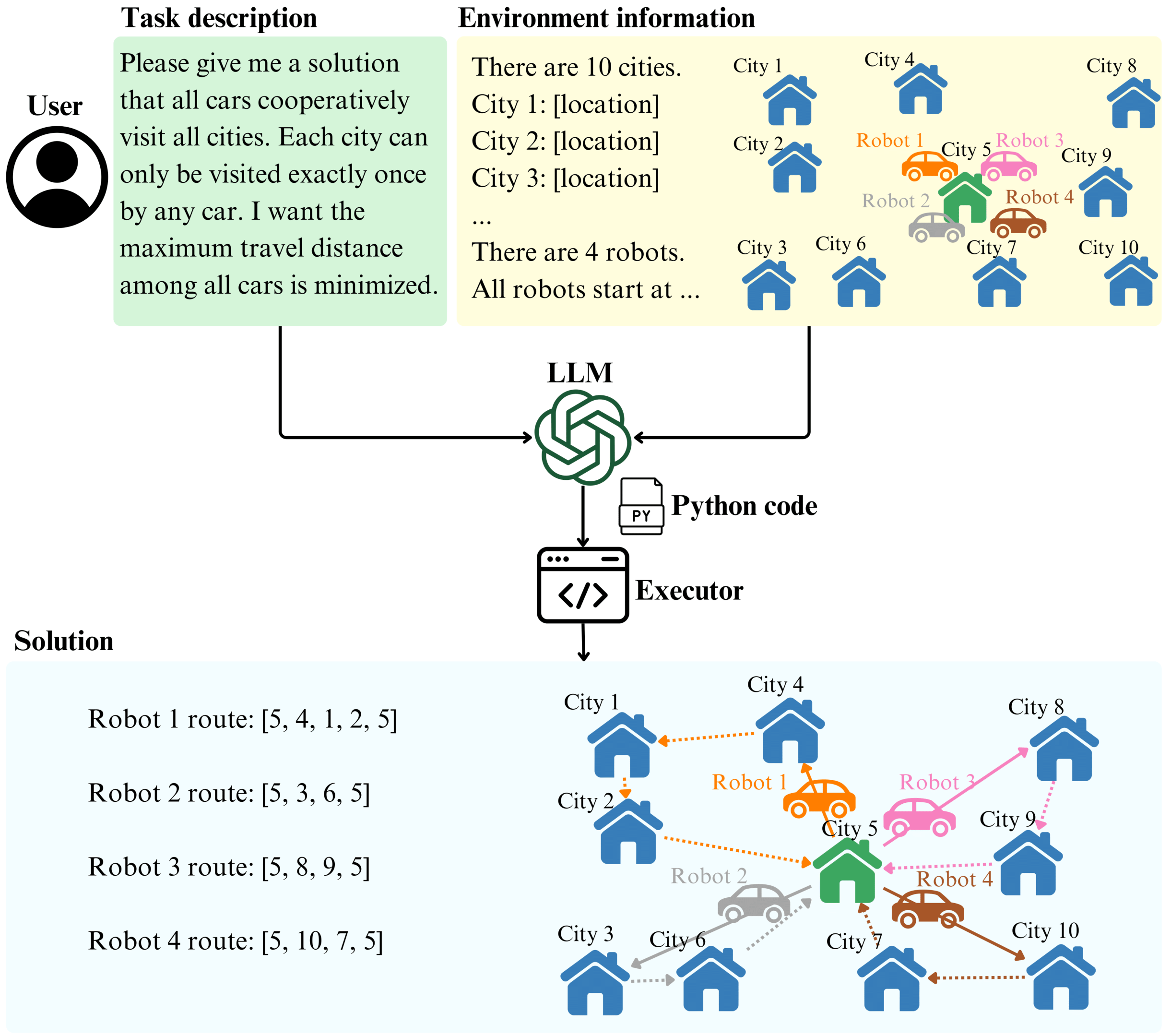
Routing problems are common in mobile robotics, encompassing tasks such as inspection, surveillance, and coverage. Depending on the objective and constraints, these problems often reduce to variants of the Traveling Salesman Problem (TSP), with solutions traditionally derived by translating high-level objectives into an optimization formulation and using modern solvers to arrive at a solution. Here, we explore the potential of Large Language Models (LLMs) to replace the entire pipeline from tasks described in natural language to the generation of robot routes. We systematically investigate the performance of LLMs in robot routing by constructing a dataset with 80 unique robot routing problems across 8 variants in both single and multi-robot settings. We evaluate LLMs through three frameworks: single attempt, self-debugging, and self-debugging with self-verification and various contexts, including mathematical formulations, pseudo-code, and related research papers. Our findings reveal that both self-debugging and self-verification enhance success rates without significantly lowering the optimality gap. We observe context-sensitive behavior - providing mathematical formulations as context decreases the optimality gap but significantly decreases success rates and providing pseudo-code and related research papers as context does not consistently improve success rates or decrease the optimality gap. We identify key challenges and propose future directions to enhance LLM performance in solving robot routing problems. Our source code is available on the project website: https://sites.google.com/view/words-to-routes/.
Motivation & Objective
- To evaluate the ability of LLMs to solve vehicle routing problems (VRPs) using only natural language task descriptions.
- To identify the most effective prompt paradigm for LLMs in VRP solving without fine-tuning.
- To improve LLM performance through a self-reflection framework enabling solution refinement via self-debugging and self-verification.
- To assess the sensitivity of LLMs to incomplete or ambiguous task descriptions in VRP settings.
- To develop a mechanism that enables LLMs to request clarifications from users to improve task description completeness.
Proposed method
- Constructed a benchmark dataset of 21 VRP variants (10 single-vehicle, 11 multi-vehicle) with detailed, unambiguous task descriptions.
- Evaluated four prompt paradigms for LLMs, finding direct text-to-code generation from natural language yields the best performance.
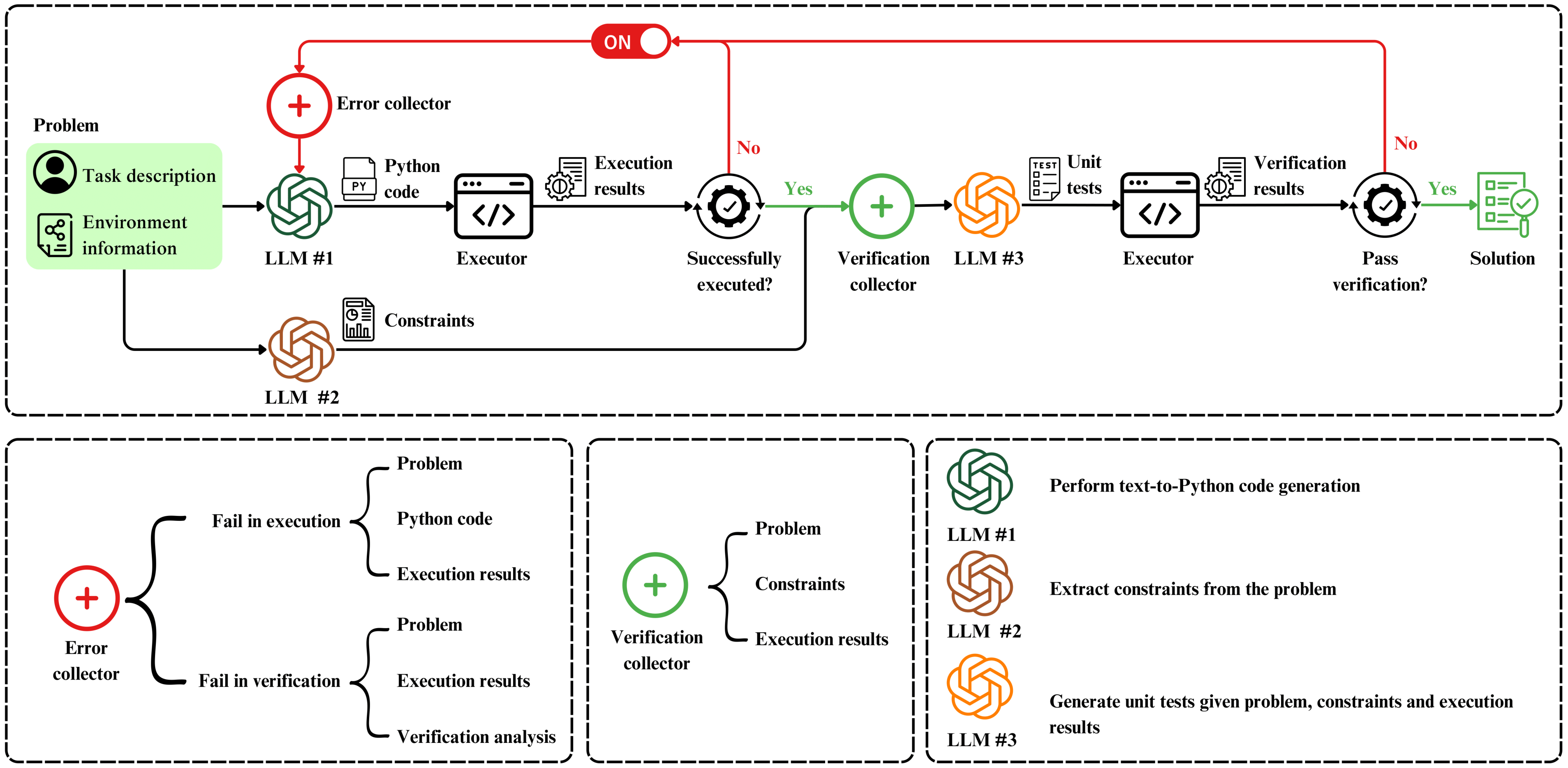
- Proposed a self-reflection framework where LLMs iteratively refine solutions through self-debugging and self-verification to improve feasibility, optimality, and efficiency.
- Designed a user-interactive mechanism where LLMs detect incomplete descriptions and ask targeted questions to elicit missing details.
- Evaluated performance across multiple LLMs, including GPT-4, Claude 3 Opus, and Gemini 1.0 Pro, under zero-shot prompting.
- Generated executable Python code from NL descriptions and validated solutions using ground-truth benchmarks.
Experimental results
Research questions
- RQ1Can LLMs solve vehicle routing problems using only natural language task descriptions without fine-tuning?
- RQ2Which prompt paradigm—among text-to-code, code-to-text, or hybrid approaches—yields the highest performance in VRP solving?
- RQ3How does self-reflection through self-debugging and self-verification improve LLM performance on VRP tasks?
- RQ4How sensitive are LLMs to missing or omitted details in natural language task descriptions, even when core meaning is preserved?
- RQ5Can an LLM-based mechanism effectively identify incomplete task descriptions and request clarifications to improve solution quality?
Key findings
- Direct text-to-code prompting achieved the highest performance with GPT-4, reaching 56% feasibility, 40% optimality, and 53% efficiency on the 21-VRP benchmark.
- The proposed self-reflection framework increased GPT-4’s performance by 16% in feasibility, 7% in optimality, and 15% in efficiency compared to zero-shot prompting.
- Omitting details from task descriptions—while preserving core meaning—reduced GPT-4’s performance by 4% in feasibility, 4% in optimality, and 5% in efficiency.
- Claude 3 Opus outperformed Gemini 1.0 Pro but underperformed GPT-4, achieving 45% feasibility, 16% optimality, and 40% efficiency overall.
- The interactive clarification mechanism improved performance on some tasks (e.g., TSPTW and CMTSP) but failed to boost performance on others due to LLMs asking irrelevant questions.
- GPT-4 struggled to identify missing details in complex tasks, with only a 30% success rate in detecting incompleteness for the SOP task, indicating limitations in self-assessment.
Read this paper
Open the full text in the Nubint reader and ask about any passage as you read.
Read this paper on NubintThis review was generated by AI from the original paper. Please check the paper before citing it.