
[Paper Review] Can Large Language Models Understand Context?
The paper introduces a context-understanding benchmark for generative LLMs, assesses in-context learning and post-training quantization, and shows that larger or quantized models outperform smaller dense ones variably across tasks.
Understanding context is key to understanding human language, an ability which Large Language Models (LLMs) have been increasingly seen to demonstrate to an impressive extent. However, though the evaluation of LLMs encompasses various domains within the realm of Natural Language Processing, limited attention has been paid to probing their linguistic capability of understanding contextual features. This paper introduces a context understanding benchmark by adapting existing datasets to suit the evaluation of generative models. This benchmark comprises of four distinct tasks and nine datasets, all featuring prompts designed to assess the models' ability to understand context. First, we evaluate the performance of LLMs under the in-context learning pretraining scenario. Experimental results indicate that pre-trained dense models struggle with understanding more nuanced contextual features when compared to state-of-the-art fine-tuned models. Second, as LLM compression holds growing significance in both research and real-world applications, we assess the context understanding of quantized models under in-context-learning settings. We find that 3-bit post-training quantization leads to varying degrees of performance reduction on our benchmark. We conduct an extensive analysis of these scenarios to substantiate our experimental results.
Motivation & Objective
- Introduce a contextual understanding benchmark built from four tasks across nine datasets to evaluate generative LLMs.
- Analyze in-context learning performance of models with varying sizes and families (OPT, LLaMA, GPT-3.5) on the benchmark.
- Evaluate the impact of post-training 3-bit quantization (GPTQ) on context understanding tasks.
- Provide a detailed linguistic and task-level analysis of where models succeed or fail in processing context.
Proposed method
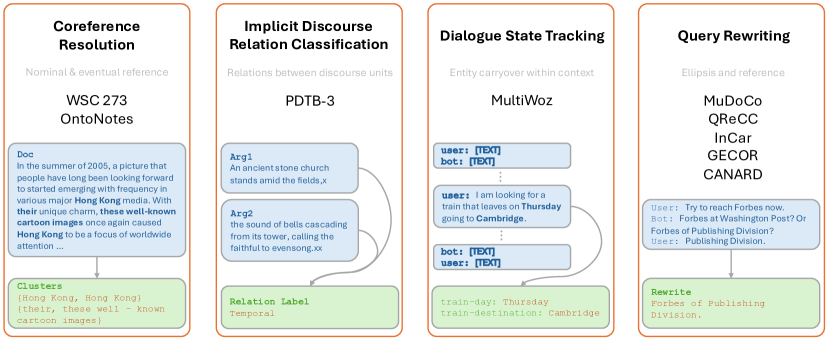
- Construct four context-focused tasks (coreference resolution, dialogue state tracking, implicit discourse relation classification, query rewriting) from nine datasets with prompts tailored for in-context learning.
- Evaluate dense pre-trained models across model families (OPT 125M–2.7B, LLaMA 7B–65B) and GPT-3.5-turbo under zero- to ten-shot settings.
- Compare post-training 3-bit quantized LLaMA models (GPTQ) against dense baselines on the same tasks.
- Use task-specific metrics (e.g., CoNLL F1 for coreference, joint goal accuracy for DST, accuracy for PDTB-3, BLEU/ROUGE for QR) to quantify performance.
- Include qualitative error analyses and a case study on Query Rewriting to understand error types and model behavior.
Experimental results
Research questions
- RQ1How well do LLMs understand contextual features across four context-centric tasks under in-context learning?
- RQ2How does model size and family (OPT, LLaMA, GPT-3.5) influence context understanding performance?
- RQ3What is the impact of 3-bit post-training quantization on context understanding across tasks?
- RQ4Do quantized models compensate for smaller sizes via scale, and where do they fail linguistically?
- RQ5What are the common error types in context-related tasks, and how do they differ between dense and quantized models?
Key findings
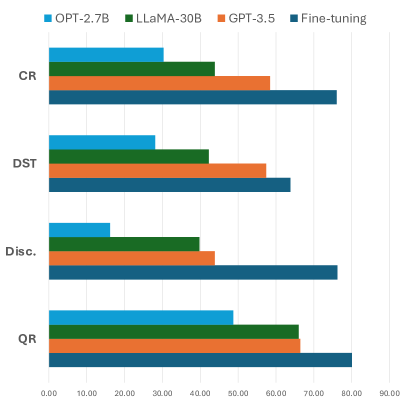
- In-context learning with pre-trained LLMs struggles to match fine-tuned models on most context tasks.
- Quantized 3-bit LLaMA (GPTQ) yields varying drops across tasks, with some gains in certain discourse tasks when scaled to 30B.
- A 30B quantized LLaMA model often outperforms the 7B dense counterpart across several tasks, indicating scale can outweigh quantization in contextual understanding.
- GPT-3.5 reaches fine-tuned model levels on dialogue state tracking but overall FT models remain superior on many tasks.
- Query rewriting shows larger models close the gap with fine-tuning, while smaller models show substantial failures, highlighting ICL limitations in generative tasks.
- Across tasks, quantization improves some generation metrics (BLEU/ROUGE) in QR datasets, but generally degrades core contextual understanding in others.
Read this paper
Open the full text in the Nubint reader and ask about any passage as you read.
Read this paper on NubintThis review was generated by AI from the original paper. Please check the paper before citing it.