
[Paper Review] Can We Read Speech Beyond the Lips? Rethinking RoI Selection for Deep Visual Speech Recognition
This paper challenges the conventional focus on lip regions in visual speech recognition (VSR) by demonstrating that extraoral facial regions—such as the cheeks and upper face—significantly improve recognition performance. Using a simple Cutout augmentation on aligned face inputs, the method forces models to learn discriminative features from non-lip regions, achieving state-of-the-art results across word- and sentence-level benchmarks, with gains up to 6.5% over lip-only baselines.
Recent advances in deep learning have heightened interest among researchers in the field of visual speech recognition (VSR). Currently, most existing methods equate VSR with automatic lip reading, which attempts to recognise speech by analysing lip motion. However, human experience and psychological studies suggest that we do not always fix our gaze at each other's lips during a face-to-face conversation, but rather scan the whole face repetitively. This inspires us to revisit a fundamental yet somehow overlooked problem: can VSR models benefit from reading extraoral facial regions, i.e. beyond the lips? In this paper, we perform a comprehensive study to evaluate the effects of different facial regions with state-of-the-art VSR models, including the mouth, the whole face, the upper face, and even the cheeks. Experiments are conducted on both word-level and sentence-level benchmarks with different characteristics. We find that despite the complex variations of the data, incorporating information from extraoral facial regions, even the upper face, consistently benefits VSR performance. Furthermore, we introduce a simple yet effective method based on Cutout to learn more discriminative features for face-based VSR, hoping to maximise the utility of information encoded in different facial regions. Our experiments show obvious improvements over existing state-of-the-art methods that use only the lip region as inputs, a result we believe would probably provide the VSR community with some new and exciting insights.
Motivation & Objective
- To investigate whether visual speech recognition (VSR) models can benefit from facial regions beyond the lips, challenging the long-standing assumption that only lip motion is informative.
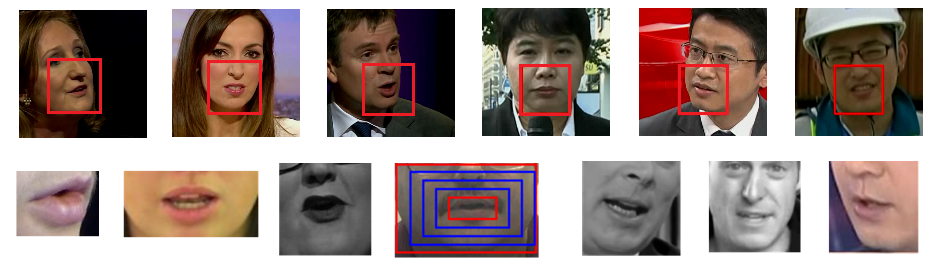
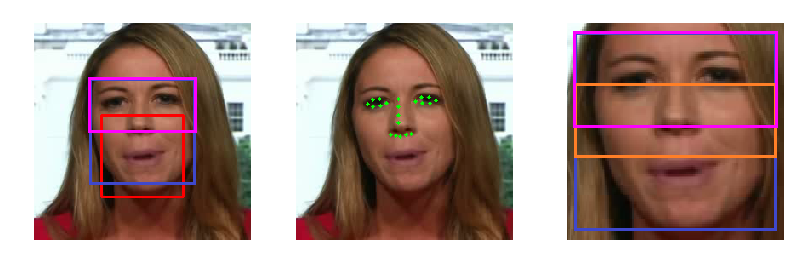
- To evaluate the contribution of different facial regions—mouth, whole face, upper face, cheeks—on VSR performance across diverse datasets and tasks.
- To develop a simple yet effective data augmentation method that encourages models to learn robust, discriminative features from extraoral facial regions.
- To reduce reliance on explicit lip-region cropping and promote a more holistic, face-based approach to VSR that better aligns with human visual scanning behavior.
Proposed method
- The authors use Cutout—a data augmentation technique that randomly masks out rectangular regions in input frames—to encourage models to attend to non-lip facial regions during training.
- Face inputs are aligned using facial landmarks to ensure spatial consistency, and RoIs are defined as the whole face, mouth, upper face, or cheeks to compare performance across regions.
- A ResNet-34 backbone is used with temporal modeling via bidirectional GRUs, and the model is trained end-to-end on word-level (LRW) and sentence-level (GRID, LRW-1000) benchmarks.
- Saliency maps and spatiotemporal masking are used to interpret model attention and identify critical facial regions for prediction.
- The method is compared against attention-based RoI selection (e.g., CBAM) to assess whether implicit attention mechanisms can achieve similar gains.
- Performance is evaluated under varying pose conditions (yaw rotation) to test robustness to head pose variation.
Experimental results
Research questions
- RQ1Can visual speech recognition models benefit from facial regions beyond the lips, such as the cheeks or upper face?
- RQ2Does data augmentation with Cutout improve model generalization by forcing attention to extraoral facial cues?
- RQ3How do different facial regions contribute to recognition performance across word-level and sentence-level VSR tasks?
- RQ4Can a simple augmentation like Cutout outperform more complex attention mechanisms in learning non-lip visual speech features?
- RQ5How robust is the proposed method to head pose variations in real-world settings?
Key findings
- The Cutout-augmented model achieves 45.24% accuracy on the LRW-1000 dataset, a 6.5% improvement over the baseline mouth-only model (38.64%).
- Even when only a 7×7 patch is occluded, the Cutout model degrades by less than 2%, while the plain model drops by up to 40%, proving robustness to occlusion in extraoral regions.
- Saliency maps show that the Cutout model learns to attend to cheeks, eyebrows, and upper face, not just the lips, indicating effective feature learning from non-lip regions.
- The model trained with Cutout maintains strong performance across pose variations, improving by ~2% on easy and medium pose subsets (yaw ≥ 20° and ≥ 40°) compared to the baseline.
- Spa-tiotemporal masking confirms that extraoral regions like the cheeks and upper face contribute significantly to predictions, with performance drops of over 10% when these areas are occluded.
- The Cutout-augmented model outperforms CBAM-augmented models, suggesting that explicit attention mechanisms fail to capture subtle extraoral cues as effectively as simple data augmentation.
Read this paper
Open the full text in the Nubint reader and ask about any passage as you read.
Read this paper on NubintThis review was generated by AI from the original paper. Please check the paper before citing it.