
[Paper Review] Can We Use Large Language Models to Fill Relevance Judgment Holes?
This paper investigates using Large Language Models (LLMs) to fill relevance judgment holes in test collections for conversational search, finding that LLM-generated labels can distort model rankings unless applied consistently across the entire document pool. While LLMs like ChatGPT show high correlation with human judgments in isolation, combining them with human-labeled data leads to significant ranking discrepancies—especially when holes are large—making whole-pool labeling essential for reliable evaluation.
Incomplete relevance judgments limit the re-usability of test collections. When new systems are compared against previous systems used to build the pool of judged documents, they often do so at a disadvantage due to the ``holes'' in test collection (i.e., pockets of un-assessed documents returned by the new system). In this paper, we take initial steps towards extending existing test collections by employing Large Language Models (LLM) to fill the holes by leveraging and grounding the method using existing human judgments. We explore this problem in the context of Conversational Search using TREC iKAT, where information needs are highly dynamic and the responses (and, the results retrieved) are much more varied (leaving bigger holes). While previous work has shown that automatic judgments from LLMs result in highly correlated rankings, we find substantially lower correlates when human plus automatic judgments are used (regardless of LLM, one/two/few shot, or fine-tuned). We further find that, depending on the LLM employed, new runs will be highly favored (or penalized), and this effect is magnified proportionally to the size of the holes. Instead, one should generate the LLM annotations on the whole document pool to achieve more consistent rankings with human-generated labels. Future work is required to prompt engineering and fine-tuning LLMs to reflect and represent the human annotations, in order to ground and align the models, such that they are more fit for purpose.
Motivation & Objective
- To address the challenge of incomplete relevance judgments (‘holes’) in test collections, which disadvantage new systems during evaluation.
- To investigate whether Large Language Models (LLMs) can reliably generate relevance judgments to fill these holes in conversational search.
- To assess the impact of LLM-generated judgments on model ranking performance when combined with human-labeled data.
- To evaluate whether prompt engineering or fine-tuning can align LLM outputs more closely with human relevance judgments.
- To determine the most effective strategy for integrating LLM judgments—hole-specific augmentation versus full-pool re-labeling—for consistent and fair evaluation.
Proposed method
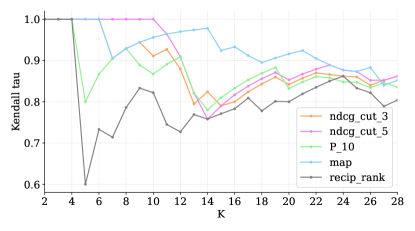
- Simulated new model evaluation by removing all relevance judgments of one model from the TREC iKAT 2023 test collection, creating varying levels of 'holes' in the pool.
- Used LLMs (ChatGPT and LLaMA) to generate relevance scores for unjudged passages using zero-shot, one-shot, and few-shot prompting templates.
- Applied a standardized prompt template with a fixed instruction, user persona, query, and document input to ensure consistency across LLMs.
- Computed performance differences by comparing the original human-based ranking of each model against its ranking when augmented with LLM-generated labels.
- Measured absolute ranking differences between original and LLM-augmented rankings to assess reliability and bias.
- Evaluated alignment between LLM-generated and human relevance scores using correlation metrics, focusing on label distribution and bias.
Experimental results
Research questions
- RQ1How do LLM-generated relevance judgments affect the relative ranking of new models when applied to incomplete test collections with 'holes'?
- RQ2Does the choice of LLM (e.g., ChatGPT vs. LLaMA) significantly alter the ranking outcome of new models with incomplete judgments?
- RQ3Is the performance of LLM-augmented evaluations more reliable when labeling only the missing passages (holes) or when re-labeling the entire document pool?
- RQ4How does the size of the 'hole' (i.e., proportion of unjudged documents) influence the reliability of LLM-generated judgments in model comparison?
- RQ5Can prompt engineering or fine-tuning improve the alignment of LLM judgments with human relevance assessments to reduce bias in evaluation?
Key findings
- LLM-generated relevance judgments show high correlation with human judgments when used in isolation, but this correlation drops significantly when combined with human-labeled data.
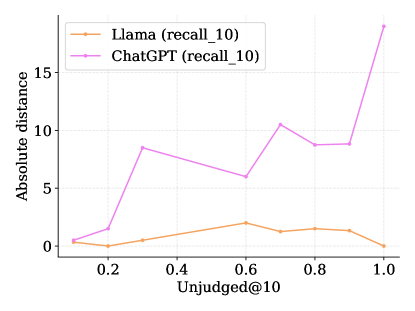
- ChatGPT tends to rate documents more favorably than humans, leading to a systematic bias that distorts model rankings—especially when the number of unjudged documents (holes) is large.
- The absolute ranking difference between human-based and LLM-augmented rankings increases with the size of the hole, indicating growing unreliability for new models with sparse judgments.
- LLaMA-based judgments show stronger alignment with human labels and maintain more consistent rankings across different hole sizes, suggesting lower bias compared to ChatGPT.
- Filling the entire document pool with LLM-generated labels—rather than just the holes—results in more consistent and reliable model rankings, minimizing bias amplification.
- The study concludes that whole-pool labeling is essential to ensure that labeling biases are uniformly applied, and that future work must focus on prompt engineering and fine-tuning to better align LLMs with human judgment standards.
Read this paper
Open the full text in the Nubint reader and ask about any passage as you read.
Read this paper on NubintThis review was generated by AI from the original paper. Please check the paper before citing it.