
[Paper Review] Casting a BAIT for Offline and Online Source-free Domain Adaptation
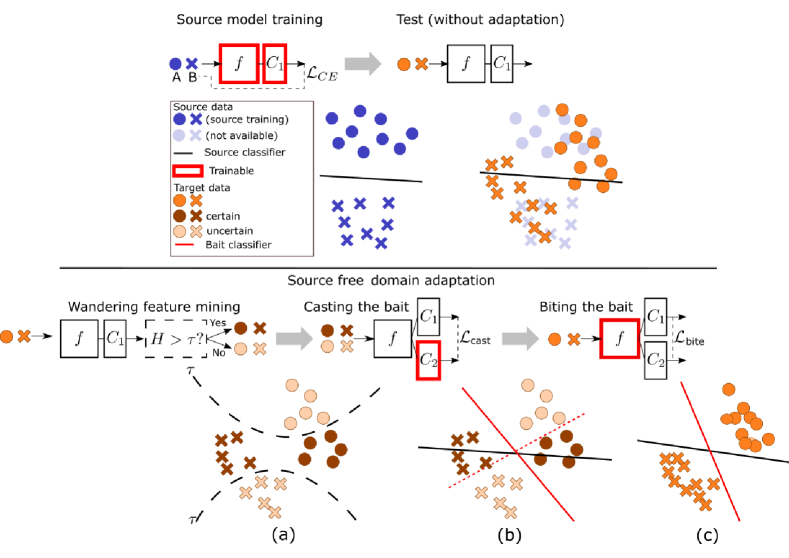
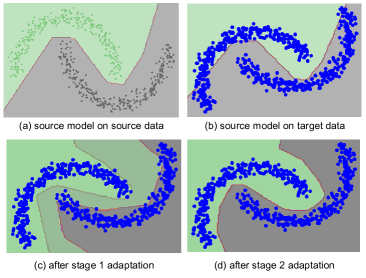
This paper proposes BAIT, a novel source-free domain adaptation method that uses a fixed source classifier as a decision boundary anchor and an auxiliary 'bait' classifier to identify and correct misclassified target features. By encouraging alignment between the bait and source classifiers, the feature extractor is updated to push uncertain target features toward the correct side of the source decision boundary, achieving state-of-the-art performance in online source-free domain adaptation without requiring access to source data.
We address the source-free domain adaptation (SFDA) problem, where only the source model is available during adaptation to the target domain. We consider two settings: the offline setting where all target data can be visited multiple times (epochs) to arrive at a prediction for each target sample, and the online setting where the target data needs to be directly classified upon arrival. Inspired by diverse classifier based domain adaptation methods, in this paper we introduce a second classifier, but with another classifier head fixed. When adapting to the target domain, the additional classifier initialized from source classifier is expected to find misclassified features. Next, when updating the feature extractor, those features will be pushed towards the right side of the source decision boundary, thus achieving source-free domain adaptation. Experimental results show that the proposed method achieves competitive results for offline SFDA on several benchmark datasets compared with existing DA and SFDA methods, and our method surpasses by a large margin other SFDA methods under online source-free domain adaptation setting.
Motivation & Objective
- To address the challenge of domain shift in source-free domain adaptation (SFDA), where source data is unavailable during adaptation.
- To develop a method effective in both offline and online SFDA settings, with a focus on the more realistic online scenario.
- To eliminate reliance on pseudo-labeling or data generation, which are sensitive to errors and computational cost.
- To enable direct, single-pass adaptation to streaming target data, suitable for real-time applications.
- To improve feature alignment with the source classifier without accessing source data or generating synthetic samples.
Proposed method
- Freeze the source classifier's head after pre-training, using its decision boundary as a fixed anchor for adaptation.
- Introduce an auxiliary 'bait' classifier initialized from the source classifier to detect misclassified target features.
- Train the bait classifier using a contrastive loss ($\mathcal{L}_{cast}$) to encourage it to predict differently on uncertain target samples.
- Update the feature extractor using a loss ($\mathcal{L}_{bite}$) that encourages target features to be classified correctly by both the bait and source classifiers.
- Apply entropy-based splitting to separate certain and uncertain samples within each mini-batch to guide the learning process.
- Use a class-balanced loss ($\mathcal{L}_b$) to stabilize training and improve generalization on imbalanced target data.
Experimental results
Research questions
- RQ1Can a fixed source classifier serve as a stable decision boundary anchor in source-free domain adaptation?
- RQ2Can an auxiliary 'bait' classifier effectively identify and correct misclassified target features without source data?
- RQ3Does the proposed method outperform existing SFDA methods, especially in the online (single-pass) adaptation setting?
- RQ4How sensitive is the method to hyperparameters such as the entropy threshold $\tau$?
- RQ5Can the method achieve competitive performance without relying on pseudo-labeling or data generation?
Key findings
- BAIT achieves competitive performance on benchmark datasets in the offline SFDA setting, matching or exceeding existing methods that use source data.
- In the online SFDA setting, BAIT significantly outperforms SHOT, a strong baseline, across all three Office-Home tasks.
- The ablation study confirms that both $\mathcal{L}_{cast}$ and $\mathcal{L}_{bite}$ are essential, with performance dropping to 45% and 8% respectively when removed.
- The method is robust to the choice of entropy threshold $\tau$, showing minimal performance degradation across 25%, 75%, and 100% uncertain set selections.
- t-SNE visualization confirms that BAIT produces more compact and discriminative target feature clusters aligned with source class prototypes.
- BAIT achieves superior results in online adaptation, where models must classify data in a single pass, demonstrating its practicality for real-time systems.
Read this paper
Open the full text in the Nubint reader and ask about any passage as you read.
Read this paper on NubintThis review was generated by AI from the original paper. Please check the paper before citing it.