
[Paper Review] CAT-Walk: Inductive Hypergraph Learning via Set Walks
CAt-Walk is an inductive hypergraph representation learning method that uses SetWalk, a temporal, higher-order random walk on hyperedges, to capture dynamic, causal patterns in temporal hypergraphs. It employs a permutation-invariant SetMixer pooling and set-based anonymization to enable robust, identity-agnostic learning, achieving state-of-the-art performance on hyperedge prediction across 10 benchmark datasets with a 96.74% ± 1.28 AUC in the inductive setting.
Temporal hypergraphs provide a powerful paradigm for modeling time-dependent, higher-order interactions in complex systems. Representation learning for hypergraphs is essential for extracting patterns of the higher-order interactions that are critically important in real-world problems in social network analysis, neuroscience, finance, etc. However, existing methods are typically designed only for specific tasks or static hypergraphs. We present CAT-Walk, an inductive method that learns the underlying dynamic laws that govern the temporal and structural processes underlying a temporal hypergraph. CAT-Walk introduces a temporal, higher-order walk on hypergraphs, SetWalk, that extracts higher-order causal patterns. CAT-Walk uses a novel adaptive and permutation invariant pooling strategy, SetMixer, along with a set-based anonymization process that hides the identity of hyperedges. Finally, we present a simple yet effective neural network model to encode hyperedges. Our evaluation on 10 hypergraph benchmark datasets shows that CAT-Walk attains outstanding performance on temporal hyperedge prediction benchmarks in both inductive and transductive settings. It also shows competitive performance with state-of-the-art methods for node classification. (https://github.com/ubc-systopia/CATWalk)
Motivation & Objective
- To address the limitations of existing hypergraph representation learning methods that are static, transductive, or task-specific.
- To develop an inductive method capable of learning dynamic, higher-order interactions in temporal hypergraphs.
- To enable robust representation learning that is invariant to hyperedge and node identities through anonymization.
- To improve performance on hyperedge prediction and node classification by capturing temporal and structural causality.
- To design a scalable, general-purpose framework that generalizes across downstream tasks.
Proposed method
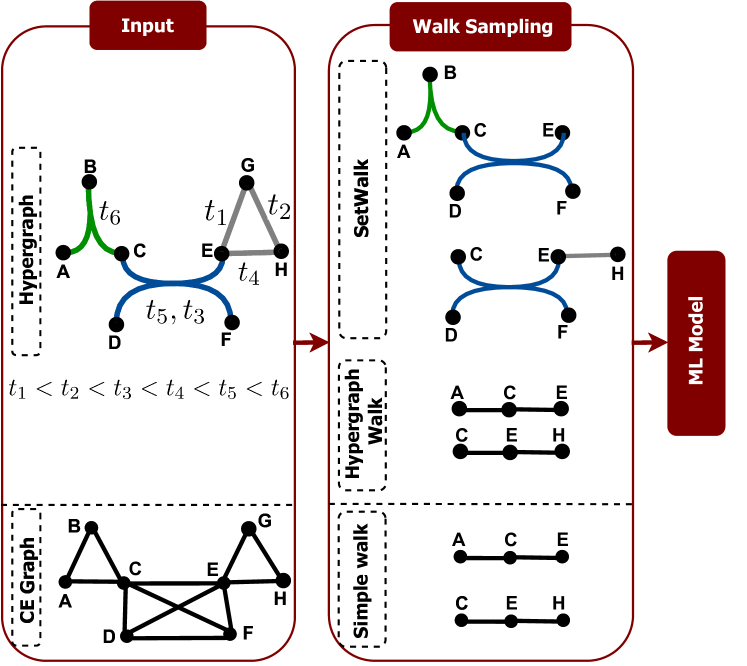
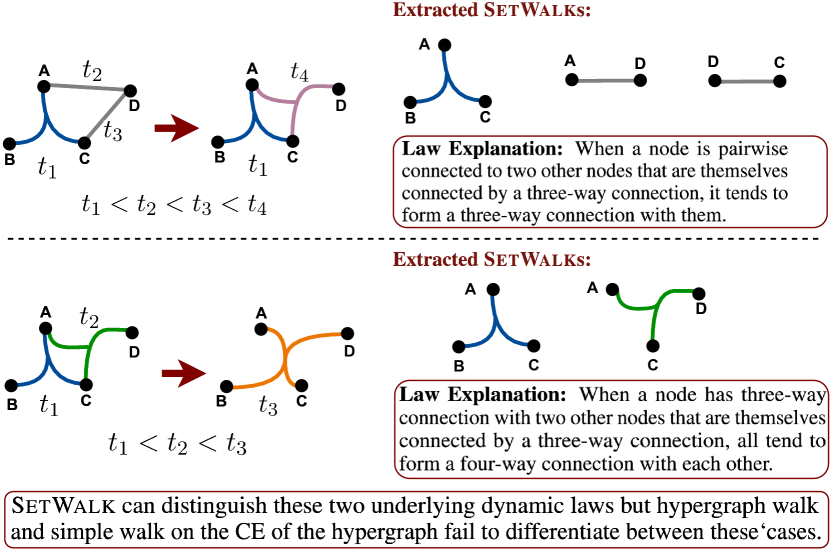
- Introduces SetWalk, a hyperedge-centric random walk that preserves higher-order semantics by traversing entire hyperedges rather than decomposing them into cliques.
- Employs a two-step set-based anonymization: first, assigns positional encodings to nodes based on their frequency in sampled walks; second, uses SetMixer to pool node encodings into hyperedge representations in a permutation-invariant manner.
- Uses a time-encoding module combined with an MLP-Mixer to encode irregularly spaced temporal walks, avoiding the limitations of sequential encoders like RNNs.
- Applies a novel neural encoding model that samples SetWalks from nodes and uses the resulting walks to train a graph neural network for downstream tasks.
- Leverages a permutation-invariant pooling strategy (SetMixer) to ensure the model is invariant to node order within hyperedges.
- Designs a framework that is both inductive and generalizable, enabling zero-shot prediction on unseen hyperedges and nodes.
Experimental results
Research questions
- RQ1Can a hyperedge-centric random walk effectively capture temporal and higher-order causal patterns in dynamic hypergraphs?
- RQ2How can representation learning be made invariant to hyperedge and node identities while preserving structural and temporal semantics?
- RQ3Can a non-sequential, continuous-time encoding method outperform traditional RNN-based sequential encoders on irregularly sampled temporal walks?
- RQ4Does the proposed method generalize across multiple downstream tasks, including hyperedge prediction and node classification, in both inductive and transductive settings?
- RQ5To what extent does SetWalk improve performance over clique-expansion-based walks and existing hypergraph GNNs?
Key findings
- CAt-Walk achieves a 96.74% ± 1.28 AUC on hyperedge prediction in the inductive setting, significantly outperforming all baselines across 10 benchmark datasets.
- In the transductive setting, CAt-Walk attains a 97.06% ± 3.72 AUC, demonstrating strong generalization and robustness.
- The model outperforms state-of-the-art methods such as CHESHIRE, CE-CAW, and HyperSAGCN on both AUC and Average Precision metrics.
- Replacing the MLP-Mixer with an RNN leads to consistent performance degradation, especially on datasets with high timestamp variance, confirming the superiority of continuous-time encoding.
- SetMixer’s permutation-invariant pooling enables effective and stable hyperedge representation learning, even when node order varies.
- The method shows competitive performance on node classification, indicating its generalizability beyond hyperedge prediction.
Read this paper
Open the full text in the Nubint reader and ask about any passage as you read.
Read this paper on NubintThis review was generated by AI from the original paper. Please check the paper before citing it.