
[Paper Review] Category-Level Multi-Part Multi-Joint 3D Shape Assembly
This paper proposes a hierarchical graph learning framework for category-level multi-part multi-joint 3D shape assembly that jointly optimizes shape structure and joint alignment. By using a two-level graph network—part-level for structural reasoning and joint-level for matching—combined with iterative coarse-to-fine refinement, the method achieves state-of-the-art performance in both shape structure fidelity and joint alignment accuracy, outperforming prior approaches on benchmark metrics including 72.81% part accuracy and 57.18% joint accuracy.
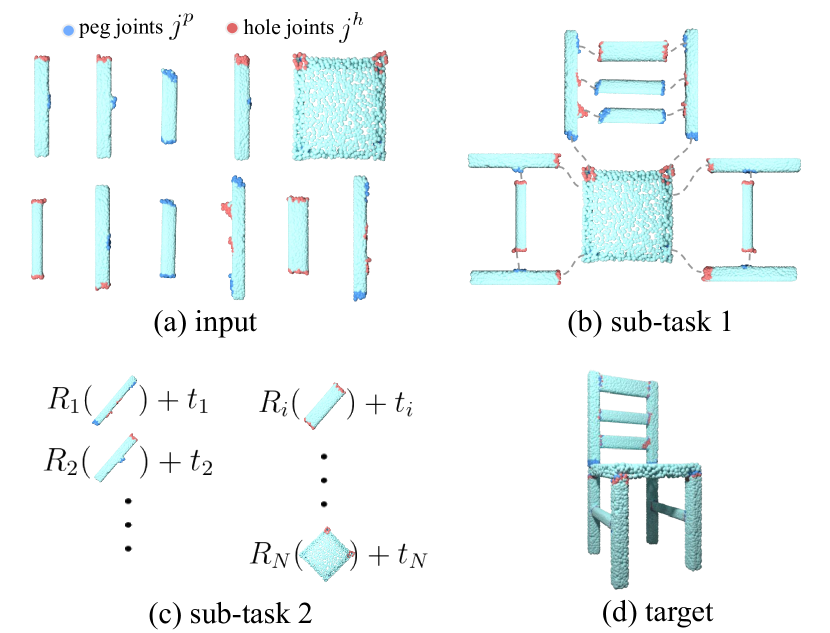
Shape assembly composes complex shapes geometries by arranging simple part geometries and has wide applications in autonomous robotic assembly and CAD modeling. Existing works focus on geometry reasoning and neglect the actual physical assembly process of matching and fitting joints, which are the contact surfaces connecting different parts. In this paper, we consider contacting joints for the task of multi-part assembly. A successful joint-optimized assembly needs to satisfy the bilateral objectives of shape structure and joint alignment. We propose a hierarchical graph learning approach composed of two levels of graph representation learning. The part graph takes part geometries as input to build the desired shape structure. The joint-level graph uses part joints information and focuses on matching and aligning joints. The two kinds of information are combined to achieve the bilateral objectives. Extensive experiments demonstrate that our method outperforms previous methods, achieving better shape structure and higher joint alignment accuracy.
Motivation & Objective
- To address the limitations of existing shape assembly methods that neglect physical joint matching and suffer from pose errors due to symmetry.
- To model the multi-part, multi-joint 3D assembly task as a joint optimization problem balancing shape structure and joint alignment.
- To develop a novel, end-to-end graph-based framework that decouples and coordinates discrete joint matching and continuous pose optimization.
- To mitigate error compounding in iterative assembly by using a coarse-to-fine, multi-iteration graph learning scheme.
- To establish a new benchmark with a joint-annotated dataset and evaluation metrics for category-level multi-part 3D shape assembly.
Proposed method
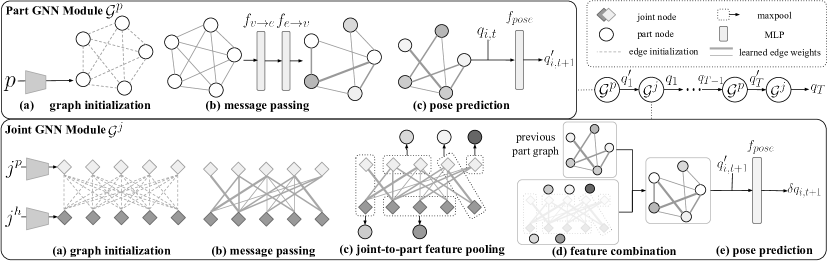
- The method employs a hierarchical graph network with two distinct graph levels: a part graph for holistic shape structure learning and a joint-level graph for matching and aligning peg-hole joints.
- Joint features are embedded and aggregated per part to form joint-centric part features, which are then fused with part graph features to guide pose prediction.
- A coarse-to-fine iterative refinement process alternates between part graph and joint graph convolutions to progressively correct pose predictions and improve joint matching.
- The framework uses a Hungarian matching algorithm in the loss function to maintain permutation invariance and synchronize geometric and joint alignment objectives.
- Joint embedding is explicitly learned to provide a strong, explicit signal for pose editing, improving alignment accuracy.
- The model is trained end-to-end with a multi-objective loss combining shape Chamfer distance, part accuracy, and joint Chamfer distance.
Experimental results
Research questions
- RQ1Can a joint-optimized 3D shape assembly method simultaneously achieve high structural fidelity and accurate joint alignment in multi-part, multi-joint settings?
- RQ2How does hierarchical graph learning with separate part and joint representations improve performance compared to unified geometry-only approaches?
- RQ3To what extent does a coarse-to-fine iterative refinement scheme reduce error compounding in multi-part assembly?
- RQ4What is the contribution of joint embedding and matching-aware loss to joint alignment accuracy?
- RQ5How does the shape structure heuristic from the first part graph iteration affect joint matching performance?
Key findings
- The proposed method achieves 72.81% part accuracy and 57.18% joint accuracy on the Chair category, significantly outperforming prior methods.
- Ablation studies show that removing the first part graph iteration reduces performance to 23.71% part accuracy, confirming its role as a shape structure heuristic.
- Eliminating joint embedding leads to a drop in part accuracy to 33.36% and a 21.4% decrease in joint accuracy, demonstrating its importance for pose refinement.
- Removing the Hungarian matching algorithm in the loss function causes a sharp decline in performance, with joint accuracy dropping to 37.50%, due to loss objective misalignment.
- The coarse-to-fine iterative scheme effectively reduces error propagation, with intermediate stages showing progressive improvement in both structure and joint alignment.
- The full model achieves a Shape Chamfer Distance (SCD) of 0.006 and a Joint Chamfer Distance (JCD) of 0.352, indicating high structural and joint fidelity.
Read this paper
Open the full text in the Nubint reader and ask about any passage as you read.
Read this paper on NubintThis review was generated by AI from the original paper. Please check the paper before citing it.