
[Paper Review] Cattle Identification Using Muzzle Images and Deep Learning Techniques
This study proposes a deep learning-based cattle identification system using muzzle images and image compression to enable accurate, low-cost biometric identification in resource-constrained settings. Using wide ResNet50 with 25% image quality retention, the method achieves 99.5% accuracy, demonstrating that high performance is possible even with compressed, low-quality images suitable for smallholder and nomadic farming contexts in Africa.
Traditional animal identification methods such as ear-tagging, ear notching, and branding have been effective but pose risks to the animal and have scalability issues. Electrical methods offer better tracking and monitoring but require specialized equipment and are susceptible to attacks. Biometric identification using time-immutable dermatoglyphic features such as muzzle prints and iris patterns is a promising solution. This project explores cattle identification using 4923 muzzle images collected from 268 beef cattle. Two deep learning classification models are implemented - wide ResNet50 and VGG16\_BN and image compression is done to lower the image quality and adapt the models to work for the African context. From the experiments run, a maximum accuracy of 99.5\% is achieved while using the wide ResNet50 model with a compression retaining 25\% of the original image. From the study, it is noted that the time required by the models to train and converge as well as recognition time are dependent on the machine used to run the model.
Motivation & Objective
- To develop a non-invasive, scalable cattle identification system that overcomes limitations of traditional and electrical tagging methods.
- To evaluate the performance of deep learning models on low-quality muzzle images to reduce hardware and operational costs in field applications.
- To assess the impact of image compression on model accuracy and training efficiency for deployment in low-resource African farming environments.
- To address scalability challenges in biometric cattle identification by proposing a scale-out ensemble model approach.
- To enable practical deployment through a system that functions effectively with minimal equipment and infrastructure.
Proposed method
- The study uses 4,923 muzzle images from 268 beef cattle collected in a real-world African farming context.
- Two deep learning models—wide ResNet50 and VGG16_BN—are trained for image classification to identify individual cattle.
- Image compression via JPEG is applied to reduce image quality to 100%, 50%, and 25% of original size to simulate low-bandwidth and low-cost imaging conditions.
- Model training is conducted on Google Colab and Colab Pro platforms, with training time, convergence speed, and inference time monitored across compression levels.
- Early stopping is used to prevent overfitting, and model performance is evaluated based on accuracy, number of epochs, and total training time.
- A scale-out ensemble model strategy is proposed to address scalability by retraining only on new cattle classes instead of retraining the entire model.
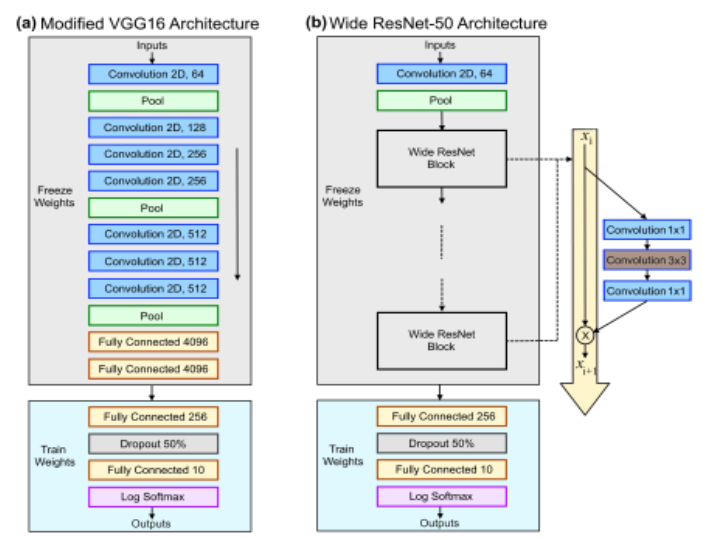
Experimental results
Research questions
- RQ1Can deep learning models achieve high accuracy in cattle identification using compressed, low-quality muzzle images suitable for low-cost field deployment?
- RQ2How does image compression affect the training time, convergence speed, and recognition accuracy of deep learning models in cattle identification?
- RQ3What is the trade-off between image quality and model performance in real-world agricultural settings with limited imaging infrastructure?
- RQ4How can scalability be improved in biometric cattle identification systems when adding new animals to the database?
- RQ5Can a scale-out ensemble model approach reduce the computational burden of retraining the entire model when new cattle are introduced?
Key findings
- The wide ResNet50 model achieved the highest accuracy of 99.5% when using images compressed to 25% of their original quality.
- Despite significant image compression, the wide ResNet50 model maintained high performance, with accuracy only slightly reduced compared to full-quality images (99.2% at 100% quality).
- Image compression reduced the time per epoch for both models, with VGG16_BN achieving faster training on Colab Pro due to higher computational power.
- The total training time remained relatively stable across compression levels, though higher compression levels slightly increased training duration.
- The VGG16_BN model achieved a maximum accuracy of 98.04% at 25% image quality, which is still high but lower than the 99.5% achieved by wide ResNet50 under the same conditions.
- The study confirms that high accuracy is achievable even with low-quality images, making the system viable for deployment in low-resource farming environments without requiring high-end cameras.
Better researchstarts right now
From reading papers to final review, dramatically reduce your research time.
No credit card · Free plan available
This review was created by AI and reviewed by human editors.