
[Paper Review] Causal clustering: design of cluster experiments under network interference
This paper introduces Causal Clustering, a framework to design cluster experiments under network interference by minimizing worst-case mean-squared error through a penalized min-cut optimization. It provides a data-driven method to choose optimal clusters and the number of clusters, balancing bias and variance, with solutions computable via semi-definite programming and applicable to real-world network data from platforms like Facebook.
This paper studies the design of cluster experiments to estimate the global treatment effect in the presence of network spillovers. We provide a framework to choose the clustering that minimizes the worst-case mean-squared error of the estimated global effect. We show that optimal clustering solves a novel penalized min-cut optimization problem computed via off-the-shelf semi-definite programming algorithms. Our analysis also characterizes simple conditions to choose between any two cluster designs, including choosing between a cluster or individual-level randomization. We illustrate the method's properties using unique network data from the universe of Facebook's users and existing data from a field experiment.
Motivation & Objective
- To develop a principled framework for designing cluster experiments when network spillovers affect outcomes, especially when cluster structure is not a priori known.
- To minimize the worst-case mean-squared error (MSE) of global treatment effect estimators under uncertainty about spillover effects.
- To provide decision rules for choosing between cluster-level and individual-level (Bernoulli) randomization based on network structure and expected spillover magnitude.
- To guide practitioners in selecting optimal clustering configurations, including the number of clusters and cluster boundaries, using network data and prior knowledge of spillover effects.
- To extend experimental design theory to settings with local asymptotics where spillovers shrink slowly to zero, capturing realistic small but non-negligible interference.
Proposed method
- Formalizes worst-case bias and variance of cluster estimators under network interference, with bias depending on inter-cluster connectivity (number of friends in other clusters per individual).
- Shows that worst-case variance depends primarily on the average squared cluster size, up to asymptotically negligible terms, enabling simplification in optimization.
- Reframes optimal clustering as a penalized min-cut problem, where the penalty balances bias (from inter-cluster spillovers) and variance (from cluster size heterogeneity).
- Solves the optimization using off-the-shelf semi-definite programming algorithms, enabling scalable computation on large networks like Facebook’s.
- Introduces a tuning parameter ξₙ that captures the relative magnitude of spillover effects (ϕ̄ₙ) compared to outcome variability (ψ̄), allowing sensitivity analysis across plausible spillover ranges.
- Provides Algorithm 1 to compute optimal clusters and Algorithm 3 to guide practical choice of ξₙ using baseline covariates and residual variance estimates.
Experimental results
Research questions
- RQ1When should researchers prefer cluster-level randomization over individual-level (Bernoulli) randomization in the presence of network interference?
- RQ2How can one optimally partition a network into clusters to minimize the worst-case mean-squared error of the global treatment effect estimator?
- RQ3What is the trade-off between bias and variance in cluster designs, and how can it be quantitatively balanced using network structure?
- RQ4How can researchers choose the optimal number of clusters and cluster boundaries when spillover effects are uncertain but non-negligible?
- RQ5Can the framework be extended to estimate other estimands, such as spillover effects or direct effects, under saturation designs?
Key findings
- The optimal clustering solution is derived from a penalized min-cut problem that balances inter-cluster spillover (bias) and cluster size variance (variance), solvable via semi-definite programming.
- Worst-case bias is proportional to the average number of friends per individual in other clusters, formalizing the impact of network interference across cluster boundaries.
- Worst-case variance depends asymptotically only on the average squared cluster size, implying that variance is minimized with many, similarly sized clusters.
- A rule of thumb for choosing between cluster and Bernoulli designs is that cluster randomization is preferred when the minimum spillover effect × √Kₙ > 2.3, where Kₙ is the number of clusters.
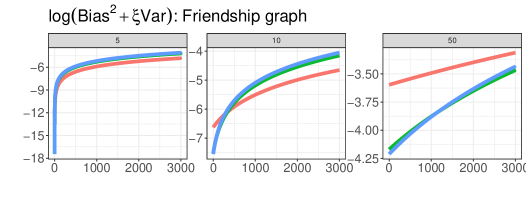
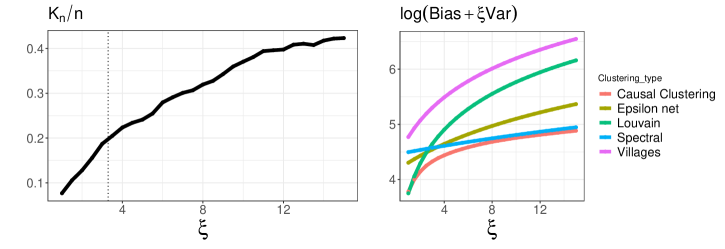
- Empirical validation on Facebook network data shows that certain clustering algorithms consistently outperform others across a wide range of plausible spillover effect magnitudes.
- The method supports practical design through a tuning parameter ξₙ, with guidance on estimating ψ̄ from residual variance and ϕ̄ₙ from prior experiments or conservative bounds.
Read this paper
Open the full text in the Nubint reader and ask about any passage as you read.
Read this paper on NubintThis review was generated by AI from the original paper. Please check the paper before citing it.