
[Paper Review] Causal Order: The Key to Leveraging Imperfect Experts in Causal Inference
This paper proposes that causal order—ranking variables by temporal causality—suffices for accurate causal effect inference, eliminating the need for full causal graphs. By using triplet-based prompting, large language models (LLMs) like GPT-3.5 and GPT-4 accurately infer causal order, which significantly improves performance when combined with constraint-based (PC) and score-based (CaMML) discovery algorithms, especially in low-sample regimes.
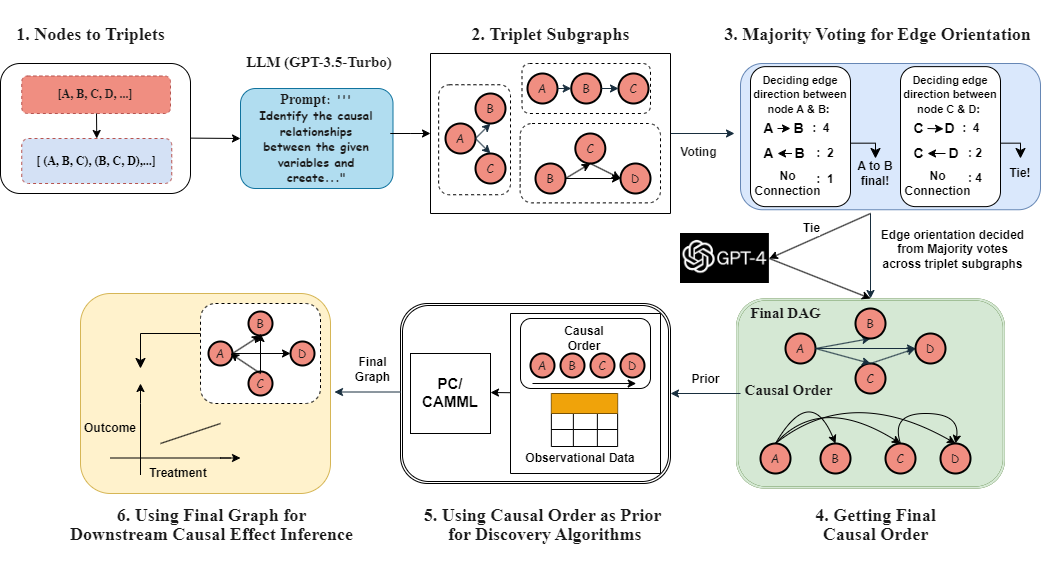
Large Language Models (LLMs) have been used as experts to infer causal graphs, often by repeatedly applying a pairwise prompt that asks about the causal relationship of each variable pair. However, such experts, including human domain experts, cannot distinguish between direct and indirect effects given a pairwise prompt. Therefore, instead of the graph, we propose that causal order be used as a more stable output interface for utilizing expert knowledge. Even when querying a perfect expert with a pairwise prompt, we show that the inferred graph can have significant errors whereas the causal order is always correct. In practice, however, LLMs are imperfect experts and we find that pairwise prompts lead to multiple cycles. Hence, we propose the triplet method, a novel querying strategy that introduces an auxiliary variable for every variable pair and instructs the LLM to avoid cycles within this triplet. It then uses a voting-based ensemble method that results in higher accuracy and fewer cycles while ensuring cost efficiency. Across multiple real-world graphs, such a triplet-based method yields a more accurate order than the pairwise prompt, using both LLMs and human annotators. The triplet method enhances robustness by repeatedly querying an expert with different auxiliary variables, enabling smaller models like Phi-3 and Llama-3 8B Instruct to surpass GPT-4 with pairwise prompting. For practical usage, we show how the expert-provided causal order from the triplet method can be used to reduce error in downstream graph discovery and effect inference tasks.
Motivation & Objective
- To demonstrate that causal order, not full causal graphs, is sufficient for reliable causal effect estimation using the backdoor criterion.
- To address the challenge of expert elicitation in causal inference by showing that causal order is easier for experts to provide than full graph edges.
- To develop and evaluate a novel triplet-based prompting strategy that enables LLMs to infer accurate causal order.
- To integrate LLM-generated causal order with established causal discovery algorithms to improve their accuracy and robustness.
- To evaluate the impact of LLM-augmented methods on causal order accuracy across diverse datasets and sample sizes.
Proposed method
- Proposes that causal order alone is sufficient for valid backdoor adjustment, based on theoretical proof of the backdoor criterion's dependence on topological ordering.
- Introduces a triplet-based prompting strategy where LLMs are queried about three variables at a time to infer their causal order, reducing cycle errors compared to pairwise prompting.
- Aggregates LLM outputs using majority voting across all three-variable subgraphs to produce a global causal order.
- Uses a second LLM (e.g., GPT-4) to resolve ties in the inferred causal order.
- Augments constraint-based algorithms (e.g., PC) by using LLM-generated order to orient undirected edges.
- Enhances score-based algorithms (e.g., CaMML) by incorporating LLM-derived order as a prior in the search space.
Experimental results
Research questions
- RQ1Can causal order alone replace the full causal graph for accurate causal effect inference?
- RQ2Is causal order easier for domain experts and LLMs to provide than full graph edges?
- RQ3Does triplet-based prompting outperform pairwise prompting in eliciting accurate causal order from LLMs?
- RQ4Can LLM-generated causal order improve the accuracy of existing causal discovery algorithms like PC and CaMML?
- RQ5How does the performance gain from LLM-augmented discovery vary across different sample sizes and datasets?
Key findings
- Causal order alone is sufficient for valid backdoor adjustment, as proven theoretically and validated empirically.
- LLM-generated causal order via triplet prompting outperforms pairwise prompting, with significantly fewer cycle errors in predictions.
- The PC+LLM and CaMML+LLM methods reduce the topological distance ($D_{ ext{top}}$) compared to base algorithms, especially at low sample sizes (e.g., 250–500 samples).
- At $N=500$, the $D_{ ext{top}}$ of PC is nearly double that of PC+LLM across most datasets, indicating substantial improvement from LLM integration.
- CaMML+LLM reduces $D_{ ext{top}}$ by up to threefold for the Child dataset and fivefold for the Asia dataset at $N=10000$, showing gains even at high sample sizes.
- For the Neuropathic dataset, CaMML+LLM improves $D_{ ext{top}}$ at $N=5000$ and $N=10000$, despite a slight degradation at smaller samples, indicating long-term benefit.
Read this paper
Open the full text in the Nubint reader and ask about any passage as you read.
Read this paper on NubintThis review was generated by AI from the original paper. Please check the paper before citing it.