
[Paper Review] Causal Structure Learning Supervised by Large Language Model
This paper proposes ILS-CSL, an iterative framework that refines causal structure learning (CSL) by using Large Language Models (LLMs) to validate and correct edges in data-driven DAGs. By iteratively applying LLM-inferred structural constraints—focusing on edge-level accuracy—ILS-CSL achieves superior performance over prior methods, especially on larger datasets, with significant SHD reductions and high-quality constraint alignment.
Causal discovery from observational data is pivotal for deciphering complex relationships. Causal Structure Learning (CSL), which focuses on deriving causal Directed Acyclic Graphs (DAGs) from data, faces challenges due to vast DAG spaces and data sparsity. The integration of Large Language Models (LLMs), recognized for their causal reasoning capabilities, offers a promising direction to enhance CSL by infusing it with knowledge-based causal inferences. However, existing approaches utilizing LLMs for CSL have encountered issues, including unreliable constraints from imperfect LLM inferences and the computational intensity of full pairwise variable analyses. In response, we introduce the Iterative LLM Supervised CSL (ILS-CSL) framework. ILS-CSL innovatively integrates LLM-based causal inference with CSL in an iterative process, refining the causal DAG using feedback from LLMs. This method not only utilizes LLM resources more efficiently but also generates more robust and high-quality structural constraints compared to previous methodologies. Our comprehensive evaluation across eight real-world datasets demonstrates ILS-CSL's superior performance, setting a new standard in CSL efficacy and showcasing its potential to significantly advance the field of causal discovery. The codes are available at \url{https://github.com/tyMadara/ILS-CSL}.
Motivation & Objective
- To address the limitations of existing LLM-augmented causal structure learning, which suffer from unreliable constraints and high computational costs.
- To improve the quality and robustness of causal DAGs learned from observational data by integrating LLM feedback in a targeted, iterative manner.
- To reduce the reliance on expert-provided constraints by leveraging LLMs as a scalable, knowledge-based source of causal inference.
- To minimize error propagation from LLM inferences by validating only edges suggested by data-driven learning, rather than applying global constraints.
- To demonstrate consistent performance gains across diverse real-world datasets, particularly as the number of variables increases.
Proposed method
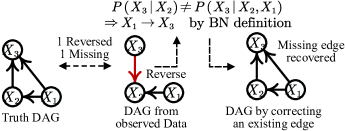
- ILS-CSL iteratively refines a causal DAG learned from data by querying an LLM to validate the direction and existence of each edge in the current structure.
- At each iteration, LLMs provide edge-level constraints—indicating whether an edge should exist or be reversed—based on causal reasoning over variable pairs.
- The framework applies these LLM-derived constraints as hard or soft priors to retrain the CSL algorithm (e.g., HC with BDeu or BIC), improving the DAG structure.
- The process continues until convergence or a maximum iteration count, with feedback used to correct erroneous edges and refine the causal graph.
- A hard constraint strategy is used to enforce LLM inferences strictly, while a voting mechanism helps reduce noise from inconsistent LLM outputs.
- The method avoids full pairwise analysis by focusing only on edges present in the current data-learned DAG, significantly reducing LLM inference cost.
Experimental results
Research questions
- RQ1Can LLM-inferred causal knowledge be effectively and efficiently integrated into causal structure learning to improve DAG quality?
- RQ2Does iterative refinement using LLM feedback lead to better causal structure recovery than single-pass constraint application?
- RQ3How does the performance of LLM-supervised CSL scale with increasing numbers of variables and data sparsity?
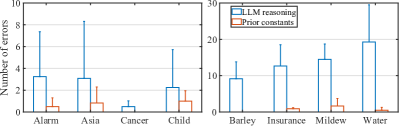
- RQ4To what extent do LLM errors degrade or improve the final causal structure, and can the framework mitigate such risks?
- RQ5Can the integration of LLM constraints lead to improvements in structural accuracy beyond the constraints themselves, suggesting discovery of unknown causal mechanisms?
Key findings
- ILS-CSL significantly reduces Structural Hamming Distance (SHD), achieving a 75% average SHD reduction on the Cancer dataset and a 50% reduction on the Barley dataset compared to baseline CSL.
- The first iteration of LLM supervision yields the most substantial improvement, reducing SHD by up to 80% in some cases, indicating high initial impact.
- On the Barley dataset (48 variables), ILS-CSL achieved an SHD of 33.7 with data alone, but reduced it to 54.5 with GPT-4 constraints—indicating degradation in prior work, while ILS-CSL achieved 52.0, showing robustness.
- In the Child dataset (20 variables, 2000 samples), ILS-CSL reduced SHD from 12 to 3 in two iterations, demonstrating strong convergence and accuracy gains.
- The framework successfully corrected 5 edges directly via constraints and an additional 3 edges not covered by constraints, indicating indirect discovery of causal mechanisms.
- Only 2 out of 9 total LLM constraints were erroneous (blue arrows), and the framework mitigated their impact, showing resilience to LLM noise.
Read this paper
Open the full text in the Nubint reader and ask about any passage as you read.
Read this paper on NubintThis review was generated by AI from the original paper. Please check the paper before citing it.