
[Paper Review] CBDC-AquaSphere: Interoperable Central Bank Digital Currency Built on Trusted Computing and Blockchain
This paper proposes CBDC-AquaSphere, a novel interoperable Central Bank Digital Currency protocol that combines trusted execution environments (TEE) and blockchain technology to enable secure, atomic cross-institutional transfers between semi-centralized CBDC instances. By adapting the atomic swap protocol within a TEE-secured framework, it ensures privacy, censorship resistance, and verifiability across multiple CBDCs—whether national central banks or retail banks—without creating new tokens.
The adoption of decentralized, tamper-proof ledger systems is paving the way for new applications and opportunities in different contexts. While most research aims to improve their scalability, privacy, and governance issues, interoperability has received less attention. Executing transactions across various blockchains is notably instrumental in unlocking the potential of novel applications, particularly in the financial sector, where their potential would otherwise be significantly diminished. Therefore, interoperable ledgers are crucial to ensure the expansion and further adoption of such a technology in various contexts. In this paper, we present a protocol that uses a combination of trusted execution environment (TEE) and blockchains to enable interoperability over independent semi-centralized CBDC ledgers, guaranteeing the atomicity of inter-bank transfers. Our interoperability protocol uses a custom adaptation of atomic swap protocol and is executed by any pair of CBDC instances to realize a one-way transfer. It ensures features such as atomicity, verifiability, correctness, censorship resistance, and privacy while offering high scalability in terms of the number of CBDC instances. Our approach enables to possible deployment scenarios that can be combined: (1) CBDC instances represent central banks of multiple countries, and (2) CBDC instances represent the set of retail banks and a paramount central bank of a single country. We provide a detailed description of our protocol as well as an extensive analysis of its benefits, features, and security. In this WIP paper, we made a proof-of-concept implementation and made a partial evaluation, while the more extensive evaluation will be made in our future work.
Motivation & Objective
- Address the critical gap in interoperability among semi-centralized CBDC systems, which limits cross-border and inter-institutional financial operations.
- Overcome privacy and trust challenges in centralized CBDC environments by integrating trusted execution environments (TEE) to enforce verifiable, secure transaction execution.
- Ensure atomicity and censorship resistance in inter-bank transfers without relying on centralized intermediaries or creating new monetary supply.
- Enable practical deployment scenarios involving both national central banks and national retail banking networks within a single, unified protocol.
- Provide indisputable proofs of censorship and verifiable transaction integrity to enhance auditability and regulatory compliance.
Proposed method
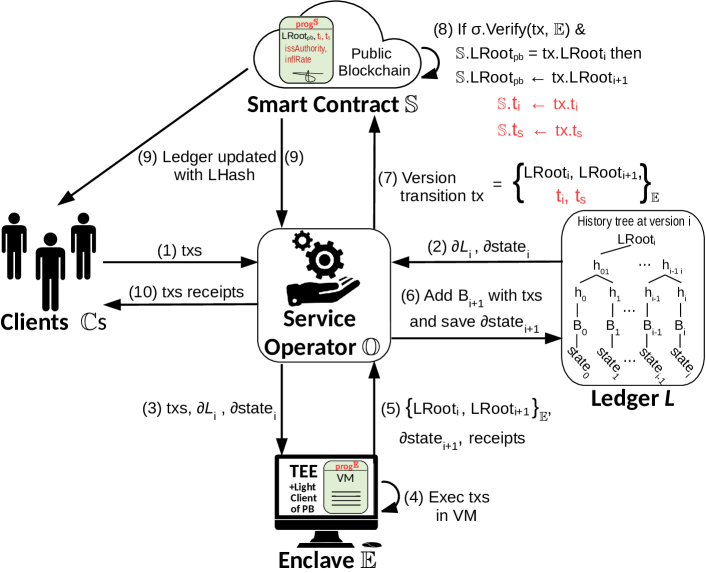
- Leverage a TEE (e.g., Intel SGX) to execute and verify transactions in a cryptographically isolated environment, ensuring correctness and confidentiality.
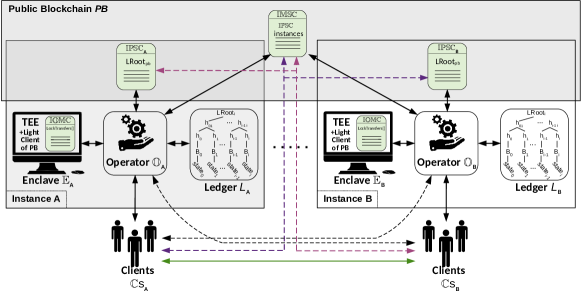
- Adapt the atomic swap protocol to enable one-way, cross-institutional transfers between any pair of CBDC instances, guaranteeing atomicity.
- Use a permissionless blockchain (e.g., Ethereum) as a public audit layer to ensure immutability, non-equivocation, and verifiability of transactions.
- Integrate smart contracts to enforce policy-level controls such as token expiration, usability restrictions, or monetary policy mechanisms.
- Design a cross-CBDC communication layer that maintains monetary equilibrium by avoiding new token creation and enabling interoperability through secure, verifiable coordination.
- Ensure privacy by encrypting all transaction data and relying on TEEs to perform computation without exposing sensitive information.
Experimental results
Research questions
- RQ1How can interoperability be achieved between semi-centralized CBDC systems without introducing new monetary supply or central coordination?
- RQ2What mechanisms can ensure atomicity and verifiability of inter-bank transfers across independent CBDC instances using trusted hardware?
- RQ3Can a TEE-based protocol provide indisputable proofs of censorship while preserving transaction privacy and correctness?
- RQ4How can the protocol support diverse deployment models, including national central banks and national retail banking networks?
- RQ5What are the security and privacy properties that can be formally guaranteed in a cross-CBDC environment using TEE and blockchain composition?
Key findings
- The protocol successfully enables atomic, privacy-preserving, and verifiable one-way transfers between any pair of CBDC instances, regardless of their institutional origin.
- Indisputable proofs of censorship are generated and verifiable by any external party, enhancing transparency and auditability without compromising privacy.
- The integration of TEE ensures correctness of transaction execution and prevents malicious manipulation, even if the CBDC instance is untrusted.
- The system maintains monetary equilibrium by avoiding the creation of new tokens during cross-institutional transfers, preserving the integrity of monetary policy.
- The protocol is compatible with existing legal and regulatory frameworks, including AML, KYC, and consumer protection laws, through its auditability and policy-compliant design.
- A proof-of-concept implementation demonstrates feasibility, though a more extensive evaluation is planned for future work.
Read this paper
Open the full text in the Nubint reader and ask about any passage as you read.
Read this paper on NubintThis review was generated by AI from the original paper. Please check the paper before citing it.