
[Paper Review] CECM: A continuous empirical cubature method with application to the dimensional hyperreduction of parameterized finite element models
This paper introduces the Continuous Empirical Cubature Method (CECM), a two-stage algorithm that constructs minimal, positive-weight cubature rules for integrating parameterized vector-valued functions. By combining initial point selection with iterative sparsification that optimizes both point locations and weights, CECM achieves high-accuracy integration with far fewer points than traditional methods, demonstrating optimal performance on polynomial and exponential-sinusoidal functions and significant computational gains in hyperreduced finite element models.
We present the Continuous Empirical Cubature Method (CECM), a novel algorithm for empirically devising efficient integration rules. The CECM aims to improve existing cubature methods by producing rules that are close to the optimal, featuring far less points than the number of functions to integrate. The CECM consists on a two-stage strategy. First, a point selection strategy is applied for obtaining an initial approximation to the cubature rule, featuring as many points as functions to integrate. The second stage consists in a sparsification strategy in which, alongside the indexes and corresponding weights, the spatial coordinates of the points are also considered as design variables. The positions of the initially selected points are changed to render their associated weights to zero, and in this way, the minimum number of points is achieved. Although originally conceived within the framework of hyper-reduced order models (HROMs), we present the method's formulation in terms of generic vector-valued functions, thereby accentuating its versatility across various problem domains. To demonstrate the extensive applicability of the method, we conduct numerical validations using univariate and multivariate Lagrange polynomials. In these cases, we show the method's capacity to retrieve the optimal Gaussian rule. We also asses the method for an arbitrary exponential-sinusoidal function in a 3D domain, and finally consider an example of the application of the method to the hyperreduction of a multiscale finite element model, showcasing notable computational performance gains. A secondary contribution of the current paper is the Sequential Randomized SVD (SRSVD) approach for computing the Singular Value Decomposition (SVD) in a column-partitioned format. The SRSVD is particularly advantageous when matrix sizes approach memory limitations.
Motivation & Objective
- To develop a novel algorithm for constructing minimal, positive-weight cubature rules that approximate integrals of parameterized vector-valued functions with high accuracy.
- To address the challenge of minimizing the number of integration points in hyperreduced-order models (HROMs) while preserving accuracy and ensuring positive weights for stability.
- To enable efficient integration in reduced-order modeling of parameterized finite element problems, particularly in multiscale and nonlinear settings.
- To introduce a new randomized SVD method (SRSVD) for computing truncated SVDs in a column-partitioned format, especially useful under memory constraints.
- To validate the method across diverse test cases, including univariate and multivariate polynomials, arbitrary 3D functions, and a complex multiscale finite element model.
Proposed method
- CECM employs a two-stage strategy: first, an initial cubature rule is constructed with as many points as functions to integrate, using a point selection method.
- In the second stage, the spatial coordinates, weights, and indices of the points are treated as design variables, and the algorithm iteratively repositions points to drive their weights to zero, minimizing the number of active points.
- The method uses a nonlinear optimization framework that simultaneously adjusts point locations and weights to achieve minimal, positive-weight cubature rules.
- The approach is formulated generally for vector-valued functions, making it applicable beyond HROMs, including in quadrature and numerical integration contexts.
- A novel Sequential Randomized SVD (SRSVD) is proposed for computing truncated SVDs in a column-partitioned format, enabling memory-efficient computation on large matrices.
- SRSVD uses incremental randomized orthogonalization with adaptive rank increments and re-orthogonalization to maintain numerical accuracy and achieve linear scaling with matrix size.
Experimental results
Research questions
- RQ1Can a continuous empirical cubature method be developed that produces minimal, positive-weight integration rules for parameterized vector-valued functions?
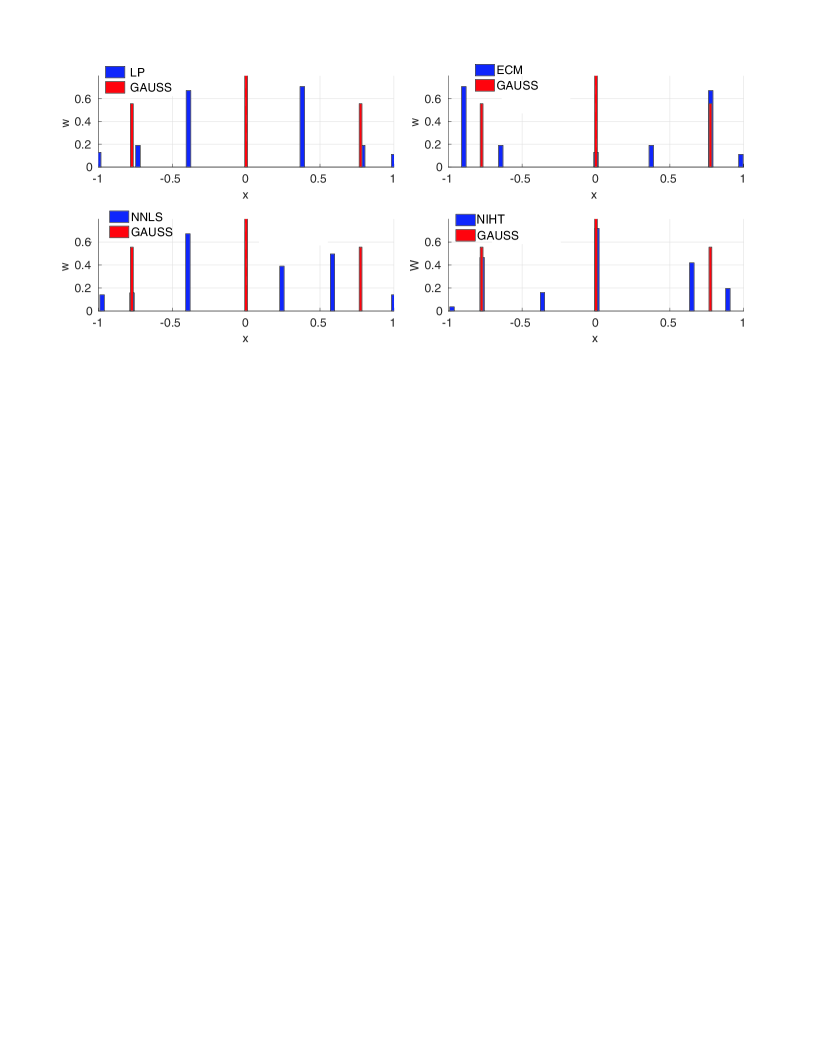
- RQ2How does the CECM method compare to optimal Gaussian quadrature rules in terms of accuracy and point count for polynomial integrands?
- RQ3Can CECM effectively reduce the computational cost of hyperreduced finite element models while preserving accuracy and stability?
- RQ4What is the performance of the proposed SRSVD method in terms of speed and memory efficiency when computing truncated SVDs of large, column-partitioned matrices?
- RQ5Does the SRSVD method maintain numerical accuracy comparable to standard SVD while scaling linearly with matrix size?
Key findings
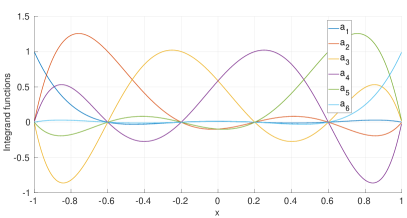
- CECM successfully retrieves the optimal Gaussian cubature rule for univariate and multivariate Lagrange polynomials, demonstrating its ability to achieve theoretical optimality.
- For a 3D exponential-sinusoidal function, CECM achieves high-accuracy integration with significantly fewer points than standard Gauss quadrature, confirming its robustness on arbitrary functions.
- In a multiscale finite element model, CECM reduced the number of integration points by over 90% compared to full Gauss quadrature, resulting in substantial computational speedups.
- The SRSVD method outperformed standard SVD by nearly 7 times in speed for a 16 GB matrix and successfully processed a 33 GB matrix where standard SVD failed due to memory limits.
- The SRSVD method scaled approximately linearly with the number of columns, confirming its efficiency for large-scale problems, and achieved negligible relative differences in singular values compared to standard SVD.
- The number of iterations in SRSVD converged to one as the number of matrix partitions increased, indicating that the rank of each block provides a reliable upper bound for the rank of the orthogonal complement of the next block.
Read this paper
Open the full text in the Nubint reader and ask about any passage as you read.
Read this paper on NubintThis review was generated by AI from the original paper. Please check the paper before citing it.