
[Paper Review] Cellular Network Radio Propagation Modeling with Deep Convolutional Neural Networks
The paper proposes PLNet, a deep convolutional neural network-based model that predicts path loss by converting GIS maps and antenna parameters into input image tensors, demonstrating superior accuracy and speed over empirical and ray-tracing models.
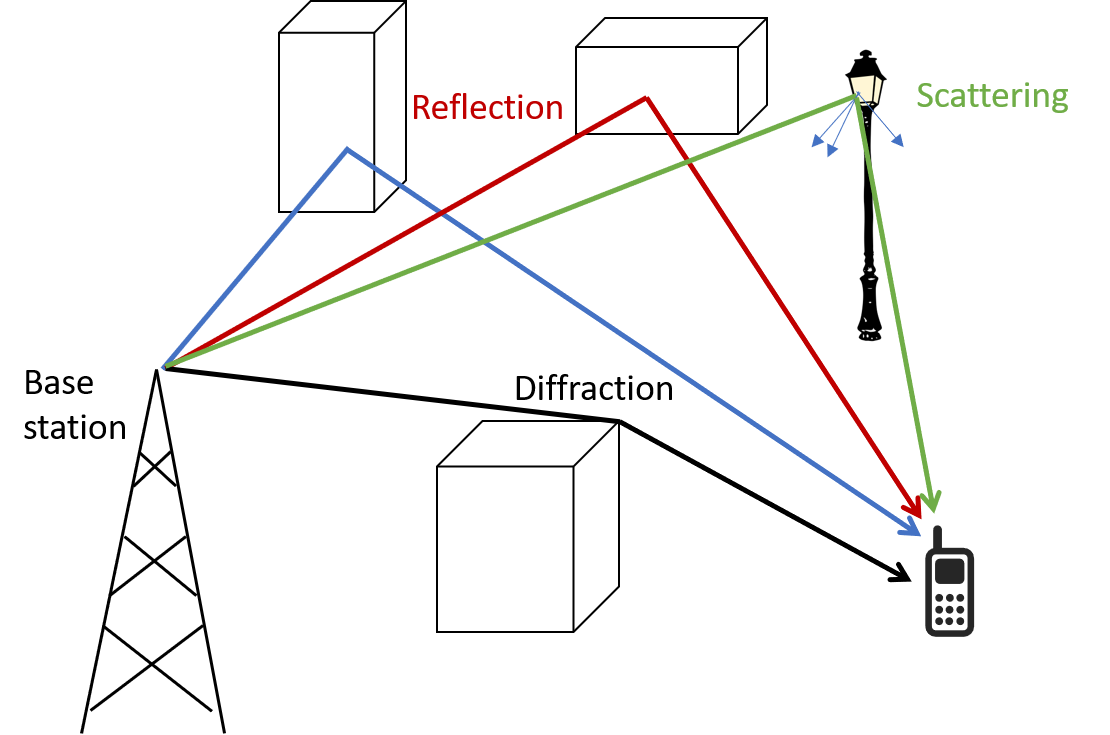
Radio propagation modeling and prediction is fundamental for modern cellular network planning and optimization. Conventional radio propagation models fall into two categories. Empirical models, based on coarse statistics, are simple and computationally efficient, but are inaccurate due to oversimplification. Deterministic models, such as ray tracing based on physical laws of wave propagation, are more accurate and site specific. But they have higher computational complexity and are inflexible to utilize site information other than traditional global information system (GIS) maps. In this article we present a novel method to model radio propagation using deep convolutional neural networks and report significantly improved performance compared to conventional models. We also lay down the framework for data-driven modeling of radio propagation and enable future research to utilize rich and unconventional information of the site, e.g. satellite photos, to provide more accurate and flexible models.
Motivation & Objective
- Reformulate radio propagation modeling as an image regression problem using deep ConvNets.
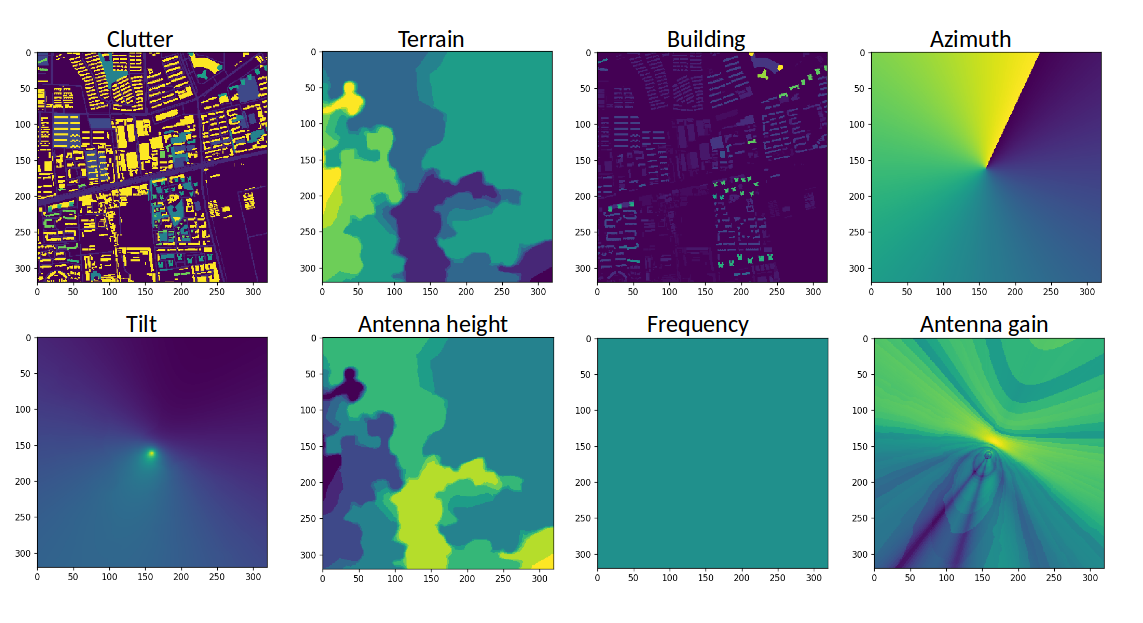
- Design input tensors that integrate GIS map layers and antenna parameters as image channels.
- Develop a U-Net–style architecture tailored for path loss prediction (PLNet).
- Demonstrate superior accuracy and speed over traditional empirical and deterministic models using simulated and real field data.
Proposed method
- Translate GIS map layers and antenna parameters into an 8-channel input tensor for each area patch.
- Use a U-Net encoder-decoder with skip connections to map input tensors to path loss images.
- Train PLNet with supervised learning using MAE/MSE loss on labeled path loss matrices.
- Use simulated ray-tracing data for pre-training and real field data for fine-tuning and evaluation.
- Compare PLNet against empirical models (e.g., SPM) and ray-tracing baselines.
- Demonstrate GPU-accelerated inference (e.g., 0.33 seconds for a 320x320 patch on a Titan Xp) against 30 seconds for ray-tracing.
Experimental results
Research questions
- RQ1Can a CNN-based model leveraging rich site information (GIS layers, antenna parameters) predict path loss more accurately than traditional empirical or deterministic models?
- RQ2Does a data-driven, image-based formulation benefit from including nontraditional inputs such as satellite imagery or additional channels in input tensors?
- RQ3How does PLNet perform on simulated versus real-world field data, and can it serve as a fast surrogate for ray-tracing in planning tasks?
Key findings
- PLNet outperforms conventional models in RMSE on real-field data across tested cities (e.g., City A–D).
- With calibrated data, PLNet achieves lower RMSE than SPM and even shows superiority over calibrated ray tracing in the reported cases.
- PLNet demonstrates substantial speed advantages, predicting a 320×320 path loss map in 0.33 seconds on a GPU, versus 30 seconds for the Volcano ray-tracing simulator.
- Visualization of first-layer filters shows learned patterns corresponding to building and terrain inputs, indicating the network captures site-specific propagation features.
- Pre-training on simulated ray-tracing data helps PLNet learn representations applicable to real data, improving performance when real data are limited.
Read this paper
Open the full text in the Nubint reader and ask about any passage as you read.
Read this paper on NubintThis review was generated by AI from the original paper. Please check the paper before citing it.