
[Paper Review] CF-KAN: Kolmogorov-Arnold Network-based Collaborative Filtering to Mitigate Catastrophic Forgetting in Recommender Systems
CF-KAN proposes a novel collaborative filtering method using Kolmogorov-Arnold Networks (KANs) to mitigate catastrophic forgetting in recommender systems by learning nonlinear functions at the edge level instead of node level. It outperforms state-of-the-art methods in recommendation accuracy, exhibits strong resilience to catastrophic forgetting in continual learning, and provides interpretable recommendations through edge-level visualization.
Collaborative filtering (CF) remains essential in recommender systems, leveraging user--item interactions to provide personalized recommendations. Meanwhile, a number of CF techniques have evolved into sophisticated model architectures based on multi-layer perceptrons (MLPs). However, MLPs often suffer from catastrophic forgetting, and thus lose previously acquired knowledge when new information is learned, particularly in dynamic environments requiring continual learning. To tackle this problem, we propose CF-KAN, a new CF method utilizing Kolmogorov-Arnold networks (KANs). By learning nonlinear functions on the edge level, KANs are more robust to the catastrophic forgetting problem than MLPs. Built upon a KAN-based autoencoder, CF-KAN is designed in the sense of effectively capturing the intricacies of sparse user--item interactions and retaining information from previous data instances. Despite its simplicity, our extensive experiments demonstrate 1) CF-KAN's superiority over state-of-the-art methods in recommendation accuracy, 2) CF-KAN's resilience to catastrophic forgetting, underscoring its effectiveness in both static and dynamic recommendation scenarios, and 3) CF-KAN's edge-level interpretation facilitating the explainability of recommendations.
Motivation & Objective
- To address catastrophic forgetting in collaborative filtering (CF) models, a critical issue in dynamic recommendation systems.
- To explore the potential of Kolmogorov-Arnold Networks (KANs), which learn nonlinear functions on edges, as a robust alternative to traditional MLP-based CF models.
- To evaluate CF-KAN’s performance in both static and continual learning settings, particularly in handling sparse user–item interactions.
- To enhance model interpretability by leveraging the edge-level parameterization of KANs for transparent recommendation reasoning.
- To demonstrate scalability and efficiency of CF-KAN compared to two-tower and autoencoder-based baselines.
Proposed method
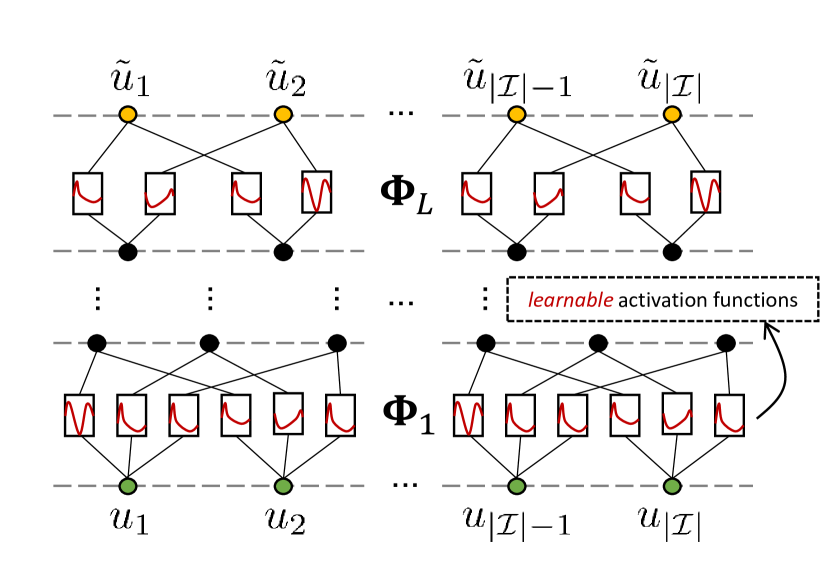
- CF-KAN is built on a KAN-based autoencoder architecture that learns user and item embeddings through edge-level nonlinear activation functions.
- Unlike MLPs, where activation functions are fixed per node, KANs learn activation functions as parameterized splines on edges, enabling more adaptive and robust function approximation.
- The model uses a simple autoencoder design to reconstruct user–item interaction matrices, preserving historical knowledge during incremental training.
- Edge-level updates in KANs localize parameter changes, reducing interference with previously learned representations and mitigating catastrophic forgetting.
- The method employs learnable spline-based activation functions (e.g., SiLU, ReLU) with a grid-based parameterization to model complex nonlinearities in sparse interaction data.
- Hyperparameters such as the number of KAN layers (L), grid count (G), hidden dimension (d), and activation function type are systematically tuned for optimal performance.
Experimental results
Research questions
- RQ1Can KAN-based collaborative filtering outperform traditional MLP-based CF methods in terms of recommendation accuracy?
- RQ2How does CF-KAN perform in continual learning scenarios where models are incrementally trained on new data?
- RQ3To what extent does CF-KAN mitigate catastrophic forgetting compared to MLP-based baselines?
- RQ4Can the edge-level structure of KANs provide interpretable and visually explainable recommendation paths?
- RQ5How does CF-KAN scale in terms of training speed and memory consumption relative to two-tower and other autoencoder-based models?
Key findings
- CF-KAN achieves superior recommendation accuracy, with R@20 scores of 0.19 on the ML-1M dataset, outperforming all baselines including MF-BPR, NGCF, LightGCN, and SGL.
- In continual learning, CF-KAN demonstrates strong resilience to catastrophic forgetting, maintaining high performance even after incremental training on new data.
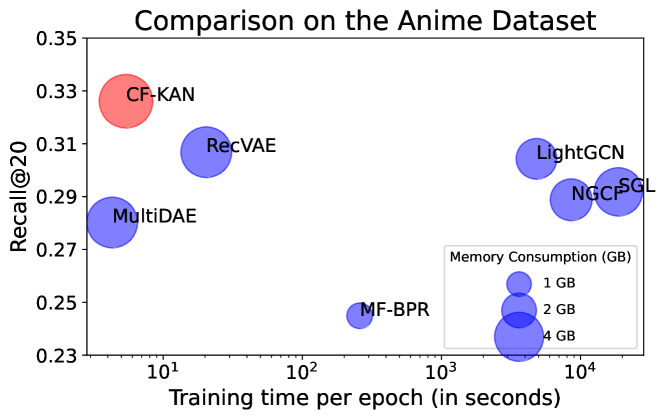
- CF-KAN achieves the fastest training speed among autoencoder-based models, with only 0.2 seconds per epoch on ML-1M, significantly faster than MultiDAE (0.1 s/ep) and RecVAE (0.4 s/ep).
- CF-KAN consumes less GPU memory than NGCF and SGL on ML-1M and Yelp, with 1.42 GB and 2.62 GB respectively, outperforming other autoencoder models in memory efficiency.
- The optimal configuration uses L=1 layer, G=2 grids, d=512, and SiLU activation, with performance degrading when deeper or with excessive parameters due to overfitting.
- Visualizations confirm that CF-KAN provides interpretable recommendation paths, such as linking 'Demon Slayer' to 'Mugen Train' via shared viewing history, unlike CF-MLP which lacks clear interpretability.
Read this paper
Open the full text in the Nubint reader and ask about any passage as you read.
Read this paper on NubintThis review was generated by AI from the original paper. Please check the paper before citing it.