
[Paper Review] CFR-ICL: Cascade-Forward Refinement with Iterative Click Loss for Interactive Image Segmentation
This paper proposes CFR-ICL, a novel interactive image segmentation framework that integrates Cascade-Forward Refinement (CFR) for unified inference, Iterative Click Loss (ICL) for training with reduced user clicks, and SUEM copy-paste augmentation to enhance training diversity. The method achieves state-of-the-art performance, reducing average clicks by 33.2% (Berkeley) and 15.5% (DAVIS) at 95% IoU compared to prior work.
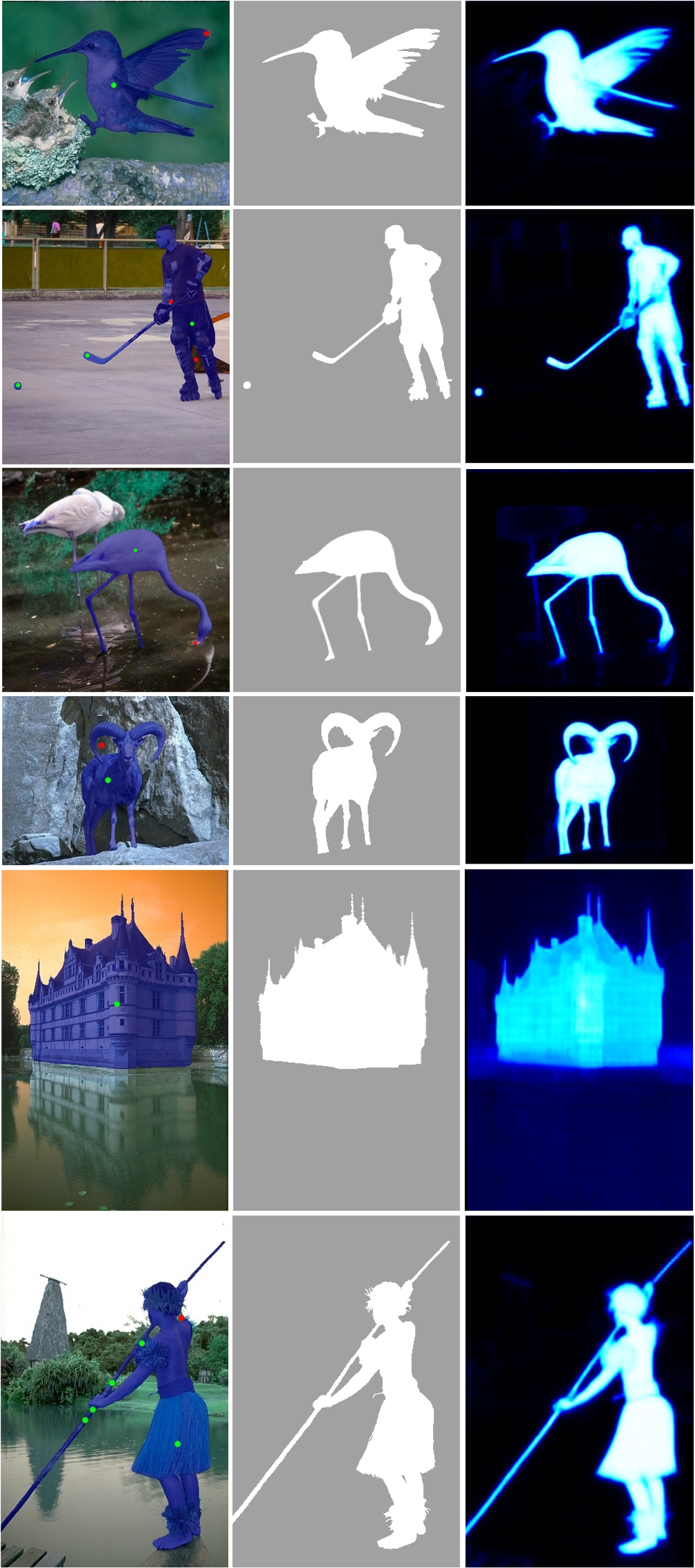
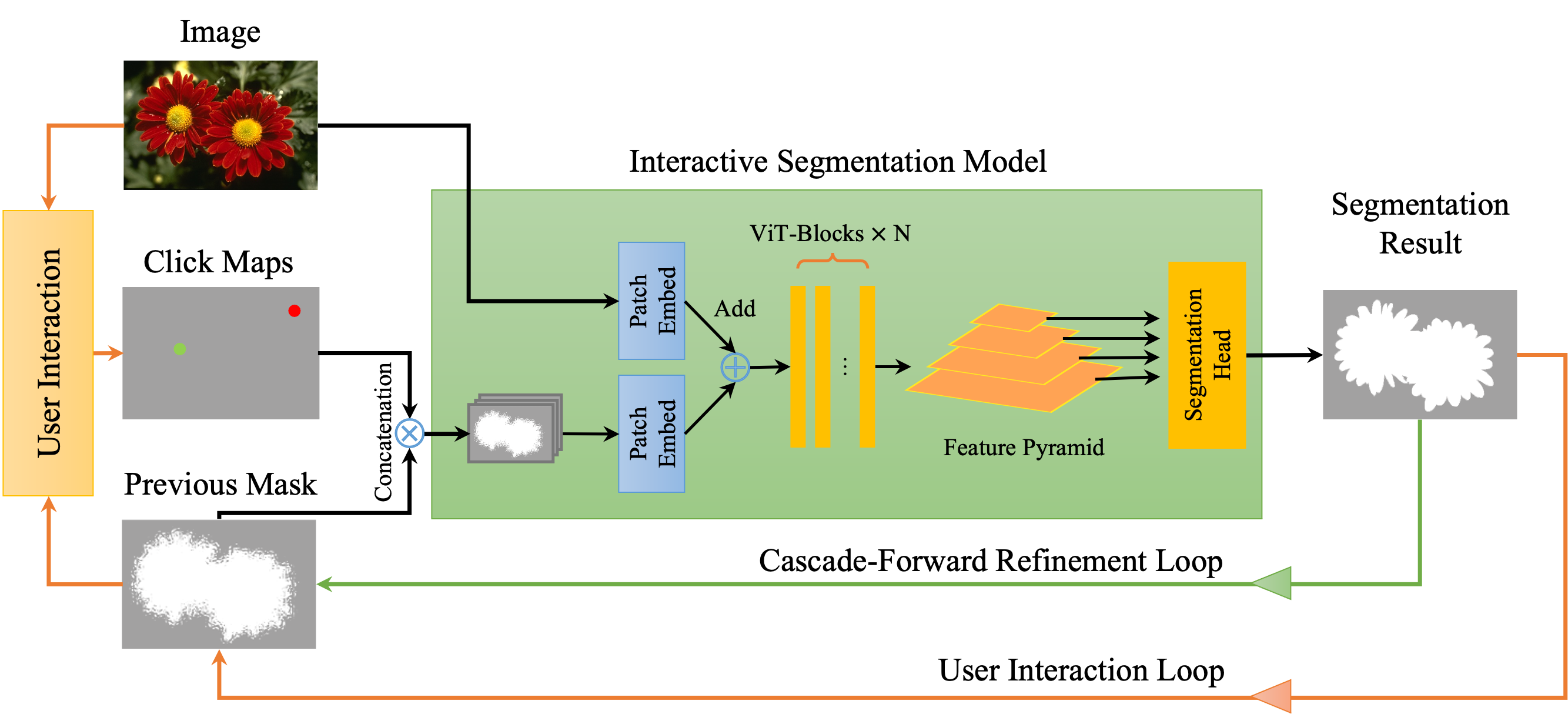
The click-based interactive segmentation aims to extract the object of interest from an image with the guidance of user clicks. Recent work has achieved great overall performance by employing feedback from the output. However, in most state-of-the-art approaches, 1) the inference stage involves inflexible heuristic rules and requires a separate refinement model, and 2) the number of user clicks and model performance cannot be balanced. To address the challenges, we propose a click-based and mask-guided interactive image segmentation framework containing three novel components: Cascade-Forward Refinement (CFR), Iterative Click Loss (ICL), and SUEM image augmentation. The CFR offers a unified inference framework to generate segmentation results in a coarse-to-fine manner. The proposed ICL allows model training to improve segmentation and reduce user interactions simultaneously. The proposed SUEM augmentation is a comprehensive way to create large and diverse training sets for interactive image segmentation. Extensive experiments demonstrate the state-of-the-art performance of the proposed approach on five public datasets. Remarkably, our model reduces by 33.2\%, and 15.5\% the number of clicks required to surpass an IoU of 0.95 in the previous state-of-the-art approach on the Berkeley and DAVIS sets, respectively.
Motivation & Objective
- To address the imbalance between segmentation quality and user interaction cost in click-based interactive segmentation.
- To eliminate heuristic rules and separate refinement models in inference by unifying the refinement process.
- To improve training efficiency and model generalization through a novel data augmentation strategy tailored for interactive segmentation.
- To enable end-to-end learning that explicitly minimizes the number of required user clicks during training.
- To develop a flexible, unified inference framework that enhances segmentation detail iteratively.
Proposed method
- Introduces Cascade-Forward Refinement (CFR), a two-loop iterative inference mechanism that refines segmentation masks in a coarse-to-fine manner using previous outputs.
- Proposes Iterative Click Loss (ICL), a novel loss function that encodes click count and order into training to optimize for fewer user clicks.
- Designs SUEM copy-paste augmentation, a comprehensive data augmentation strategy with four variants to increase training set diversity and size.
- Employs a ViT-Huge backbone fine-tuned with ICL and SUEM on SBD and C+L datasets for optimal performance.
- Applies CFR-1 inference (one-step refinement) in practice due to its computational efficiency and strong performance.
- Uses a threshold-based adaptive termination in A-CFR to dynamically stop refinement when improvements fall below 20 pixels.
Experimental results
Research questions
- RQ1Can a unified inference framework improve segmentation quality without relying on heuristic rules or separate refinement models?
- RQ2Can a loss function that encodes click count and order during training reduce the number of user clicks required for high-accuracy segmentation?
- RQ3Does a comprehensive data augmentation strategy like SUEM copy-paste significantly improve model generalization in interactive segmentation?
- RQ4Can the combination of ICL, CFR, and SUEM achieve state-of-the-art performance across diverse benchmarks?
- RQ5How does the proposed method compare in efficiency and accuracy to existing iterative mask-guided and inference-time optimization approaches?
Key findings
- The proposed CFR-1 inference scheme achieves superior performance with 2.9 average clicks at 95% IoU on the Berkeley dataset, a 33.2% improvement over the previous state-of-the-art.
- On the DAVIS dataset, the method reduces average clicks to 7.5 at 95% IoU, a 15.5% improvement over the prior best result.
- The Iterative Click Loss (ICL) enables training that explicitly minimizes user clicks, improving model preference for low-interaction scenarios.
- SUEM copy-paste augmentation significantly boosts performance on GrabCut, Berkeley, and DAVIS datasets, demonstrating its effectiveness in data diversity and model generalization.
- The A-CFR-4 variant outperforms CFR-4 by adaptively terminating refinement when changes become negligible, showing the benefit of dynamic stopping.
- The full CFR-ICL framework achieves state-of-the-art performance across five public datasets, including SBD, DAVIS, PascalVOC, Berkeley, and GrabCut.
Read this paper
Open the full text in the Nubint reader and ask about any passage as you read.
Read this paper on NubintThis review was generated by AI from the original paper. Please check the paper before citing it.