
[Paper Review] Chain of History: Learning and Forecasting with LLMs for Temporal Knowledge Graph Completion
This paper presents a PEFT-finetuned LLM framework that leverages structure-aware history and reverse-logic prompts to perform temporal knowledge graph completion, achieving competitive results on ICEWS and YAGO datasets compared to embedding-based and other LLM approaches.
Temporal Knowledge Graph Completion (TKGC) is a complex task involving the prediction of missing event links at future timestamps by leveraging established temporal structural knowledge. This paper aims to provide a comprehensive perspective on harnessing the advantages of Large Language Models (LLMs) for reasoning in temporal knowledge graphs, presenting an easily transferable pipeline. In terms of graph modality, we underscore the LLMs' prowess in discerning the structural information of pivotal nodes within the historical chain. As for the generation mode of the LLMs utilized for inference, we conduct an exhaustive exploration into the variances induced by a range of inherent factors in LLMs, with particular attention to the challenges in comprehending reverse logic. We adopt a parameter-efficient fine-tuning strategy to harmonize the LLMs with the task requirements, facilitating the learning of the key knowledge highlighted earlier. Comprehensive experiments are undertaken on several widely recognized datasets, revealing that our framework exceeds or parallels existing methods across numerous popular metrics. Additionally, we execute a substantial range of ablation experiments and draw comparisons with several advanced commercial LLMs, to investigate the crucial factors influencing LLMs' performance in structured temporal knowledge inference tasks.
Motivation & Objective
- Motivate and enable effective reasoning over temporal knowledge graphs (TKGs) using large language models (LLMs).
- Develop a transferable, structure-aware framework that incorporates historical graph information for TKGC.
- Mitigate the reversal curse in LLM-based structured reasoning via reverse logic prompts during fine-tuning.
- Demonstrate parameter-efficient fine-tuning (PEFT) to align LLMs with TKGC tasks.
- Provide comprehensive ablations and comparisons with existing TKGC methods and commercial LLMs.
Proposed method
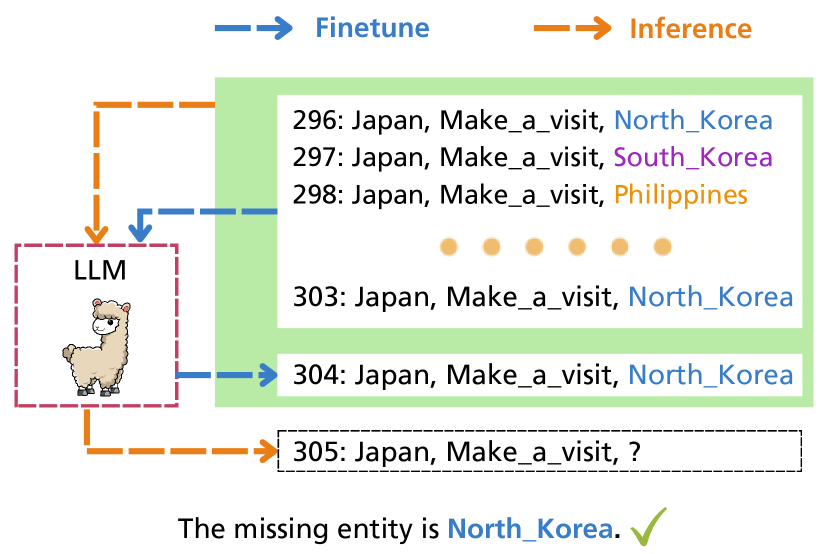
- Structure-augmented history modeling that combines schema-matching history, entity-augmented history, and relation-augmented history to inform LLM reasoning.
- Introduction of reverse logic during fine-tuning via three prompt strategies (ordinary, text-aware, position-aware) to alleviate reversal issues in structured reasoning.
- Instruction-tuning using LoRA-based PEFT to update a small set of parameters while keeping the base model fixed.
- Prediction with LLMs via beam search decoding to generate candidate answer sequences, selecting the highest probability sequence.
- Use of historical chains (L) to provide context, with attention to optimal history length for different datasets.
- Comparative evaluation against embedding-based TKGC models and various open-source/commercial LLMs on ICEWS and YAGO datasets.
Experimental results
Research questions
- RQ1Can LLMs serve as effective reasoning agents for extrapolative TKGC when equipped with structure-aware history and reverse-logic prompts?
- RQ2How does PEFT (LoRA) fine-tuning influence LLM performance on TKGC tasks compared to full-parameter fine-tuning?
- RQ3What impact do history augmentation, reverse data, and prompt strategies have on forward and backward (reverse) temporal reasoning?
- RQ4How do model size and dataset characteristics affect LLM-based TKGC performance, including comparisons with commercial LLMs?
Key findings
- The proposed framework achieves highly competitive or superior performance compared to state-of-the-art methods on several TKGC benchmarks.
- Structure-based history augmentation (schema, entity, and relation history) improves both forward and backward inference in TKGC.
- Introducing reverse logic during fine-tuning alleviates the reversal curse and generally improves or preserves forward reasoning.
- LoRA-based instruction tuning yields strong results with relatively small parameter updates, and larger model sizes do not necessarily guarantee better TKGC performance.
- Commercial LLMs show varied performance; some chat models with RLHF can approach or exceed baseline models on certain datasets, while performance on others remains below specialized TKGC models.
- Across datasets, history length and data augmentation strategies influence performance, with diminishing returns or adverse effects when history becomes too long on some datasets.

Read this paper
Open the full text in the Nubint reader and ask about any passage as you read.
Read this paper on NubintThis review was generated by AI from the original paper. Please check the paper before citing it.