
[Paper Review] Challenges and Applications of Large Language Models
A survey that systematically outlines open problems (design, behavior, science) and current successes in applying large language models across diverse domains, highlighting constraints and trade-offs.
Large Language Models (LLMs) went from non-existent to ubiquitous in the machine learning discourse within a few years. Due to the fast pace of the field, it is difficult to identify the remaining challenges and already fruitful application areas. In this paper, we aim to establish a systematic set of open problems and application successes so that ML researchers can comprehend the field's current state more quickly and become productive.
Motivation & Objective
- Identify unresolved challenges in LLM design, behavior, and scientific progress.
- Catalog successful application domains and how challenges constrain them.
- Provide guidance for ML researchers to accelerate progress in LLM research and deployment.
Proposed method
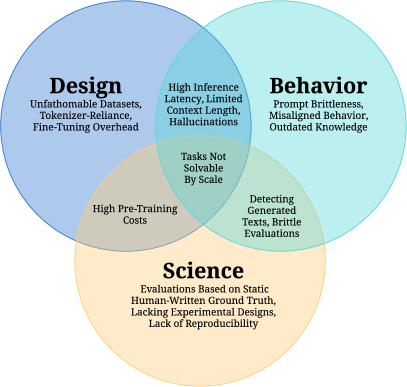
- Classify challenges into three broad categories: design, behavior, and science.
- Review literature and reported techniques addressing each challenge.
- Summarize application areas and associated constraints to guide future work.
Experimental results
Research questions
- RQ1What challenges remain unresolved for large language models across design, behavior, and science?
- RQ2Where are LLMs currently applied, and what limitations do these challenges impose on these applications?
- RQ3What data, tokenization, training, fine-tuning, and evaluation practices influence LLM performance and trustworthiness?
Key findings
- Datasets for pre-training are vast and often unfathmanable, with near-duplicates and benchmark contamination impacting model behavior and evaluation.
- Tokenization and tokenizer–model coupling introduce language and resource inequities, especially for multilingual and low-resource languages.
- Pre-training costs are extremely high, driving interest in scaling laws, compute-optimal strategies, and alternative training objectives to improve data efficiency.
- Fine-tuning LLMs faces practical barriers due to memory and storage requirements, prompting exploration of parameter-efficient fine-tuning methods like adapters, prefix-tuning, and prompt-tuning.
- A variety of pre-training objectives (MLM, prefix LM, span denoising, MoD) and data construction strategies impact data efficiency and downstream transfer, with ongoing research into their trade-offs.
- The paper also surveys a wide range of applications including chatbots, computational biology, programming, creative work, knowledge work, law, medicine, reasoning, robotics, social sciences, and synthetic data generation.
Better researchstarts right now
From reading papers to final review, dramatically reduce your research time.
No credit card · Free plan available
This review was created by AI and reviewed by human editors.