
[Paper Review] Challenges of cellwise outliers
This paper addresses the challenge of cellwise outliers—individual data entries that deviate from their expected pattern—by proposing a new framework for robust statistics under cellwise contamination. It introduces cellwise breakdown values for location, covariance, and regression, and presents the first cellwise robust method for correspondence analysis, demonstrating its effectiveness on real data.
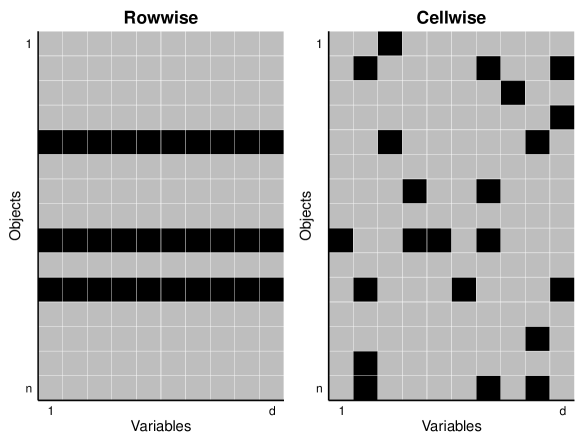
It is well-known that real data often contain outliers. The term outlier typically refers to a case, that is, a row of the $n imes d$ data matrix. In recent times a different type has come into focus, the cellwise outliers. These are suspicious cells (entries) that can occur anywhere in the data matrix. Even a relatively small proportion of outlying cells can contaminate over half the rows, which is a problem for rowwise robust methods. In this article we discuss the challenges posed by cellwise outliers, and some methods developed so far to deal with them. We obtain new results on cellwise breakdown values for location, covariance and regression. We also propose a cellwise robust method for correspondence analysis, with real data illustrations. The paper concludes by formulating some points for debate.
Motivation & Objective
- To address the limitations of traditional rowwise robust methods when faced with cellwise outliers, where a small fraction of contaminated cells can affect the majority of rows.
- To develop a new theoretical framework for robust statistics under cellwise contamination, distinct from the classical casewise (rowwise) contamination model.
- To establish cellwise breakdown values for location, scatter, and regression, providing a measure of robustness under cellwise deviations.
- To propose the first cellwise robust method for correspondence analysis, enabling robust analysis of contingency tables with contaminated entries.
- To stimulate debate on the current state and future directions of cellwise robust statistics, particularly in high-dimensional settings.
Proposed method
- Proposes a cellwise contamination model where individual cells (entries) in the data matrix are independently replaced by outlying values, unlike the traditional rowwise model.
- Introduces cellwise breakdown values as a measure of robustness, defined as the smallest fraction of contaminated cells that can drive an estimator to arbitrary values.
- Derives theoretical bounds on cellwise breakdown values for location, covariance, and regression estimators using affine and orthogonal equivariance properties.
- Develops a cellwise robust correspondence analysis method by modifying the classical correspondence analysis to downweight only suspicious cells rather than entire rows.
- Employs orthogonal transformations and matrix decomposition techniques to prove theoretical properties of robust estimators under cellwise contamination.
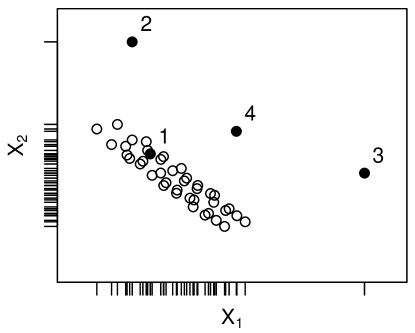
- Uses the exact fit property and implosion arguments to demonstrate breakdown under minimal cell contamination, showing that even a small number of strategically placed outliers can destabilize classical methods.
Experimental results
Research questions
- RQ1How does cellwise contamination affect the breakdown behavior of classical robust estimators such as location, covariance, and regression?
- RQ2What is the theoretical maximum fraction of contaminated cells that can be tolerated before a robust estimator breaks down, and how does this differ from rowwise breakdown?
- RQ3Can a robust method for correspondence analysis be designed that is sensitive to individual cell outliers rather than entire rows?
- RQ4How does the cellwise contamination model change the interpretation and design of robust statistical methods compared to the traditional casewise model?
- RQ5What are the practical implications of cellwise outliers in high-dimensional data, and how can they be detected and handled effectively?
Key findings
- A small fraction of cellwise outliers—as low as 5% in 15 dimensions—can contaminate over 50% of rows, rendering standard rowwise robust methods ineffective.
- The cellwise breakdown value for location and covariance estimators is shown to be strictly less than 0.5, indicating that even a small proportion of contaminated cells can cause breakdown.
- For regression, the cellwise breakdown value is bounded by $\lceil(n-1)/(p+1)\rceil/n$, which can be significantly smaller than the rowwise breakdown value, especially in high dimensions.
- The proposed cellwise robust correspondence analysis method successfully identifies and downweights only the suspicious cells, preserving information in otherwise valid rows.
- Theoretical proofs demonstrate that under cellwise contamination, classical estimators can break down with minimal cell-level perturbations, highlighting the need for dedicated cellwise robust methods.
- The paper establishes that the cellwise breakdown value for the covariance estimator is zero when $n \leq d$, indicating that in high-dimensional settings, even a single cell contamination can cause implosion.
Read this paper
Open the full text in the Nubint reader and ask about any passage as you read.
Read this paper on NubintThis review was generated by AI from the original paper. Please check the paper before citing it.