
[论文解读] Channel Estimation for IRS-aided Multiuser Communications with Reduced Error Propagation
该论文为IRS辅助的多用户SIMO系统提出了一种新颖的两阶段信道估计(2PCE)策略,可同时估计目标用户的直射与反射信道,减少了传统三阶段方法固有的误差传播问题。2PCE方法在信道状态信息(CSI)估计中实现了更低的均方误差(MSE),尤其在大规模天线系统中表现更优,且未增加训练开销,其性能在理论分析与仿真中均优于现有方法。
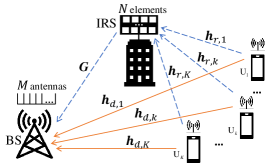
Intelligent reflecting surface (IRS) has emerged as a promising paradigm to improve the capacity and reliability of a wireless communication system by smartly reconfiguring the wireless propagation environment. To achieve the promising gains of IRS, the acquisition of the channel state information (CSI) is essential, which however is practically difficult since the IRS does not employ any transmit/receive radio frequency (RF) chains in general and it has limited signal processing capability. In this paper, we study the uplink channel estimation problem for an IRS-aided multiuser single-input multi-output (SIMO) system, and propose a novel two-phase channel estimation (2PCE) strategy which can alleviate the negative effects caused by error propagation in the existing three-phase channel estimation approach, i.e., the channel estimation errors in previous phases will deteriorate the estimation performance in later phases, and enhance the channel estimation performance with the same amount of channel training overhead as in the existing approach. Moreover, the asymptotic mean squared error (MSE) of the 2PCE strategy is analyzed when the least-square (LS) channel estimation method is employed, and we show that the 2PCE strategy can outperform the existing approach. Finally, extensive simulation results are presented to validate the effectiveness of the 2PCE strategy.
研究动机与目标
- 为解决传统三阶段信道估计在IRS辅助多用户系统中固有的误差传播问题。
- 设计一种训练策略,可同时估计目标用户的直射与反射信道,以最小化各阶段之间的误差依赖性。
- 在实际IRS约束条件下(有限信号处理能力且无射频链路)提升信道状态信息(CSI)获取的准确性。
- 在保持相同训练开销的前提下,实现优于现有方法的估计性能。
- 对所提出的2PCE策略的渐近MSE性能进行理论分析与验证。
提出的方法
- 提出两阶段信道估计框架:第一阶段通过改变IRS反射波束模式,估计单个用户的直射与反射信道。
- 第二阶段通过联合设计导频符号与IRS反射模式,实现对其他用户的CSI估计,从而实现直射与反射信道的同时估计。
- 采用最小二乘(LS)估计方法进行信道估计,并推导出用于性能分析的渐近MSE表达式。
- 利用结构化的反射模式与导频设计,解耦估计误差,降低跨阶段误差传播。
- 在不同系统条件(M ≥ N 与 M < N)下,分析2PCE与传统三阶段估计(3PCE)之间的MSE差异。
- 推导出MSE差异的解析表达式,证明在渐近系统中,2PCE始终优于3PCE。
实验结果
研究问题
- RQ1在IRS辅助的多用户系统中,能否通过同时估计目标用户的直射与反射信道来减少误差传播?
- RQ2所提出的两阶段策略是否在相同训练开销下,实现优于传统三阶段方法的CSI估计精度?
- RQ3在不同系统配置下,所提出的2PCE方法的渐近均方误差(MSE)与3PCE方法相比如何?
- RQ4系统参数(如基站天线数M、用户数K、IRS元素数)对估计性能有何影响?
- RQ5在何种条件下,2PCE策略在直射与反射信道估计的MSE方面优于3PCE策略?
主要发现
- 当基站天线数M大于等于用户数N时,所提出的2PCE策略在渐近系统中实现的均方误差(MSE)低于传统三阶段方法。
- 在M ≥ N条件下,MSE差异分析表明,2PCE在直射与反射信道估计中均优于3PCE,且所有MSE差异分量均为正值。
- 当M < N时,2PCE在反射信道估计中仍优于3PCE,这由解析推导中为正的MSE差异项所证实。
- 2PCE的性能增益源于减少了误差传播:由于第一阶段采用联合估计,直射信道估计误差不再影响反射信道估计。
- 仿真结果验证了理论分析,确认2PCE在相同训练开销下实现了更高的估计精度。
- 解析的MSE表达式表明,2PCE方法在所有用户组中均保持更低的估计误差,尤其在高信噪比与大规模天线条件下表现更优。

更好的研究,从现在开始
从阅读论文到最终审阅,大幅缩短您的研究时间。
无需绑定信用卡
本解读由 AI 生成,并经人工编辑审核。