
[Paper Review] Chaotic interactions between dark matter and dark energy
This paper proposes a novel thermodynamic interaction schema for dark matter and dark energy as open, non-equilibrium, coupled systems, deriving new interaction equations from the first law of thermodynamics. It proves these systems exhibit chaotic dynamics via Lyapunov exponents and phase space analysis, introducing a new physical law of chaotic behavior in interacting thermodynamic systems with hidden symmetries and self-organization.
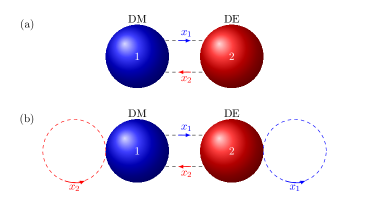
In this study, we consider dark matter and dark energy as grand-canonical systems which are open, non-equilibrium coupled, and interacting systems. For the first time, we propose a new more realistic interaction scheme to explain dynamics between coupled interacting thermodynamic systems. Based on this new interaction schema, we propose new theorems to define the interactions including mutual and self-interactions. We proved the theorems based on the energy conservation law of thermodynamics. Furthermore, we obtain new coupled equations using the theorems. We numerically solved the interaction equations and obtained phase space diagrams and Lyapunov exponents. We show that the interaction between dark matter and dark energy is chaotic. We conclude that these theorems and results can be generalized to all coupled interacting particle and thermodynamic systems. Finally, we evaluated that the obtained results indicate the existence of a new law in physics. Additionally, based on the results, we gave physical definitions of basic concepts such as chaos and self-organization and pointed out the existence of hidden symmetries and variables in interacting systems.
Motivation & Objective
- To develop a new, more realistic interaction schema for dark matter and dark energy as open, non-equilibrium, coupled thermodynamic systems.
- To derive new interaction equations from the first law of thermodynamics using energy conservation and graph-theory-inspired complementary equations.
- To prove chaotic dynamics in dark matter-dark energy interactions through numerical solutions and Lyapunov exponent analysis.
- To generalize the findings to all coupled, interacting, non-equilibrium thermodynamic and particle systems.
- To redefine core physical concepts such as chaos, self-organization, and hidden variables in interacting systems.
Proposed method
- Proposes a new interaction schema treating dark matter and dark energy as grand-canonical, open, non-equilibrium systems.
- Derives new coupled differential equations based on energy conservation and introduces a graph-theory-inspired complementary equation.
- Applies Theorem 1 and Theorem 2 to model mutual and self-interactions, with proofs grounded in thermodynamic energy conservation.
- Numerically solves the derived equations to generate phase space diagrams and compute Lyapunov exponents.
- Uses Lotka-Volterra-like equations as a foundation but extends them with self-interaction and hidden variable mechanisms.
- Analyzes chaotic behavior through sensitivity to initial conditions and time evolution unpredictability.

Experimental results
Research questions
- RQ1Can a new thermodynamic interaction schema accurately model the dynamics between dark matter and dark energy as coupled, non-equilibrium systems?
- RQ2Do the derived interaction equations, based on energy conservation, lead to chaotic behavior in dark matter-dark energy systems?
- RQ3What role do self-interactions and hidden symmetries play in the dynamics of coupled thermodynamic systems?
- RQ4Can the chaotic behavior of dark matter-dark energy interactions be generalized to all coupled, non-equilibrium thermodynamic systems?
- RQ5How do the proposed definitions of chaos and self-organization differ from classical interpretations in physical systems?
Key findings
- The interaction between dark matter and dark energy is proven to be chaotic through numerical solutions and positive Lyapunov exponents.
- The system exhibits chaotic dynamics in phase space, indicating high sensitivity to initial conditions and unpredictable time evolution.
- Hidden symmetries are revealed through self-interaction loops in the coupled system, suggesting underlying structural order.
- The model introduces hidden variables and vectorial fields associated with self-interaction, implying deeper physical mechanisms.
- A new physical law is proposed: all coupled, interacting, non-equilibrium thermodynamic systems exhibit chaotic dynamics.
- Chaos is redefined as the collective minimum action of synchronized, self-organized interacting systems, linking chaos to self-organization.
Read this paper
Open the full text in the Nubint reader and ask about any passage as you read.
Read this paper on NubintThis review was generated by AI from the original paper. Please check the paper before citing it.