
[Paper Review] Chat-3D: Data-efficiently Tuning Large Language Model for Universal Dialogue of 3D Scenes
Chat-3D introduces the first universal dialogue system for 3D scenes by aligning pre-trained 3D representations with large language models (LLMs) through a data-efficient three-stage training strategy. It achieves strong performance—75.6% relative score to GPT-4—on a novel object-centric 3D instruction dataset, enabling accurate spatial reasoning, object-aware dialogue, and external knowledge integration in low-resource settings.
3D scene understanding has gained significant attention due to its wide range of applications. However, existing methods for 3D scene understanding are limited to specific downstream tasks, which hinders their practicality in real-world applications. This paper presents Chat-3D, which combines the 3D visual perceptual ability of pre-trained 3D representations and the impressive reasoning and conversation capabilities of advanced LLMs to achieve the first universal dialogue systems for 3D scenes. Specifically, we align 3D representations into the feature space of LLMs, thus enabling LLMs to perceive the 3D world. Given the scarcity of 3D scene-text data, we propose a three-stage training strategy to efficiently utilize the available data for better alignment. To enhance the reasoning ability and develop a user-friendly interaction scheme, we further construct a high-quality object-centric 3D instruction dataset and design an associated object-centric prompt. Our experiments show that Chat-3D achieves an impressive ability to comprehend diverse instructions for 3D scenes, engage in intricate spatial reasoning, and incorporate external knowledge into its responses. Chat-3D achieves a 75.6% relative score compared with GPT-4 on the constructed instruction dataset.
Motivation & Objective
- Address the lack of universal dialogue systems for 3D scenes, which currently only support narrow tasks like captioning or QA.
- Overcome the challenge of limited 3D scene-text data by designing a data-efficient training strategy for multi-modal LLMs.
- Enable rich, user-friendly interactions in 3D environments by introducing an object-centric prompt and instruction dataset.
- Enhance spatial reasoning and knowledge integration in 3D scene understanding beyond 2D visual models.
Proposed method
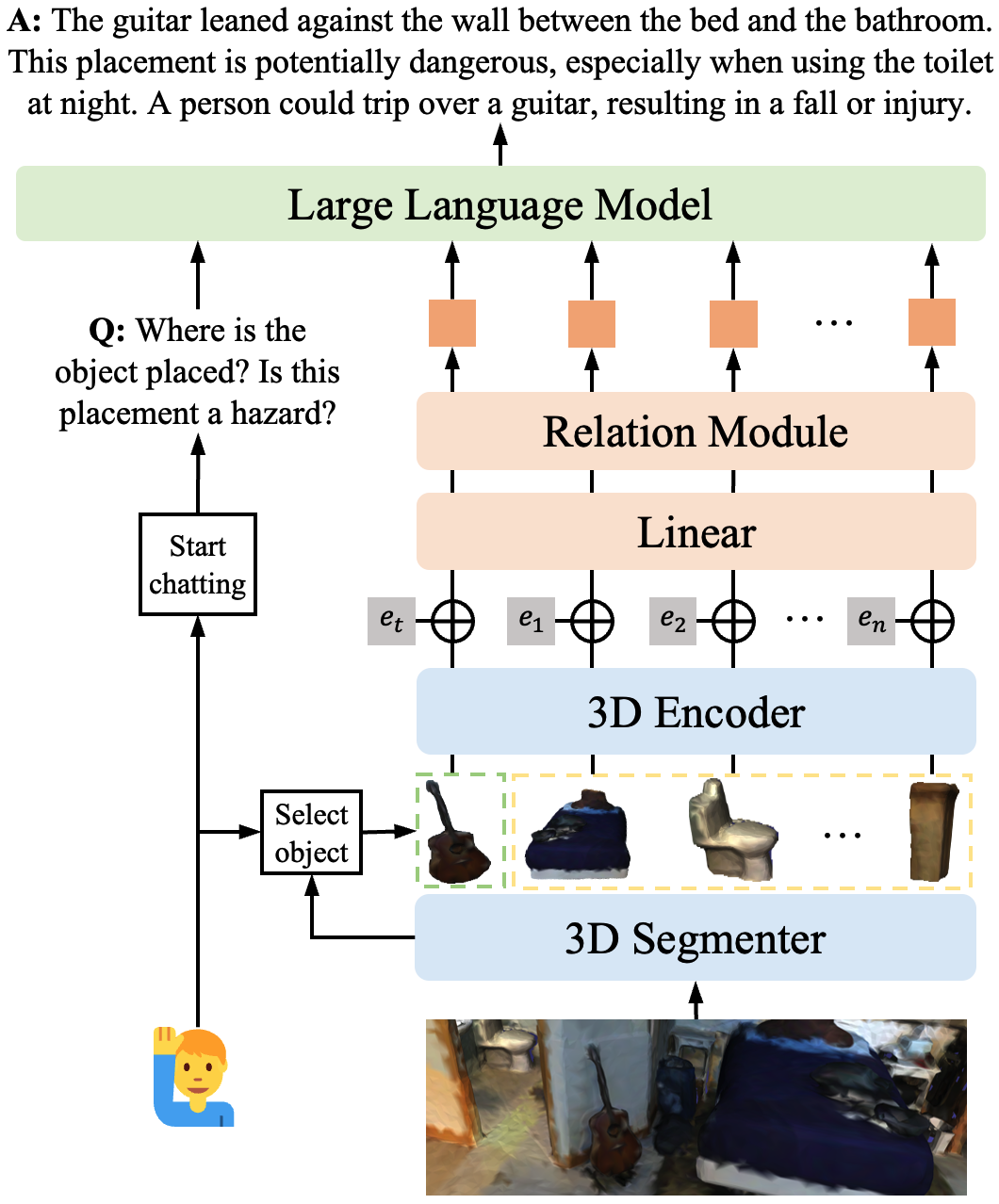
- Propose a three-stage training scheme: (1) align 3D object features with class name embeddings, (2) train a 3D object relation module using scene-text data, and (3) fine-tune on a high-quality instruction dataset.
- Construct a diverse, object-centric 3D instruction dataset covering attributes, positions, relationships, functionalities, and placement suggestions.
- Design an object-centric prompt that allows users to select a target object via interaction, reducing ambiguity in 3D dialogue.
- Align 3D visual representations into the LLM’s semantic feature space to enable perception of 3D spatial and semantic content.
- Leverage pre-trained 3D models (e.g., PointBERT, Point-MAE) and LLMs (e.g., LLaMA) as foundational components for joint visual-linguistic learning.
- Use contrastive learning and cross-attention mechanisms to align 3D features with LLM token embeddings during alignment stages.
Experimental results
Research questions
- RQ1Can a multi-modal LLM be effectively fine-tuned to support universal dialogue in 3D scenes despite limited 3D scene-text data?
- RQ2Does a three-stage training strategy improve data efficiency and performance in low-resource 3D dialogue compared to standard two-stage methods?
- RQ3Can an object-centric instruction dataset and prompt design significantly improve user-friendliness and reduce ambiguity in 3D scene interactions?
- RQ4How does Chat-3D compare to 2D multi-modal LLMs (e.g., LLaVA, MiniGPT-4) in spatial perception and reasoning on 3D scenes?
- RQ5To what extent can the model integrate external knowledge and perform complex spatial reasoning in 3D environments?
Key findings
- Chat-3D achieves a 75.6% relative score compared to GPT-4 on the constructed 3D instruction dataset, demonstrating strong performance in universal dialogue and reasoning.
- The three-stage training scheme improves performance by 8.6 points over the standard two-stage method, proving its data efficiency in low-resource settings.
- Incorporating conversation data into the instruction dataset leads to higher gains in dialogue tasks, while detailed caption data improves performance in captioning benchmarks.
- Combining all data types yields the highest overall performance, showing Chat-3D’s proficiency in both dialogue and detailed description tasks.
- Chat-3D outperforms 2D multi-modal LLMs (e.g., LLaVA, MiniGPT-4) in spatial perception and reasoning, especially in depth and perspective understanding.
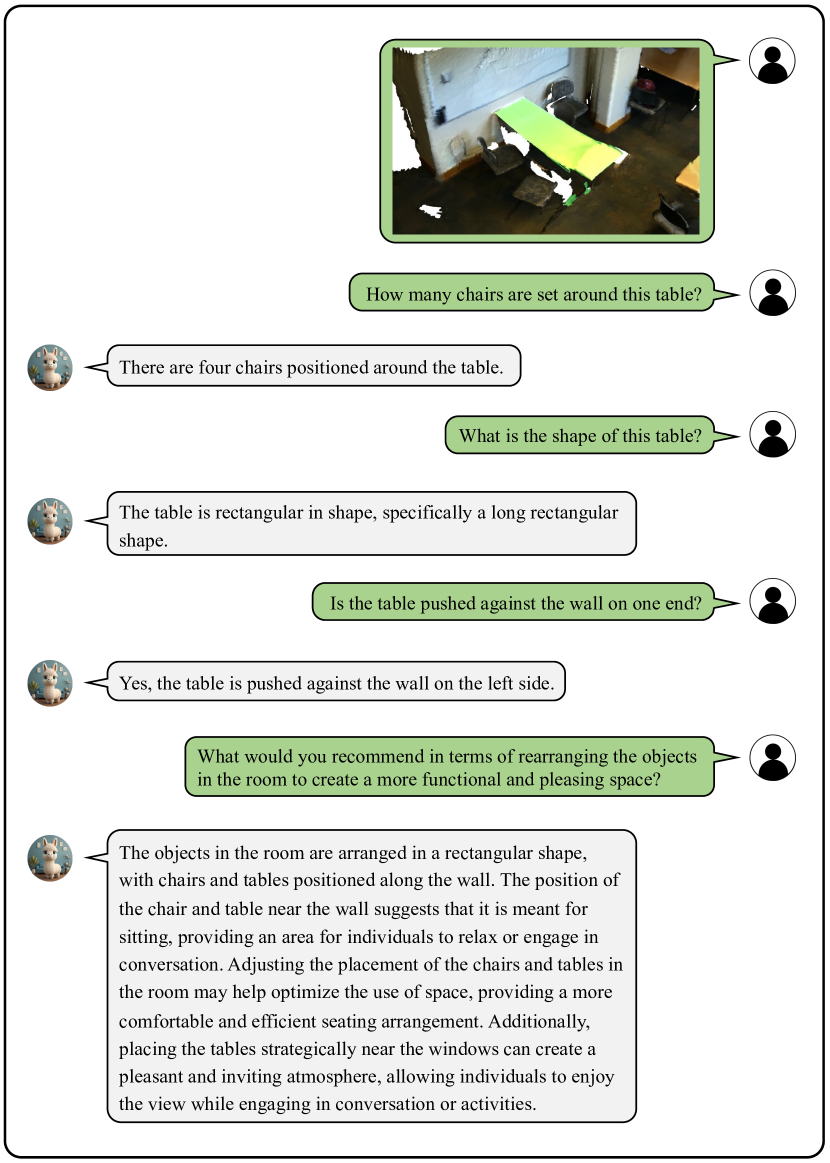
- Visualizations confirm Chat-3D’s ability to accurately count objects, localize them in 3D space, and reason about object functionality and spatial relationships.
Read this paper
Open the full text in the Nubint reader and ask about any passage as you read.
Read this paper on NubintThis review was generated by AI from the original paper. Please check the paper before citing it.