
[Paper Review] Chat-Scene: Bridging 3D Scene and Large Language Models with Object Identifiers
This paper proposes Chat-3D v2, a two-stage alignment method that uses object identifiers to enable large language models (LLMs) to precisely reference and reason about multiple objects in 3D scenes. By learning attribute-aware and relation-aware tokens for each object, the model establishes robust 3D-LLM alignment, achieving state-of-the-art performance on grounding and captioning tasks with improved object referencing accuracy.
Recent advancements in 3D Large Language Models (LLMs) have demonstrated promising capabilities for 3D scene understanding. However, previous methods exhibit deficiencies in general referencing and grounding capabilities for intricate scene comprehension. In this paper, we introduce the use of object identifiers and object-centric representations to interact with scenes at the object level. Specifically, we decompose the input 3D scene into a set of object proposals, each assigned a unique identifier token, which enables efficient object referencing and grounding during user-assistant interactions. Given the scarcity of scene-language data, we model the scene embeddings as a sequence of explicit object-level embeddings, derived from semantic-rich 2D or 3D representations. By employing object identifiers, we transform diverse 3D scene-language tasks into a unified question-answering format, facilitating joint training without the need for additional task-specific heads. With minimal fine-tuning on all downstream tasks, our model significantly outperforms existing methods on benchmarks including ScanRefer, Multi3DRefer, Scan2Cap, ScanQA, and SQA3D.
Motivation & Objective
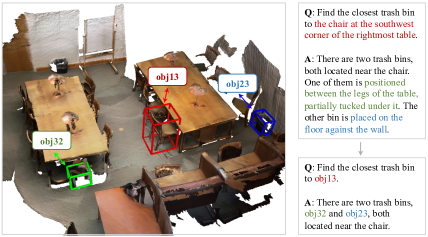
- To enable large language models (LLMs) to handle multi-object queries in 3D scenes by introducing object identifiers for unambiguous referencing.
- To address the challenge of establishing reliable one-to-one correspondence between 3D objects and their identifiers in the LLM's embedding space.
- To incorporate complex spatial relationships among dozens of 3D objects into the LLM's reasoning through learned relation-aware tokens.
- To improve downstream 3D scene understanding tasks such as grounding, captioning, and visual question answering using identifier-enhanced instruction tuning.
- To create a new 3D scene captioning dataset annotated with rich object identifiers using GPT-4 for enhanced evaluation.
Proposed method
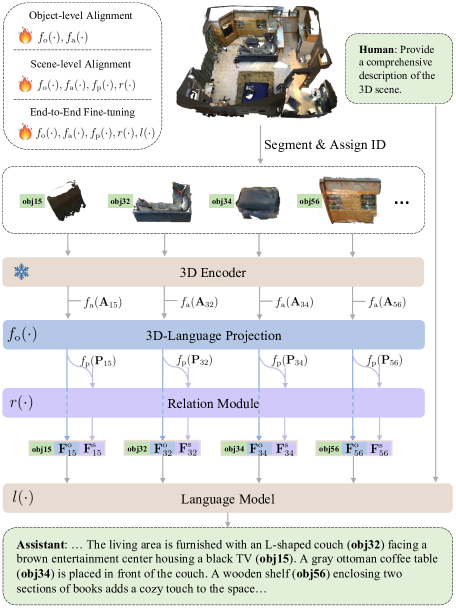
- Proposes a two-stage alignment framework: first learning attribute-aware tokens for each object’s visual and semantic features, then learning relation-aware tokens to encode spatial relationships with neighboring objects.
- Introduces unique object identifiers (e.g., obj13, obj23) for each 3D instance, extracted via reliable 3D instance segmentation models, to enable precise referencing.
- Uses a relation module to aggregate spatial information from surrounding objects and inject it into the relation-aware token, enhancing spatial reasoning in the LLM.
- Employs a two-stage training strategy: object-level alignment to map 3D features into LLM embedding space, followed by scene-level alignment to refine token representations.
- Fine-tunes the model on instruction-tuned datasets using object identifiers as input context, enabling flexible and accurate dialogue in 3D environments.
- Enables model ensembling with supervised baselines by using their predicted probability distributions to filter candidate objects, then prompting the identifier-aware model to select the final answer.
Experimental results
Research questions
- RQ1Can object identifiers significantly improve the precision and clarity of object referencing in 3D scene conversations with LLMs?
- RQ2How can a reliable one-to-one mapping between 3D objects and their identifiers be established within the LLM’s embedding space?
- RQ3To what extent can learned relation-aware tokens enhance spatial reasoning in 3D scenes compared to relying only on attribute-aware tokens?
- RQ4Can the proposed alignment method outperform existing 3D-LLM approaches in multi-object grounding and scene captioning tasks?
- RQ5How effective is the integration of identifier-aware LLMs with high-performing supervised baselines in improving grounding accuracy?
Key findings
- The proposed method achieves state-of-the-art performance on the Nr3D/Sr3D grounding benchmark, outperforming previous 3D-LLMs that lack object identifier support.
- On ScanRefer and Nr3D/Sr3D, the model achieves competitive results with supervised baselines, demonstrating strong scene understanding and reasoning despite using a simple relation module.
- The ablation study confirms that object identifiers alone significantly improve performance, and the combination of attribute-aware and relation-aware tokens yields the best results.
- Replacing the learned relation-aware token with a mean-pooled representation leads to a notable performance drop, proving the importance of the relation module in capturing spatial structure.
- Ensembling with ViL3DRel improves grounding accuracy by approximately 1.0%, showing that identifier-aware models can effectively refine high-confidence candidate predictions.
- In 3D scene captioning, the model generates more comprehensive and scene-aware descriptions compared to Chat-3D, which tends to overfocus on isolated visual elements.
Read this paper
Open the full text in the Nubint reader and ask about any passage as you read.
Read this paper on NubintThis review was generated by AI from the original paper. Please check the paper before citing it.