
[Paper Review] ChatCAD: Interactive Computer-Aided Diagnosis on Medical Image using Large Language Models
ChatCAD integrates large language models with medical-image CAD networks to translate visual outputs into text, enabling LLM-driven summarization, interactive explanations, and treatment guidance for radiology reports.
Large language models (LLMs) have recently demonstrated their potential in clinical applications, providing valuable medical knowledge and advice. For example, a large dialog LLM like ChatGPT has successfully passed part of the US medical licensing exam. However, LLMs currently have difficulty processing images, making it challenging to interpret information from medical images, which are rich in information that supports clinical decisions. On the other hand, computer-aided diagnosis (CAD) networks for medical images have seen significant success in the medical field by using advanced deep-learning algorithms to support clinical decision-making. This paper presents a method for integrating LLMs into medical-image CAD networks. The proposed framework uses LLMs to enhance the output of multiple CAD networks, such as diagnosis networks, lesion segmentation networks, and report generation networks, by summarizing and reorganizing the information presented in natural language text format. The goal is to merge the strengths of LLMs' medical domain knowledge and logical reasoning with the vision understanding capability of existing medical-image CAD models to create a more user-friendly and understandable system for patients compared to conventional CAD systems. In the future, LLM's medical knowledge can be also used to improve the performance of vision-based medical-image CAD models.
Motivation & Objective
- Motivate combining LLMs with vision-based CAD systems to leverage medical knowledge and reasoning for radiology reports.
- Translate CAD outputs into text to bridge vision and language for LLM reasoning.
- Enhance report quality and provide interactive explanations and medical advice to patients.
- Demonstrate improvements over state-of-the-art report generation on chest X-ray datasets.
Proposed method
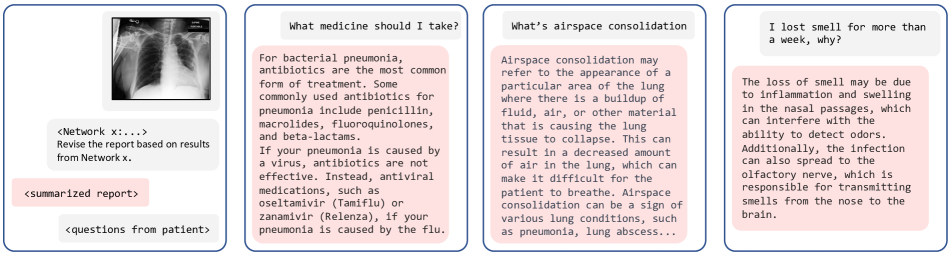
- Process chest X-ray images with multiple CAD networks (classification, lesion segmentation, and report generation).
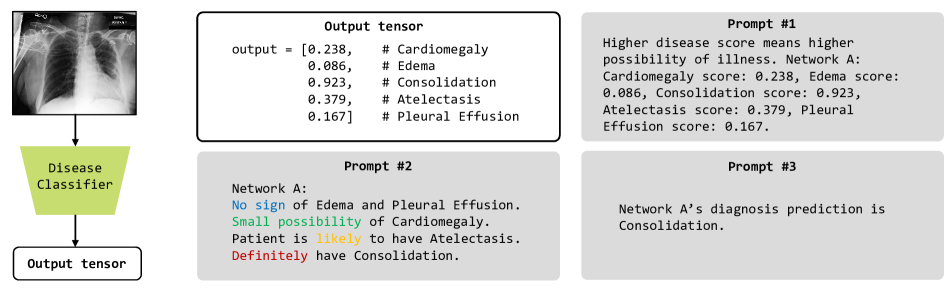
- Convert CAD outputs (tensors/masks) into natural language descriptions to form prompts.
- Use an LLM (GPT-3/ChatGPT) to summarize cross-network results and generate a refined radiology report.
- Design prompts that convert scores into severity descriptions to align with clinical language.
- Evaluate report quality against baselines using precision, recall, and F1 on MIMIC-CXR with CheXpert labels."],
- research_questions([
Experimental results
Research questions
- RQ1Can LLMs improve radiology report quality when fed structured outputs from multiple CAD networks?
- RQ2How does prompt design affect LLM-driven report quality and diagnostic accuracy?
- RQ3What is the impact of using different LLM sizes (and ChatGPT) on diagnostic performance metrics?
- RQ4Can interactive LLM-based dialogue provide useful explanations and treatment guidance based on image findings?
Key findings
- ChatCAD improves diagnostic performance metrics (F1) for five chest radiograph observations compared with two state-of-the-art report-generation baselines.
- GPT-3-based prompting yields higher average F1 and recall than CvT2DistilGPT2 and R2GenCMN across the five observations, with notable gains in Edema and Consolidation.
- ChatGPT achieves an average F1 of 0.605, outperforming text-davinci-003 (0.591) and smaller models (e.g., 0.471–0.508 average for smaller GPT-3 sizes).
- Larger LLMs provide longer, more capable reports and better diagnostic performance on average, highlighting the role of model size in medical reasoning tasks.
- ChatCAD enables interactive explanations and medical-advice-style dialogue, potentially reducing consultation costs and improving online healthcare experiences.
Read this paper
Open the full text in the Nubint reader and ask about any passage as you read.
Read this paper on NubintThis review was generated by AI from the original paper. Please check the paper before citing it.