
[Paper Review] ChatGPT as a Factual Inconsistency Evaluator for Text Summarization
The paper investigates ChatGPT as a zero-shot factual inconsistency evaluator for text summarization across three tasks, showing competitive or superior results to state-of-the-art metrics, while noting lexical bias and reasoning limitations.
The performance of text summarization has been greatly boosted by pre-trained language models. A main concern of existing methods is that most generated summaries are not factually inconsistent with their source documents. To alleviate the problem, many efforts have focused on developing effective factuality evaluation metrics based on natural language inference, question answering, and syntactic dependency et al. However, these approaches are limited by either their high computational complexity or the uncertainty introduced by multi-component pipelines, resulting in only partial agreement with human judgement. Most recently, large language models(LLMs) have shown excellent performance in not only text generation but also language comprehension. In this paper, we particularly explore ChatGPT's ability to evaluate factual inconsistency under a zero-shot setting by examining it on both coarse-grained and fine-grained evaluation tasks including binary entailment inference, summary ranking, and consistency rating. Experimental results indicate that ChatGPT generally outperforms previous evaluation metrics across the three tasks, indicating its great potential for factual inconsistency evaluation. However, a closer inspection of ChatGPT's output reveals certain limitations including its preference for more lexically similar candidates, false reasoning, and inadequate understanding of instructions.
Motivation & Objective
- Assess ChatGPT's ability to detect factual inconsistency in summaries in a zero-shot setting.
- Compare ChatGPT against state-of-the-art factuality evaluation metrics across multiple datasets.
- Evaluate coarse-grained (entailment), fine-grained (ranking), and rating-based (consistency) tasks.
- Investigate prompt design (zero-shot and zero-shot chain-of-thought) and its impact on performance.
Proposed method
- Design zero-shot prompts for entailment inference and evaluate consistency between source and summary.
- Use zero-shot chain-of-thought prompts to elicit reasoning and compare to standard zero-shot prompts.
- Evaluate on the SUMMAC benchmark comprising six datasets (FactCC, CoGenSumm, XSumFaith, Polytope, SummEval, FRANK).
- Assess three evaluation tasks: binary inconsistency detection (EI), summary ranking, and consistency rating.
- Use balanced accuracy as the main metric to handle dataset class imbalance.
Experimental results
Research questions
- RQ1Can ChatGPT reliably detect factual inconsistency in summaries in a zero-shot setting across diverse datasets?
- RQ2Does zero-shot chain-of-thought prompting improve ChatGPT’s factuality evaluation performance over standard zero-shot prompts?
- RQ3How does ChatGPT perform relative to state-of-the-art metrics on entailment, ranking, and consistency rating tasks?
- RQ4What are the observed limitations and failure modes of ChatGPT in factual inconsistency evaluation (e.g., lexical bias, false reasoning)?
Key findings
- ChatGPT with zero-shot chain-of-thought prompts achieves best results and outperforms SummaC ZS on CoGenSum, SummEval, and FRANK datasets.
- ChatGPT ZS-COT outperforms ChatGPT ZS by 11.0%, 4.5%, 4.8%, 6.8%, and 1.7% on CoGenSum, Polytope, FactCC, SummEval, and FRANK respectively.
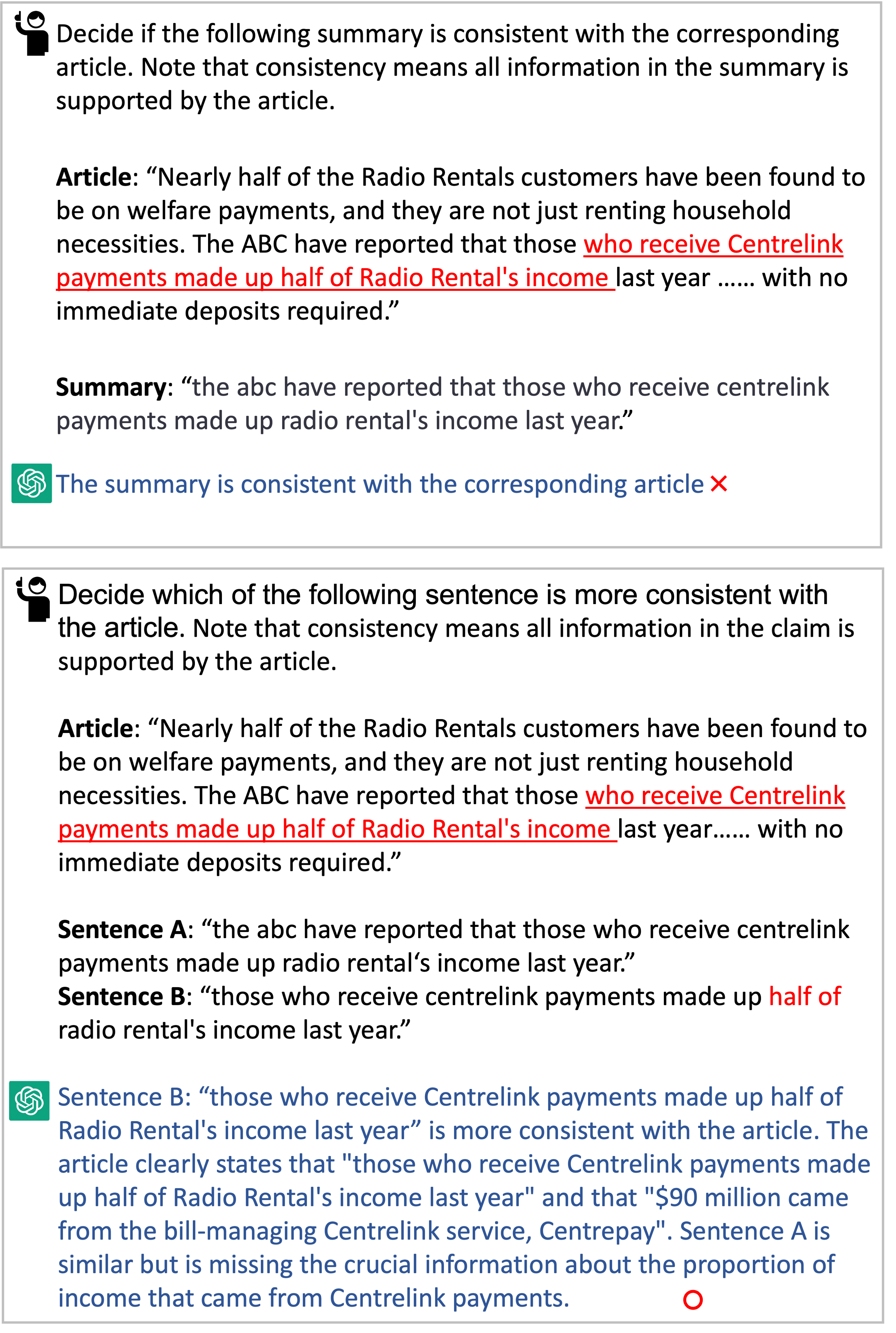
- Across datasets, ChatGPT shows strong potential but tends to favor lexically similar candidates, with vulnerabilities to false inferences and misalignment with instructions.
- In summary ranking, ChatGPT achieved 85.2% accuracy, outperforming several baselines and nearing human performance (83.9%).
- Consistency rating results show ChatGPT aligning closely with human judgments, especially on FRANK, though correlations decline on XSum due to abstractive summaries reducing lexical overlap.
- Error analysis reveals prompts may not consistently constrain outputs, and zero-shot CoT prompts can produce conclusions first, hindering justification.
Read this paper
Open the full text in the Nubint reader and ask about any passage as you read.
Read this paper on NubintThis review was generated by AI from the original paper. Please check the paper before citing it.