
[Paper Review] ChatGPT-Powered Hierarchical Comparisons for Image Classification
The paper proposes using ChatGPT-driven summary-based and direct comparisons to improve image classification, with hierarchical tree structures and confusion-matrix analyses across multiple datasets, while noting failure modes of prompts.
The zero-shot open-vocabulary challenge in image classification is tackled by pretrained vision-language models like CLIP, which benefit from incorporating class-specific knowledge from large language models (LLMs) like ChatGPT. However, biases in CLIP lead to similar descriptions for distinct but related classes, prompting our novel image classification framework via hierarchical comparisons: using LLMs to recursively group classes into hierarchies and classifying images by comparing image-text embeddings at each hierarchy level, resulting in an intuitive, effective, and explainable approach.
Motivation & Objective
- Motivate the need for comparative descriptions to aid image classification accuracy.
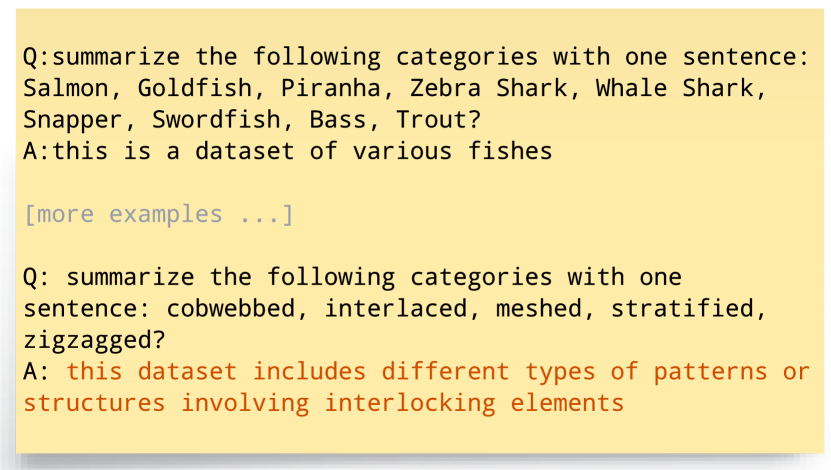
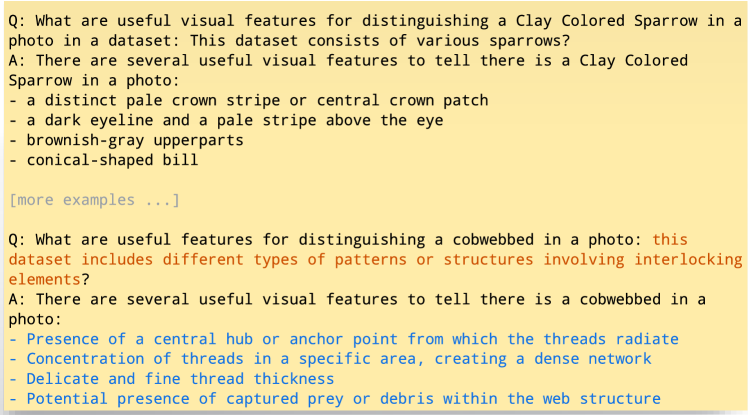
- Introduce summary-based and direct comparison methods leveraging ChatGPT.
- Visualize hierarchies and evaluate improvements via confusion matrices across standard datasets.
Proposed method
- Develop summary-based and direct comparison prompts to generate descriptive, set-aware comparisons for images.
- Construct and visualize a hierarchical tree structure (Describable Textures dataset) to group similar categories.
- Compare results against a baseline using confusion matrices across six datasets (CUB200, ImageNet, Food101, Oxford Pets, Places365, Describable Textures).
- Highlight failure cases due to prompt design and limitations of CLIP in handling comparative descriptions.
Experimental results
Research questions
- RQ1Can ChatGPT-based summary and direct comparisons improve image classification performance over baseline descriptions?
- RQ2How does a hierarchical (tree) representation of descriptive categories influence classification accuracy and grouping of similar categories?
- RQ3What are the failure modes of prompt engineering when used with CLIP-based classifiers for visual/textual comparisons?
Key findings
- Summary-based comparisons can provide set-aware and comparative descriptions that benefit classification.
- The proposed method yields corrected misclassifications in confusion matrices across multiple datasets compared to the baseline.
- Failure cases show that certain prompt formulations drastically reduce accuracy (e.g., P1 prompts).
- Size and color descriptions in prompts can be ambiguous or misrepresented, affecting discrimination in pixel space.
- Encoding relative content is challenging for CLIP due to bias toward training dataset references.
Read this paper
Open the full text in the Nubint reader and ask about any passage as you read.
Read this paper on NubintThis review was generated by AI from the original paper. Please check the paper before citing it.