
[Paper Review] ChatIDS: Explainable Cybersecurity Using Generative AI
ChatIDS proposes using large language models (LLMs) like ChatGPT to explain intrusion detection system (IDS) alerts in plain language for non-expert users, improving comprehension and enabling timely security responses. Experiments show the approach is technically feasible and effective in generating intuitive, actionable explanations, though challenges remain in trust, privacy, and ethical use.
Intrusion Detection Systems (IDS) are a proven approach to secure networks. However, in a privately used network, it is difficult for users without cybersecurity expertise to understand IDS alerts, and to respond in time with adequate measures. This puts the security of home networks, smart home installations, home-office workers, etc. at risk, even if an IDS is correctly installed and configured. In this work, we propose ChatIDS, our approach to explain IDS alerts to non-experts by using large language models. We evaluate the feasibility of ChatIDS by using ChatGPT, and we identify open research issues with the help of interdisciplinary experts in artificial intelligence. Our results show that ChatIDS has the potential to increase network security by proposing meaningful security measures in an intuitive language from IDS alerts. Nevertheless, some potential issues in areas such as trust, privacy, ethics, etc. need to be resolved, before ChatIDS might be put into practice.
Motivation & Objective
- Address the critical gap in understanding IDS alerts among non-expert users in private networks.
- Improve network security by enabling home users to respond effectively to cyber threats without cybersecurity expertise.
- Develop a practical, scalable method to translate technical IDS alerts into human-readable, actionable guidance.
- Explore the feasibility and design space of LLM-powered security explanation systems in real-world contexts.
- Identify interdisciplinary research challenges related to trust, privacy, ethics, and compliance before real-world deployment.
Proposed method
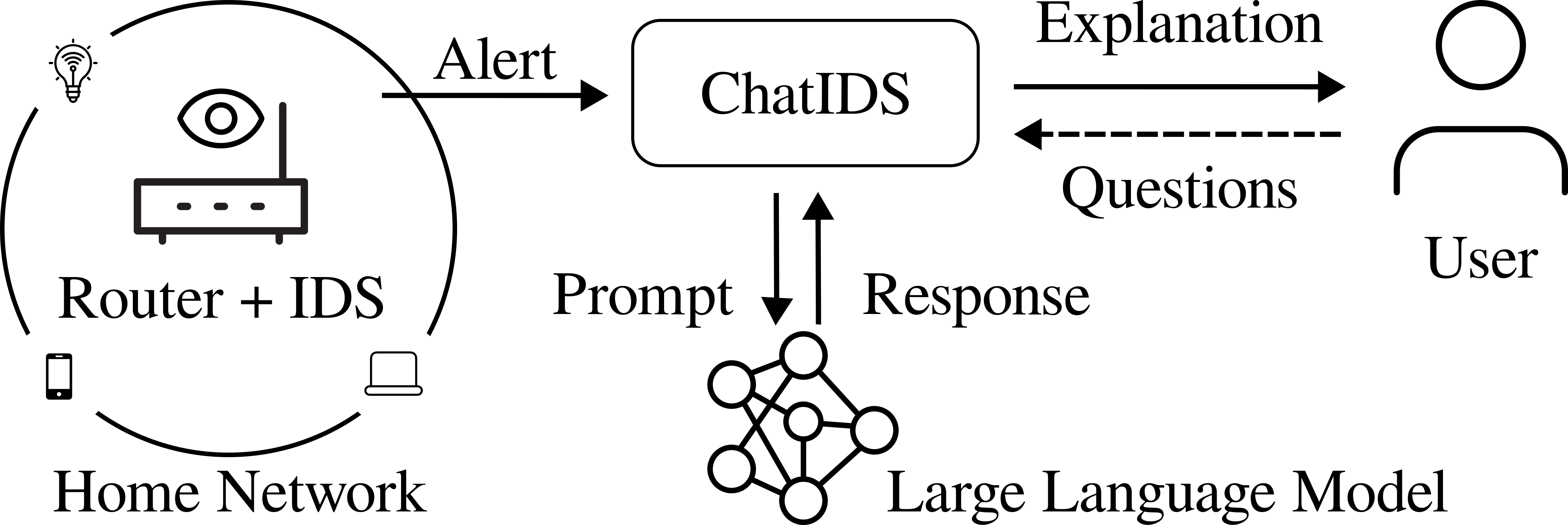
- Collect and anonymize IDS alerts from open-source tools like Snort, Suricata, and Zeek.
- Send anonymized alerts as prompts to a pre-trained LLM (specifically ChatGPT) to generate natural language explanations.
- Design prompts to elicit explanations covering problem description, urgency, and concrete countermeasures.
- Use iterative prompting to allow users to ask follow-up questions for clarification.
- Evaluate outputs based on three criteria: error description (R1), urgency of consequences (R2), and actionable security measures (R3).
- Conduct expert reviews with interdisciplinary AI experts to identify open issues in security, privacy, ethics, and compliance.
Experimental results
Research questions
- RQ1Can LLMs like ChatGPT generate accurate, intuitive, and actionable explanations of IDS alerts for non-expert users?
- RQ2How effective are LLM-generated explanations in conveying the severity and required actions for different types of cyber threats?
- RQ3What are the key risks and open issues—especially in trust, privacy, and ethics—that must be addressed before deploying such systems?
- RQ4How can anonymization techniques prevent information leakage while preserving the utility of alerts for LLMs?
- RQ5To what extent does reliance on LLM explanations affect user autonomy and decision-making in cybersecurity?
Key findings
- ChatIDS is technically feasible and can generate explanations that are intuitively understandable and convey urgency.
- The LLM consistently produced correct descriptions of security issues and consequences of inaction across tested alerts.
- Explanations included meaningful, actionable countermeasures in most cases, though terminology and clarity could be improved.
- Anonymization of device IDs and use of dummy alerts still pose privacy risks, as LLMs may infer network characteristics.
- Experts identified significant open issues in trust, ethics, legal liability, and compliance, especially regarding false positives and user over-reliance.
- The approach shows potential to increase network security in non-expert environments, but real-world impact depends on user behavior and system reliability.
Read this paper
Open the full text in the Nubint reader and ask about any passage as you read.
Read this paper on NubintThis review was generated by AI from the original paper. Please check the paper before citing it.