
[Paper Review] ChatLog: Carefully Evaluating the Evolution of ChatGPT Across Time
This paper introduces ChatLog, a continuously updated dataset recording ChatGPT's responses over time across 21 benchmarks. It conducts comprehensive evaluation and feature analysis, revealing temporal evolution in model behavior and identifying stable linguistic and knowledge features that improve detection robustness across new versions of ChatGPT.
ChatGPT has achieved great success and can be considered to have acquired an infrastructural status. There are abundant works for evaluating ChatGPT on benchmarks. However, existing benchmarks encounter two challenges: (1) Disregard for periodical evaluation and (2) Lack of fine-grained features. In this paper, we construct ChatLog, an ever-updating dataset with large-scale records of diverse long-form ChatGPT responses for 21 NLP benchmarks from March, 2023 to now. We conduct a comprehensive performance evaluation to find that most capabilities of ChatGPT improve over time except for some abilities, and there exists a step-wise evolving pattern of ChatGPT. We further analyze the inherent characteristics of ChatGPT by extracting the knowledge and linguistic features. We find some stable features that stay unchanged and apply them on the detection of ChatGPT-generated texts to improve the robustness of cross-version detection. We will continuously maintain our project at \url{https://github.com/THU-KEG/ChatLog/}.
Motivation & Objective
- To systematically study how ChatGPT's behavior evolves over time, particularly in response to ongoing training and alignment updates.
- To address the gap in existing evaluations that focus on single time points or limited version comparisons.
- To develop a longitudinal dataset that captures both coarse (monthly) and fine-grained (daily) changes in model outputs.
- To extract and analyze intrinsic features—both linguistic and knowledge-based—that remain stable or shift over time.
- To improve the robustness of ChatGPT detection models by leveraging stable features identified across temporal evolution.
Proposed method
- Collecting a dual-dataset setup: ChatLog-Monthly (38,730 QA pairs monthly) and ChatLog-Daily (1,000 identical ELI5 questions daily) to capture temporal changes.
- Performing automatic and human evaluation across 21 benchmarks, including generation and classification tasks, to track performance evolution.
- Extracting 10 knowledge features and 255 linguistic features from model outputs using NLP tools like information extraction and linguistic analysis.
- Conducting three analyses: trend analysis of feature scores over time, performance correlation analysis using Pearson correlation, and variation analysis to identify stable features.
- Training a RoBERTa-based detector on HC3 data and enhancing it with LightGBM to ensemble RoBERTa probabilities and stable features for improved generalization.
- Continuously monitoring and updating the dataset on GitHub to ensure long-term temporal coverage and reproducibility.
Experimental results
Research questions
- RQ1How does ChatGPT’s performance evolve over time across diverse NLP tasks?
- RQ2Which intrinsic features of ChatGPT’s outputs remain stable or change significantly across model updates?
- RQ3To what extent do linguistic and knowledge-based features correlate with benchmark performance over time?
- RQ4Can stable features extracted from historical outputs improve the robustness of detection models for new ChatGPT versions?
- RQ5How do pre-trained model-based detectors (e.g., RoBERTa) and rule-based classifiers (e.g., GLTR, perplexity) perform on evolving model outputs?
Key findings
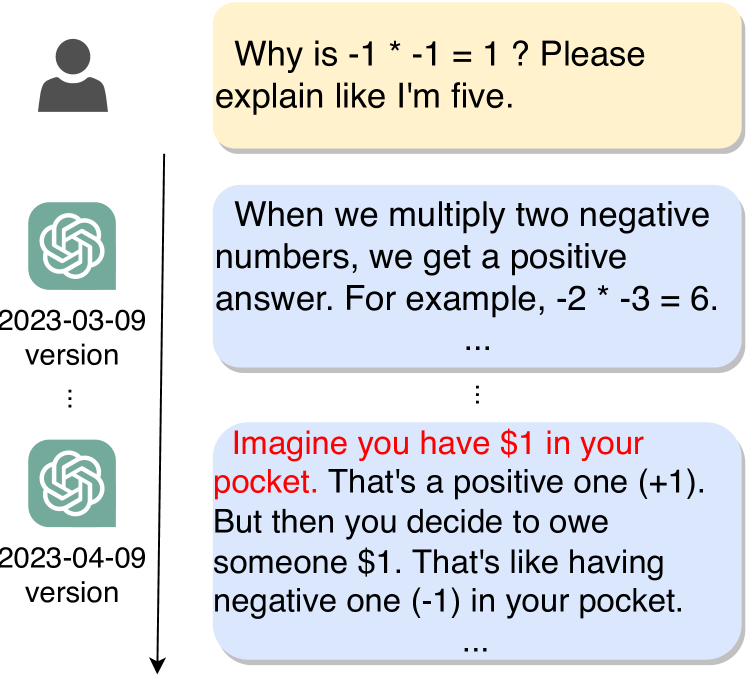
- ChatGPT’s responses evolved significantly between March and April 2023, with later versions providing more natural, metaphorical explanations for 'Explain Like I'm 5' tasks.
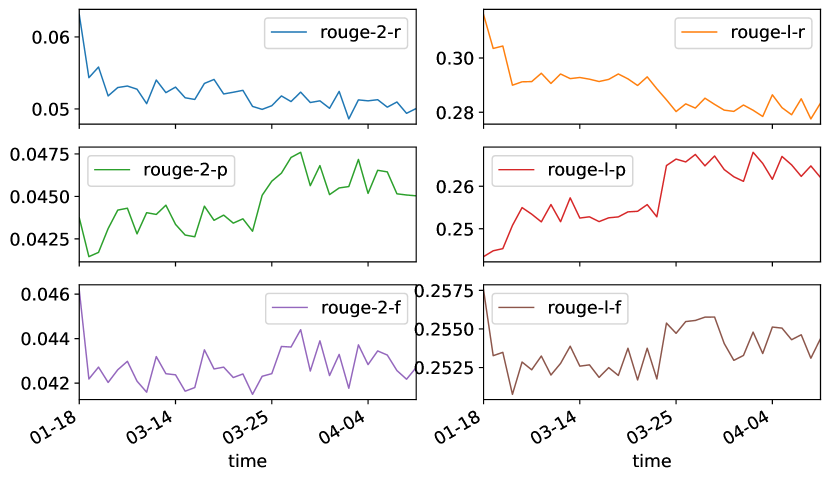
- Performance of RoBERTa-based detectors dropped by up to 10% when tested on April 2023 data compared to January 2023 data, indicating distribution shift due to model updates.
- The RoBERTa-qa model achieved high accuracy by leveraging question context, but performance dropped to 90% when only the answer was used, highlighting reliance on question information.
- GLTR and perplexity-based classifiers showed larger performance drops than fine-tuned RoBERTa models, indicating that pre-trained models generalize better across temporal shifts.
- Stable features—identified via low variation coefficient—were found to correlate strongly with benchmark performance and improved detection robustness when combined with RoBERTa.
- The ensemble detector using RoBERTa probabilities and 10 stable features achieved better generalization on new ChatGPT versions than standalone models.
Read this paper
Open the full text in the Nubint reader and ask about any passage as you read.
Read this paper on NubintThis review was generated by AI from the original paper. Please check the paper before citing it.