
[Paper Review] ChatPose: Chatting about 3D Human Pose
PoseGPT is a multimodal LLM framework that embeds SMPL poses as a distinct token to generate and reason about 3D human poses from text or images, introducing speculative pose generation and reasoning-based pose estimation benchmarks.
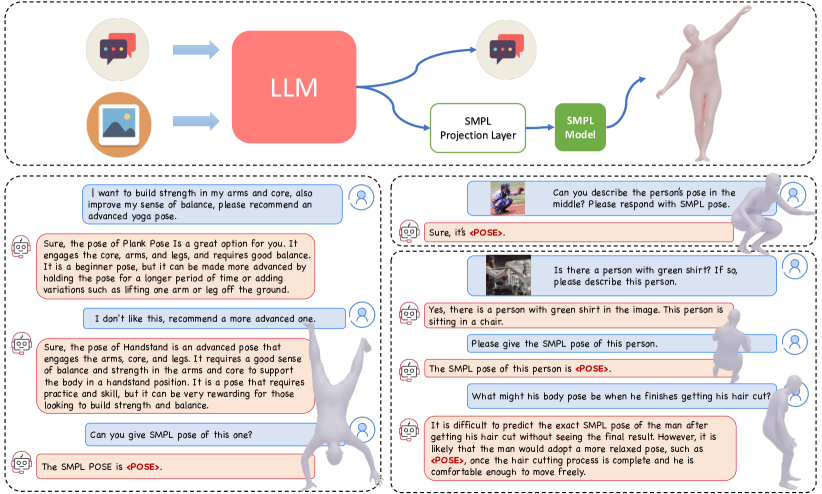
We introduce ChatPose, a framework employing Large Language Models (LLMs) to understand and reason about 3D human poses from images or textual descriptions. Our work is motivated by the human ability to intuitively understand postures from a single image or a brief description, a process that intertwines image interpretation, world knowledge, and an understanding of body language. Traditional human pose estimation and generation methods often operate in isolation, lacking semantic understanding and reasoning abilities. ChatPose addresses these limitations by embedding SMPL poses as distinct signal tokens within a multimodal LLM, enabling the direct generation of 3D body poses from both textual and visual inputs. Leveraging the powerful capabilities of multimodal LLMs, ChatPose unifies classical 3D human pose and generation tasks while offering user interactions. Additionally, ChatPose empowers LLMs to apply their extensive world knowledge in reasoning about human poses, leading to two advanced tasks: speculative pose generation and reasoning about pose estimation. These tasks involve reasoning about humans to generate 3D poses from subtle text queries, possibly accompanied by images. We establish benchmarks for these tasks, moving beyond traditional 3D pose generation and estimation methods. Our results show that ChatPose outperforms existing multimodal LLMs and task-specific methods on these newly proposed tasks. Furthermore, ChatPose's ability to understand and generate 3D human poses based on complex reasoning opens new directions in human pose analysis.
Motivation & Objective
- Motivate bridging image/text understanding with 3D human pose in a unified model.
- Enable generation and estimation of SMPL poses via a chat-based, multimodal LLM.
- Introduce speculative pose generation and reasoning-based pose estimation as new tasks.
Proposed method
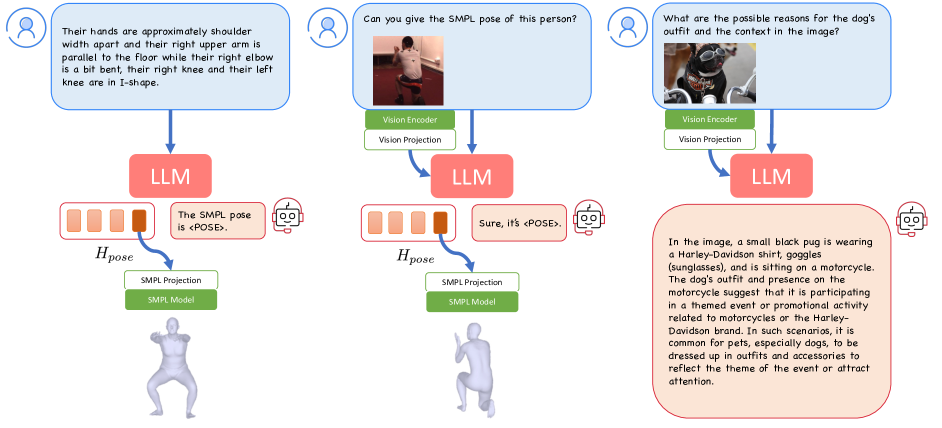
- Embed SMPL pose as a <POSE> token within a multi-modal LLM to map language embeddings to SMPL pose parameters via an MLP projection layer.
- Keep vision encoder frozen during training; fine-tune the LLM with LoRA while training only the SMPL projection layer.
- Train on text-to-pose, image-to-pose, and multi-modal instruction-following data to enable pose generation and pose reasoning.
Experimental results
Research questions
- RQ1Can a multimodal LLM understand and generate 3D human poses (SMPL) from text or images?
- RQ2Can the model perform speculative pose generation and reasoning-based pose estimation by leveraging world and scene knowledge?
- RQ3How does PoseGPT compare to task-specific and other multimodal baselines on pose generation and pose estimation, including reasoning-based tasks?
Key findings
- PoseGPT can generate SMPL poses from text or images and enables conversation-driven pose reasoning.
- On speculative pose generation, PoseGPT outperforms PoseScript and achieves competitive results with classical pose generation baselines.
- For reasoning-based pose estimation, PoseGPT surpasses other multimodal LLMs and task-specific methods, though classical pose estimators remain stronger on standard pose estimation metrics.
- The model demonstrates robustness to occlusion and benefits from using pose embeddings over textual pose descriptions.
- Using larger LLM backbones (13B vs 7B) improves PoseGPT performance.
- The approach enables two new benchmarks (SPG and RPE) to evaluate reasoning capabilities in 3D pose contexts.
Read this paper
Open the full text in the Nubint reader and ask about any passage as you read.
Read this paper on NubintThis review was generated by AI from the original paper. Please check the paper before citing it.