
[Paper Review] ChatUniTest: A Framework for LLM-Based Test Generation
ChatUniTest uses a Generation-Validation-Repair framework with adaptive focal context generation and repair mechanisms to produce high-quality unit tests via ChatGPT, outperforming EvoSuite, AthenaTest, and A3Test in several coverage and correctness metrics.
Unit testing is an essential yet frequently arduous task. Various automated unit test generation tools have been introduced to mitigate this challenge. Notably, methods based on large language models (LLMs) have garnered considerable attention and exhibited promising results in recent years. Nevertheless, LLM-based tools encounter limitations in generating accurate unit tests. This paper presents ChatUniTest, an LLM-based automated unit test generation framework. ChatUniTest incorporates an adaptive focal context mechanism to encompass valuable context in prompts and adheres to a generation-validation-repair mechanism to rectify errors in generated unit tests. Subsequently, we have developed ChatUniTest Core, a common library that implements core workflow, complemented by the ChatUniTest Toolchain, a suite of seamlessly integrated tools enhancing the capabilities of ChatUniTest. Our effectiveness evaluation reveals that ChatUniTest outperforms TestSpark and EvoSuite in half of the evaluated projects, achieving the highest overall line coverage. Furthermore, insights from our user study affirm that ChatUniTest delivers substantial value to various stakeholders in the software testing domain. ChatUniTest is available at https://github.com/ZJU-ACES-ISE/ChatUniTest, and the demo video is available at https://www.youtube.com/watch?v=GmfxQUqm2ZQ.
Motivation & Objective
- Motivate automated unit test generation to reduce developer burden and improve test readability and correctness.
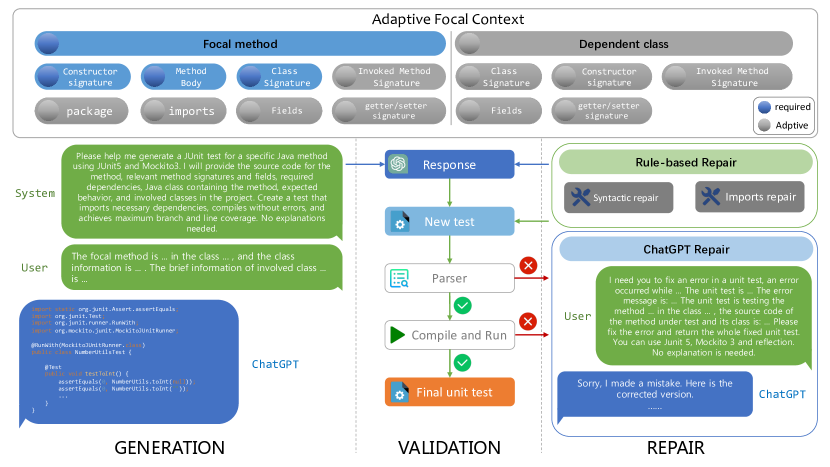
- Propose a ChatGPT-based framework (Generation-Validation-Repair) with adaptive focal context generation to respect prompt token limits.
- Introduce validation and repair components (rule-based and ChatGPT-based) to improve syntactic/compile/runtime correctness of generated tests.
- Empirically evaluate ChatUniTest against EvoSuite, AthenaTest, and A3Test across multiple Java projects and Defects4J datasets.
Proposed method
- Preprocess Java projects by parsing ASTs to collect class and method context.
- Generate an adaptive focal context within a maximum prompt token limit to form prompts for ChatGPT.
- Extract, parse, and validate ChatGPT-generated tests using a Java parser and a test executor.
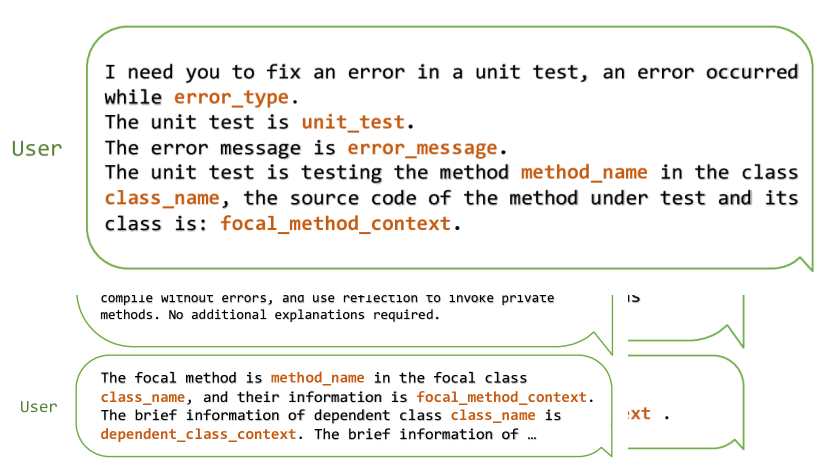
- Repair syntactic/compile errors with a rule-based component; invoke ChatGPT-based repair for more complex errors.
- Evaluate tests for syntactic correctness, compilation, runtime success, assertion usage, and mocks; compare coverage against baselines.
Experimental results
Research questions
- RQ1RQ1: What is the quality of the generated unit tests in terms of syntax, compilation, execution, and correctness?
- RQ2RQ2: How does ChatUniTest performance compare to EvoSuite, AthenaTest, and A3Test in coverage and correctness?
- RQ3RQ3: What are the contributions of each ChatUniTest component (generation, rule-based repair, ChatGPT-based repair) to overall quality?
- RQ4RQ4: What is the practical cost (token usage) of generating unit tests with ChatUniTest?
Key findings
- ChatUniTest achieved a 30.86% pass rate and 29.98% correct tests across 97,878 successful attempts.
- On 10 Java projects, ChatUniTest generally outperformed EvoSuite in branch coverage and line coverage, with average branch 90.61% and line 89.36%.
- Compared with AthenaTest and A3Test on Defects4J, ChatUniTest achieved higher focal method coverage and a higher percentage of correct tests in most cases.
- Adaptive focal context generation enables prompts within token limits, reducing truncation and enabling more complete responses.
- Rule-based repair substantially reduces syntactic and import-related errors; ChatGPT-based repair accounts for large gains in passing and correct tests, addressing more challenging errors.
Read this paper
Open the full text in the Nubint reader and ask about any passage as you read.
Read this paper on NubintThis review was generated by AI from the original paper. Please check the paper before citing it.