
[Paper Review] CHEAT: A Large-scale Dataset for Detecting ChatGPT-writtEn AbsTracts
CHEAT provides a large-scale dataset of ChatGPT-written abstracts (35,304) to aid detection methods and analyzes how detection performance changes with varying levels of human involvement.
The powerful ability of ChatGPT has caused widespread concern in the academic community. Malicious users could synthesize dummy academic content through ChatGPT, which is extremely harmful to academic rigor and originality. The need to develop ChatGPT-written content detection algorithms call for large-scale datasets. In this paper, we initially investigate the possible negative impact of ChatGPT on academia,and present a large-scale CHatGPT-writtEn AbsTract dataset (CHEAT) to support the development of detection algorithms. In particular, the ChatGPT-written abstract dataset contains 35,304 synthetic abstracts, with Generation, Polish, and Mix as prominent representatives. Based on these data, we perform a thorough analysis of the existing text synthesis detection algorithms. We show that ChatGPT-written abstracts are detectable, while the detection difficulty increases with human involvement.Our dataset is available in https://github.com/botianzhe/CHEAT.
Motivation & Objective
- Motivate the need to detect ChatGPT-written abstracts to preserve academic originality.
- Create a large-scale, diverse CHEAT dataset of ChatGPT-written abstracts and analyze its properties.
- Evaluate existing detection algorithms on CHEAT and assess their limitations under different synthesis scenarios.
- Investigate linguistic and structural differences between human-written and ChatGPT-written abstracts to inform detectors.
Proposed method
- Construct CHEAT with 15,395 human-written and 35,304 ChatGPT-written abstracts from computer science sources.
- Synthesize abstracts using Generation, Polish, and Mix methods with ChatGPT via gpt-3.5-turbo.
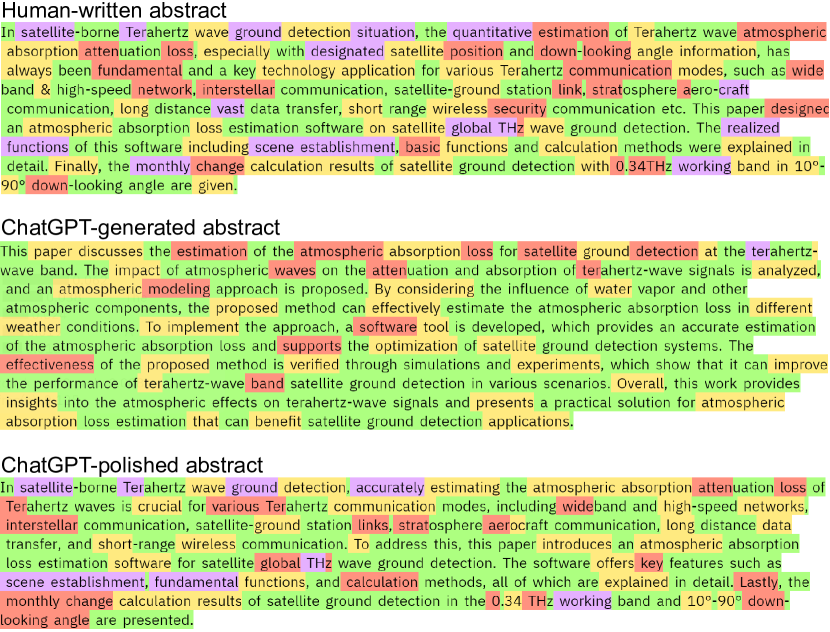
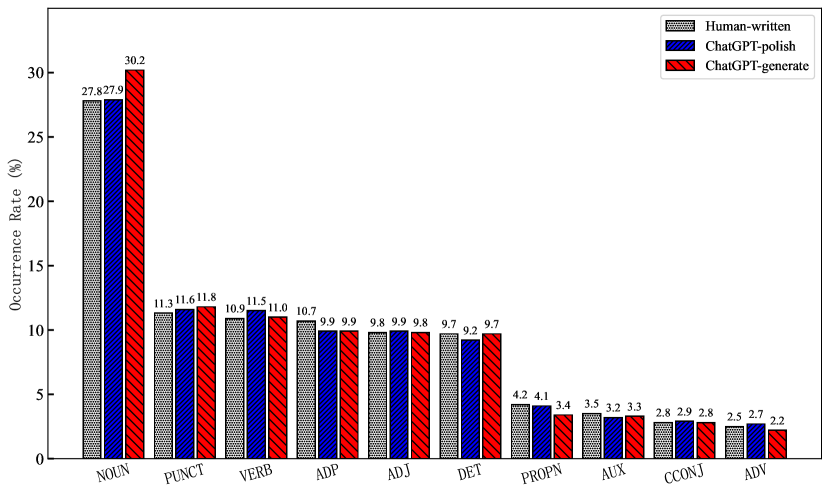
- Perform lexical and dependency analyses to compare human vs. ChatGPT abstracts.
- Evaluate multiple existing detectors on CHEAT without fine-tuning and then with CHEAT-specific training.
- Use SHAP explanations to interpret detector decisions and identify features influencing detection.
Experimental results
Research questions
- RQ1Can existing detection methods effectively distinguish ChatGPT-written abstracts on CHEAT without fine-tuning?
- RQ2How do linguistic properties differ between human-written and ChatGPT-written abstracts, and how does human involvement affect detectability?
- RQ3What is the impact of training detectors on CHEAT-specific data (Generation, Polish, Mix) on detection performance?
- RQ4Are detection models interpretable, and which features drive decisions (via SHAP)?
Key findings
- CHEAT is the largest public dataset for ChatGPT-written abstract detection (15,395 human-written; 35,304 ChatGPT-written).
- ChatGPT-generated abstracts are highly detectable when trained on generation data, with PubMedBERT achieving strong performance.
- Detection accuracy and AUC drop as human involvement increases (Polish and Mix datasets are harder to detect than Generation).
- Baseline detectors trained on CHEAT data achieve higher AUC on corresponding test sets (e.g., 100 AUC on Generation) but lower on Polish and Mix.
- SHAP analysis reveals that detection relies on certain words and patterns, and human-involved abstracts shift reliance toward precise words, complicating detection.
Read this paper
Open the full text in the Nubint reader and ask about any passage as you read.
Read this paper on NubintThis review was generated by AI from the original paper. Please check the paper before citing it.